Twin Extruder vs Single Extruder: Deep Guide to Extrusion Technology
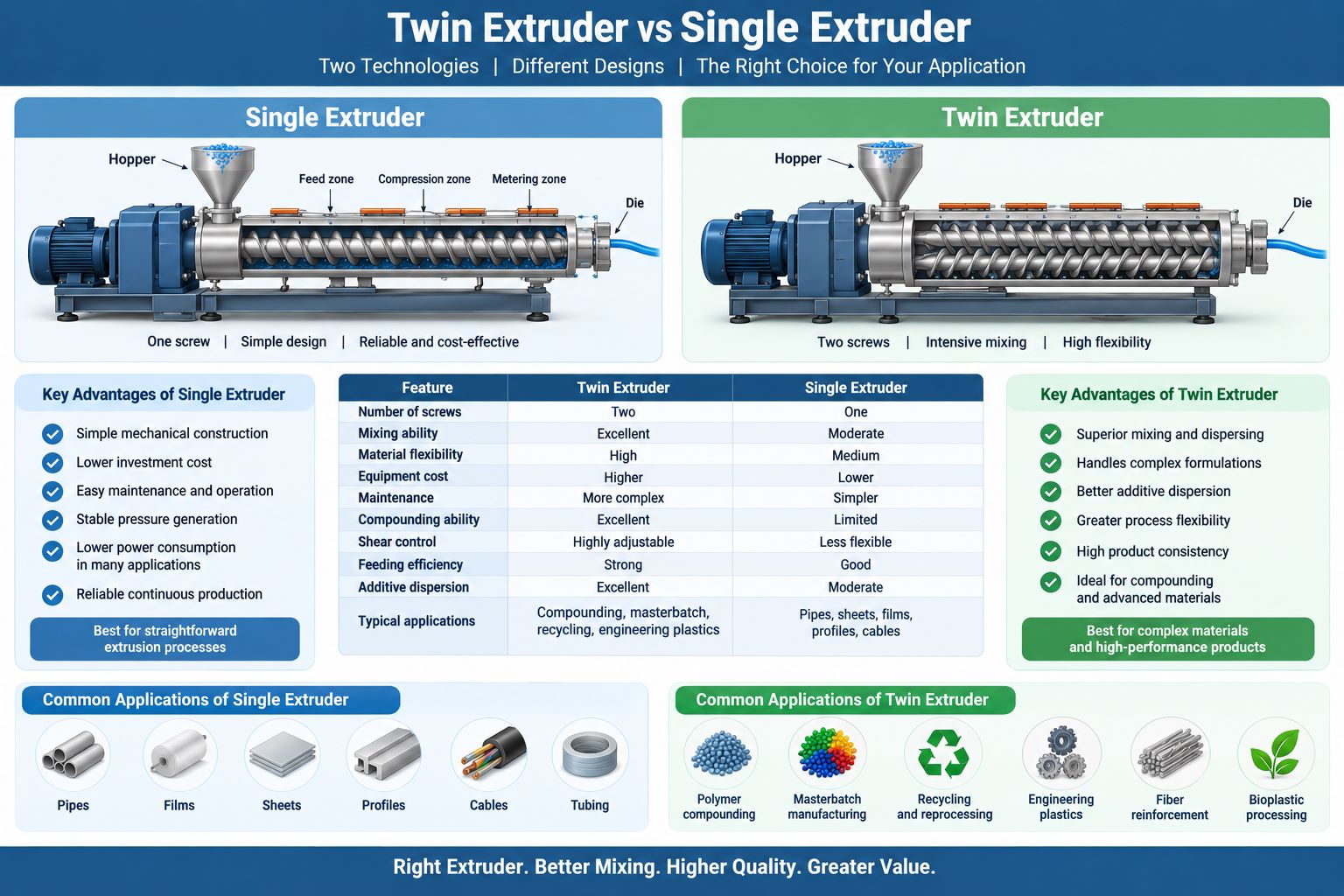
Extrusion is one of the most important manufacturing processes used in plastics, polymers, food processing, compounding, recycling, masterbatch production, and many other industrial applications. At the center of an extrusion line is the extruder, a machine designed to continuously melt, mix, transport, and shape raw material into a required form.
Two of the most widely used technologies are the twin extruder and single extruder. Although both machines perform the basic task of processing material through a heated barrel and screw system, their internal design, mixing capability, productivity, operating flexibility, and suitable applications are significantly different.
Understanding these differences helps manufacturers select equipment that delivers better product quality, lower production costs, and more efficient processing.
How an Extruder Works
An extruder generally consists of a hopper, screw or screws, barrel, heating system, motor, gearbox, control system, and extrusion die.
Raw material enters through the hopper and moves forward through rotating screws. During this process, heat generated by barrel heaters and mechanical friction softens or melts the material. The rotating screw continuously transports, compresses, mixes, and homogenizes it before forcing the molten material through a die.
The design of the screw system determines how efficiently this process occurs.
What Is a Single Extruder?
A single extruder contains one rotating screw inside a cylindrical heated barrel. It is one of the simplest and most commonly used extrusion systems in polymer processing.
The screw is normally divided into feeding, compression, and metering zones. Material enters the feed zone, becomes compressed and melted, and then moves toward the die at controlled pressure.
Main Characteristics of a Single Extruder
A single extruder is particularly effective when the raw material is already relatively uniform and does not require intensive mixing.
Typical advantages include:
- Simple mechanical construction
- Lower investment cost
- Easy maintenance and operation
- Stable pressure generation
- Lower power consumption in many applications
- Reliable continuous production
- Good efficiency for straightforward extrusion processes
Because of its uncomplicated design, the single extruder remains widely used for pipes, sheets, films, profiles, cables, and general thermoplastic processing.
What Is a Twin Extruder?
A twin extruder uses two screws rotating inside the same barrel. Depending on machine design, the screws may rotate in the same direction or opposite directions.
The two screws generate significantly more mixing, shearing, dispersing, and material-transfer capability than a conventional single-screw system.
This makes the twin extruder especially useful for processing complex formulations containing polymers, additives, fillers, pigments, stabilizers, fibers, or recycled materials.
Types of Twin Extruder Systems
Twin-screw machines are generally classified into two major configurations.
Co-Rotating Twin Screw
In a co-rotating system, both screws rotate in the same direction.
This configuration provides strong distributive and dispersive mixing and is widely used for polymer compounding, masterbatch, engineering plastics, and filler incorporation.
Counter-Rotating Twin Screw
In a counter-rotating system, screws rotate in opposite directions.
These machines provide controlled conveying and pressure development and are frequently used in applications such as rigid PVC processing.
Twin Extruder and Single Extruder Comparison
| Factor | Twin Extruder | Single Extruder |
| Number of screws | Two | One |
| Mixing ability | Excellent | Moderate |
| Material flexibility | High | Medium |
| Equipment cost | Higher | Lower |
| Maintenance | More complex | Simpler |
| Compounding ability | Excellent | Limited |
| Shear control | Highly adjustable | Less flexible |
| Feeding efficiency | Strong | Good |
| Additive dispersion | Excellent | Moderate |
| Typical applications | Compounding, masterbatch, recycling | Pipes, sheets, films, profiles |
The correct selection depends primarily on material characteristics and the complexity of the manufacturing process.
Mixing Performance of Twin Extruder
One of the strongest advantages of a twin extruder is its exceptional mixing capability.
When two screws interact inside the barrel, material repeatedly moves between screw channels. This creates intensive distributive mixing while breaking down agglomerates and dispersing additives throughout the polymer matrix.
This capability becomes especially important when manufacturers need to combine:
- Base polymers
- Color pigments
- Mineral fillers
- Reinforcing fibers
- Stabilizers
- Flame retardants
- Processing additives
A properly configured twin extruder can produce highly consistent compounds even when multiple ingredients have different physical properties.
Processing Efficiency of Single Extruder
The single extruder performs exceptionally well when intensive mixing is unnecessary.
For example, when manufacturers process standard polyethylene or polypropylene material into pipes or sheets, the primary requirement is continuous melting, conveying, and pressure generation.
In such applications, a single extruder can offer excellent output with relatively low operating complexity.
Its simpler screw geometry also makes process adjustment and maintenance easier for production teams.
Material Handling Differences
Material feeding behavior can significantly influence extrusion quality.
A twin extruder generally handles powders, fillers, additives, and mixed formulations more efficiently because the interacting screws provide positive material conveying.
A single extruder, however, depends more heavily on friction between the material, barrel, and screw for forward transportation.
As a result, materials with unusual bulk density or poor flow characteristics may sometimes be more difficult to process using single-screw technology.
Applications of Twin Extruder
The twin extruder is commonly selected for technically demanding processing operations.
Typical applications include:
- Polymer compounding
- Masterbatch manufacturing
- Engineering plastic modification
- Glass-fiber reinforcement
- Calcium carbonate filling
- Bioplastic processing
- Reactive extrusion
- Polymer blending
- Recycling and reprocessing
- High-performance material development
Why Compounding Requires Twin Extrusion
Compounding involves combining several materials into a uniform formulation.
The strong screw interaction in a twin extruder allows manufacturers to precisely control residence time, temperature, shear force, and ingredient distribution.
This produces consistent pellets with predictable mechanical and thermal properties.
Applications of Single Extruder
A single extruder is commonly used where material formulation is already prepared and the objective is primarily shaping.
Major applications include:
- Plastic pipe extrusion
- Film manufacturing
- Plastic sheet extrusion
- Wire and cable coating
- Plastic profiles
- Tubing
- Extrusion coating
- Certain pelletizing operations
When Single-Screw Technology Makes More Sense
If the production process does not require complex blending or additive dispersion, investing in a more complicated machine may provide limited additional benefit.
In these situations, a single extruder offers an economical and dependable manufacturing solution.
Energy Consumption and Production Cost
Energy efficiency depends on machine size, screw design, material type, production capacity, and operating conditions.
A single extruder usually has fewer mechanical components and may consume less energy for straightforward processing.
A twin extruder requires additional drive power because two screws are operating simultaneously. However, its superior mixing capability can eliminate additional processing stages.
Therefore, the total production cost should be evaluated across the complete manufacturing process rather than only considering motor power.
Screw Design and Process Control
Modern extrusion performance depends heavily on screw geometry.
In a single extruder, the screw generally follows a relatively continuous geometry designed around conveying, compression, melting, and metering.
A twin extruder, particularly a modular co-rotating design, can use different screw elements.
These may include conveying elements, kneading blocks, mixing elements, reverse elements, and specialized sections.
Manufacturers can configure these elements according to the required mixing intensity and material residence time.
Maintenance Requirements
Maintenance is generally easier with a single extruder because it contains fewer rotating components.
Routine servicing usually includes checking the screw, barrel, heaters, gearbox, motor, seals, and lubrication system.
A twin extruder requires more specialized maintenance because screw alignment, gearbox synchronization, and element condition are particularly important.
However, modern extrusion systems are engineered for long operating life when preventive maintenance schedules are followed correctly.
How to Choose Between Twin Extruder and Single Extruder
The decision should be based on processing requirements rather than machine price alone.
Manufacturers should evaluate:
- Raw material composition
- Required mixing intensity
- Additive percentage
- Production capacity
- Product quality requirements
- Temperature sensitivity
- Available floor space
- Maintenance capability
- Energy consumption
- Future product development plans
For straightforward polymer shaping, a single extruder may provide the best cost-performance ratio.
For complex formulations and advanced compounding, a twin extruder is generally the more capable solution.
Frequently Asked Questions
What is the main difference between twin and single extrusion?
A twin extruder uses two screws for intensive mixing, while a single extruder uses one screw for simpler processing.
Which extruder provides better mixing?
A twin extruder generally provides better dispersive and distributive mixing due to interactions between its two screws.
Is a single extruder cheaper?
Yes. A single extruder usually has lower equipment, installation, and maintenance costs.
Which extruder is best for plastic compounding?
A twin extruder is generally preferred because it can efficiently mix polymers, additives, pigments, fillers, and reinforcing materials.
Can a single extruder process recycled plastic?
Yes. A single extruder can process many recycled materials, particularly when the feedstock is already reasonably uniform.
Why is twin extrusion used for masterbatch?
Masterbatch requires accurate pigment and additive dispersion, making the strong mixing action of a twin extruder particularly valuable.
Which extruder is suitable for pipe manufacturing?
A single extruder is commonly used for PE and PP pipes, while specialized twin-screw systems are frequently used for rigid PVC.
Does a twin extruder provide higher productivity?
It can provide higher processing efficiency for complex formulations, although actual output depends on material, machine design, and operating conditions.
Which machine requires more maintenance?
A twin extruder generally requires more specialized maintenance because it contains two screws and a more complex gearbox system.
Can twin extrusion improve product quality?
Yes. Better material homogenization and additive dispersion can significantly improve consistency and final compound properties.