Indian Brands and Music Creators Step Up Copyright Protection Amid Rising Digital Use
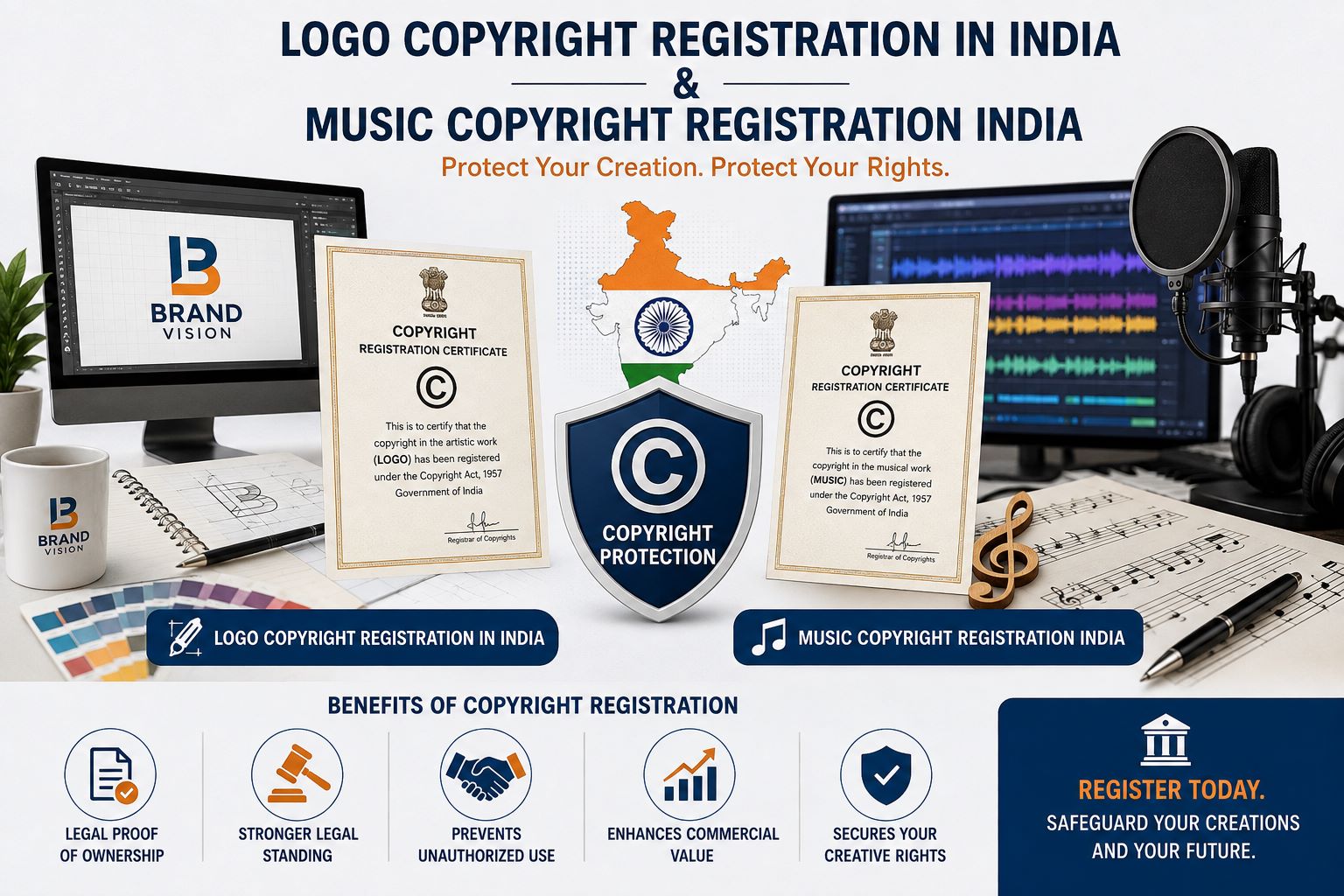
The increasing commercial use of creative content across websites, streaming platforms, e-commerce marketplaces and social media is bringing copyright ownership into sharper focus in India. Businesses and creators are paying closer attention to Logo Copyright Registration in India and Music Copyright Registration India as original designs and music become increasingly valuable digital assets.
The issue is particularly relevant for startups, established brands, graphic designers, independent musicians, composers, producers and content companies. A logo can be copied from a website within seconds, while an original song can travel across videos, advertisements and digital platforms almost immediately after release.
Copyright protection, however, involves more than simply submitting an application. Determining authorship, establishing ownership and documenting commercial rights can be equally important.
Original Creative Work Emerges as a Valuable Business Asset
Digital transformation has changed the economic role of intellectual property.
A professionally designed logo can become closely associated with a company’s reputation. Likewise, a successful composition or sound recording can generate revenue through licensing and distribution long after its original release.
Under India’s copyright framework, qualifying original works can receive copyright protection without registration being a mandatory condition for copyright to exist.
Registration nevertheless offers an official mechanism for recording relevant particulars relating to a work and its claimed ownership.
This can become important when an asset is licensed, assigned, commercially exploited or involved in an ownership dispute.
Logo Copyright Registration in India Becomes Relevant for Modern Brands
For businesses, a logo is often the most visible element of corporate identity.
Companies use logos on websites, product labels, advertisements, mobile applications, packaging, invoices, social profiles, brochures and promotional merchandise.
Where the design contains qualifying original artistic expression, Logo Copyright Registration in India may be considered as part of the company’s intellectual property strategy.
Copyright protection is directed towards eligible artistic expression rather than an abstract branding concept.
For instance, a company cannot necessarily claim copyright over the broad idea of using a lion as a brand symbol. However, a particular original illustration of that lion may potentially attract copyright protection.
Logo Copyright and Trademark Rights Should Not Be Confused
Although both can concern the same logo, copyright and trademark rights perform different functions.
| Issue | Copyright | Trademark |
| Protects | Original creative expression | Commercial brand identifiers |
| Main logo concern | Artistic design | Brand identity |
| Primary objective | Control protected creative uses | Distinguish goods or services |
| Key risk | Unauthorised copying | Confusing commercial use |
| Main legal framework | Copyright law | Trademark law |
This means Logo Copyright Registration in India should not automatically be treated as a substitute for trademark registration.
For a business actively trading under a logo, evaluating both forms of intellectual property protection may provide a more comprehensive strategy.
Commissioned Logos Highlight Importance of Written Agreements
A growing number of companies obtain their logos from freelance designers, online creative professionals and branding agencies.
This arrangement can create questions about copyright ownership.
Paying for the design does not mean businesses should ignore contractual intellectual property provisions.
Before using a commissioned logo commercially, companies should ensure their agreement addresses:
- Identity of the author
- Ownership of copyright
- Assignment of relevant rights
- Permitted uses
- Commercial exploitation
- Rights retained by the creator
- Territory and duration where applicable
- Consideration
Such records can become particularly significant during mergers, investments, licensing negotiations or disputes.
Copyright Application Requires Accurate Ownership Details
An applicant pursuing Logo Copyright Registration in India should first establish who created the artwork and who currently owns the relevant rights.
The broad application process generally involves:
- Identifying the correct category of work.
- Preparing the prescribed application.
- Providing authorship information.
- Providing ownership details.
- Uploading the relevant logo artwork.
- Submitting supporting documentation where required.
- Paying the applicable fee.
- Obtaining a Diary Number.
- Monitoring the registration process.
- Responding to objections or discrepancies where applicable.
For artistic works used or capable of being used in connection with goods or services, additional procedural considerations involving trademark records may apply.
Music Creators Face a Different Copyright Challenge
India’s music ecosystem has changed significantly with the rise of independent releases, streaming platforms and social media.
An artist can now create a track independently and make it available to listeners without traditional physical distribution.
However, wider accessibility also means music can be reused, copied, remixed or incorporated into other content more easily.
This has increased interest in Music Copyright Registration India among independent artists and established music businesses alike.
The biggest challenge is understanding that a song may contain several different rights.
One Track Does Not Necessarily Mean One Copyright
A listener experiences music as a finished song. Legally, the underlying rights can be more complex.
Consider a track created by a lyricist, composer, singer and music producer.
Each contribution may involve a different legal interest.
| Creative Contribution | Relevant Copyright/Right |
| Melody and composition | Musical work |
| Written lyrics | Literary work |
| Recorded audio | Sound recording |
| Vocal or instrumental performance | Performers’ rights may apply |
This separation becomes critical when determining ownership, royalties and licensing rights.
Music Copyright Registration India Requires Creators to Identify Their Rights
Before starting Music Copyright Registration India, an applicant should determine precisely what is being registered.
A musical composition is different from the recording made from that composition. Lyrics can also constitute a separate copyright work.
A creator preparing an application should therefore ask:
Who composed the music?
Who wrote the lyrics?
Who produced the recording?
Were rights assigned to another party?
Were multiple creators involved?
Has the work been published?
These questions help establish the appropriate registration and ownership position.
Music Licensing Expands Beyond Traditional Entertainment
The commercial market for music now extends well beyond albums and films.
Original music can be licensed for:
- Digital advertisements
- Social media campaigns
- Films and web series
- Streaming platforms
- Podcasts
- Video games
- Mobile applications
- Corporate videos
- Events
- YouTube content
- Brand promotions
As these opportunities expand, creators need to understand what rights they are granting.
Music Copyright Registration India can support formal documentation, while carefully drafted agreements define how those rights can be commercially exploited.
Licensing and Assignment Have Different Commercial Effects
For creators, selling copyright is not the only way to monetise intellectual property.
A licence can permit another party to use specific copyright rights while ownership may remain with the creator.
Suppose a company wants to use an original track in a six-month digital advertising campaign. The creator could potentially grant specified usage rights rather than permanently transferring the copyright.
A commercial licence may define:
- Permitted purpose
- Media platforms
- Geographic territory
- Licence period
- Exclusivity
- Royalty or fixed payment
- Editing rights
- Distribution
- Sub-licensing
An assignment can have a different legal effect because specified copyright interests may be transferred.
Creators should understand this difference before signing commercial agreements.
Unclear Ownership Can Become Expensive Later
Copyright disputes are not always caused by deliberate copying.
Sometimes they arise because collaborators never established who owned the work.
A composer may believe that providing music for a project was merely a licence. The production company may believe it purchased complete ownership.
A designer may believe a company received only permission to use a logo. The company may believe all rights were transferred.
Written agreements can prevent such misunderstandings.
Registration, contracts, invoices, correspondence and original working files can collectively contribute to better intellectual property records.
Frequently Asked Questions
1. What is Logo Copyright Registration in India?
It is the registration process for qualifying original artistic work contained in a logo.
2. Is copyright registration compulsory for a logo?
No. Eligible copyright generally does not depend upon registration.
3. Can a simple logo receive copyright protection?
Protection depends on whether the work satisfies applicable copyright requirements, including originality.
4. Should a copyrighted logo also be trademarked?
Trademark protection serves a different purpose and may be appropriate for logos used commercially.
5. Who owns a logo created by a freelancer?
Ownership depends on applicable law and contractual arrangements, so written documentation is important.
6. What does Music Copyright Registration India cover?
It can concern qualifying musical works and related copyright subject matter, depending on the application.
7. Can song lyrics have separate copyright?
Yes. Original lyrics may qualify as literary works.
8. Is a recorded song different from a musical composition?
Yes. A sound recording and the underlying musical work are separate copyright categories.
9. Can different people own rights in the same song?
Yes. Different contributors may hold different rights depending on authorship, law and contractual arrangements.
10. Can a copyright owner license music without selling it?
Yes. A licence can grant specified usage rights without necessarily transferring copyright ownership.
https://newsgrow.blogspot.com/2026/08/logo-copyright-registration-in-india.html