Water Testing in Delhi: 7 Common Myths That Could Be Misleading You About Water Quality
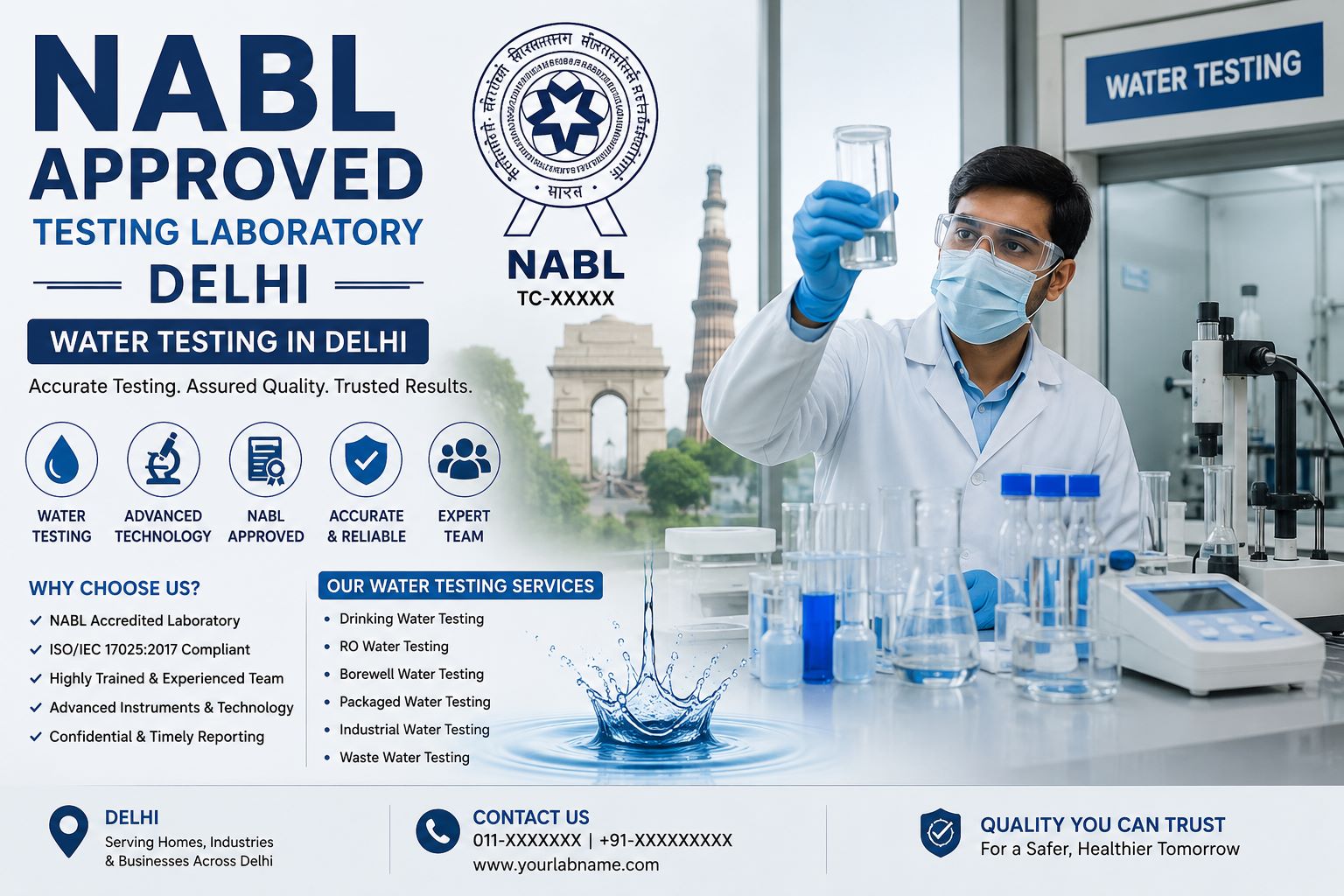
Water is tested, filtered, stored and consumed every day, yet there are still plenty of misconceptions about what actually determines its quality. Some people believe clear water is automatically good water. Others rely entirely on a home TDS meter or assume an RO purifier removes every possible concern.
The reality is more complicated.
Water can contain dissolved minerals, chemical constituents and microorganisms that cannot be identified through appearance alone. Professional water testing in Delhi provides a scientific way to understand these characteristics.
For detailed or formally required analysis, choosing a competent NABL approved testing laboratory Delhi can also help ensure that testing is performed under recognised laboratory quality systems for activities covered within its accredited scope.
Let’s separate some common assumptions from the facts.
Myth 1: Clear Water Means the Water Is Fine
This is probably the most common water-quality misconception.
Crystal-clear water certainly looks reassuring, but transparency tells us mainly about visible characteristics. It cannot reveal everything dissolved or present within the sample.
Fact: Many Water Parameters Are Invisible
Laboratory analysis may be required to determine characteristics such as:
- pH
- Hardness
- Alkalinity
- Chloride
- Sulphate
- Fluoride
- Nitrate
- Iron
- Calcium
- Magnesium
- Selected metals
- Microbiological indicators
This is why water should not be evaluated purely by sight, taste or smell.
Myth 2: A Good TDS Reading Means Drinking Water Needs No Further Testing
TDS meters have become common in households, offices and commercial properties.
They are convenient and provide an instant number, but that number has a specific meaning.
TDS stands for total dissolved solids.
Fact: TDS Is Only One Part of Water Analysis
A TDS meter does not provide a complete breakdown of individual substances present in water. More importantly, it does not replace microbiological testing.
Professional water testing in Delhi can investigate several parameters instead of relying on a single measurement.
For drinking-water evaluation in India, BIS IS 10500 is an important reference specification covering drinking-water requirements and methods of sampling and testing.
Myth 3: RO Water Never Needs Laboratory Testing
An RO system can significantly change several characteristics of incoming water. That does not mean there is never a reason to test treated water.
Fact: Testing Can Help Evaluate Treatment Performance
One useful approach is to compare water before and after treatment.
| Sampling Point | What It Can Help Show |
| Raw water | Initial water characteristics |
| RO inlet | Water entering the system |
| RO outlet | Characteristics after treatment |
| Storage tank | Condition following storage |
| Drinking tap | Water near the point of consumption |
If the objective is to assess treatment performance, analysing appropriate parameters on both sides of the system can provide more meaningful information than testing only the final sample.
Myth 4: Every Test Offered by a NABL Laboratory Is NABL Accredited
This misconception is particularly important when selecting a laboratory.
NABL stands for the National Accreditation Board for Testing and Calibration Laboratories. Laboratories can receive accreditation for defined testing activities after assessment against applicable competence requirements.
Fact: NABL Accreditation Has a Defined Scope
Finding a NABL approved testing laboratory Delhi does not automatically mean every service listed by that laboratory is covered by accreditation.
Customers should verify:
- Current accreditation status
- Relevant field of testing
- Parameters included in scope
- Applicable methods where necessary
- Scope validity
This becomes especially important when reports are being obtained for regulatory, contractual or formal quality requirements.
Myth 5: Municipal Water Does Not Need Testing at the Consumer End
Water may leave its original supply point under one set of conditions, but there can be several stages before it reaches a glass.
In a multi-storey property, for example, the journey may look like this:
Incoming supply → Underground reservoir → Pump → Overhead tank → Internal plumbing → Tap
Fact: Storage and Distribution Are Part of the Water Journey
When investigating a water-quality concern, choosing the correct sampling location matters.
If you want to evaluate incoming supply, test at an appropriate point before storage.
If you suspect a storage problem, collect an appropriate sample from the tank.
If you want information about the water actually being consumed, the final point of use may be particularly relevant.
A well-planned water testing in Delhi programme begins by asking what problem the sample is supposed to investigate.
Myth 6: Borewell Water Is Naturally Pure Because It Comes from Underground
Groundwater is sometimes considered naturally filtered and therefore automatically suitable for every application.
This assumption overlooks the influence of local geology and surrounding environmental conditions.
Fact: Groundwater Characteristics Can Vary
Depending on location and intended use, borewell analysis may include parameters such as:
- Total hardness
- TDS
- Alkalinity
- Chloride
- Fluoride
- Nitrate
- Iron
- Calcium
- Magnesium
Other chemical, metal or microbiological parameters may be relevant depending on the testing objective.
A NABL approved testing laboratory Delhi can help determine which tests are appropriate for a particular groundwater application.
Myth 7: Any Clean Bottle Can Be Used for a Water Sample
People often spend considerable time selecting a laboratory but very little time thinking about how the sample reaches it.
That can be a mistake.
Fact: Sampling Can Directly Influence the Usefulness of Testing
Different analyses can require specific containers, quantities and handling conditions.
Microbiological testing, in particular, can require careful collection to avoid introducing contamination into the sample.
Before collecting water, ask the laboratory about:
- Correct sampling container
- Required water quantity
- Appropriate sampling location
- Preservation requirements
- Transportation conditions
- Temperature requirements where applicable
- Recommended time between collection and testing
Never assume that a household bottle is suitable for every laboratory analysis.
What Does Professional Water Testing Actually Cover?
Water analysis is commonly divided into three broad categories.
Physical Testing
Physical testing examines characteristics such as colour, odour, taste and turbidity.
These parameters can influence the appearance and general acceptability of water.
Chemical Testing
Chemical analysis provides information about dissolved constituents and chemical properties.
Common parameters may include pH, hardness, alkalinity, chloride, sulphate, nitrate, fluoride, iron and other substances according to the requirement.
Microbiological Testing
Microbiological analysis examines relevant microbial indicators.
Tests may include total coliform organisms and E. coli where applicable.
The right combination of these categories depends on the water’s intended use.
Which Water Sources Can Be Tested in Delhi?
Professional water testing in Delhi is relevant to much more than drinking-water taps.
Laboratories may analyse:
- Municipal water
- Borewell water
- Groundwater
- Tanker water
- RO water
- Stored water
- Institutional water
- Industrial process water
- Treated water
The testing parameters should be customised according to the sample rather than assuming every type of water requires exactly the same analysis.
Who Needs Water Testing?
Laboratory analysis can be useful across numerous environments.
Housing societies may want to compare incoming and stored water. Schools and colleges may require periodic monitoring. Hotels and restaurants use water across drinking, food preparation and operational activities.
Hospitals, commercial facilities, manufacturing units and food-related businesses may have their own water-quality requirements.
The important point is to define the intended use before selecting the testing programme.
How to Choose a NABL Approved Testing Laboratory Delhi
A long list of tests or an unusually low price should not be the only deciding factors.
Look for technical suitability.
Before choosing a laboratory, consider asking:
Is your NABL accreditation currently valid?
Are my required water parameters within your accredited scope?
Which parameters do you recommend for this particular water source?
How should I collect and transport the sample?
When can I expect the report?
Can you explain which standard or requirement is relevant to my testing objective?
A technically competent laboratory should be able to answer these questions clearly.
Frequently Asked Questions About Water Testing
1. Can water look clean but still require testing?
Yes. Many chemical and microbiological characteristics cannot be identified visually.
2. Is TDS the same as water quality?
No. TDS is one water-quality parameter and should not be treated as a complete assessment.
3. What does NABL stand for?
NABL stands for the National Accreditation Board for Testing and Calibration Laboratories.
4. Is every NABL laboratory accredited for water testing?
Not necessarily. Always check the laboratory’s current scope of accreditation.
5. Can borewell water be tested?
Yes. Borewell water can be analysed for appropriate physical, chemical and microbiological characteristics.
6. Can tanker water undergo laboratory testing?
Yes. A representative tanker-water sample can be submitted for analysis.
7. Should RO-treated water be tested?
Testing can be useful when evaluating treated-water characteristics or comparing water before and after treatment.
8. What is IS 10500?
IS 10500 is an Indian Standard specification associated with drinking-water requirements.
9. Can microbiological contamination be detected with a TDS meter?
No. Microbiological analysis requires appropriate laboratory methods.
10. Can overhead tank water be tested?
Yes. Testing stored water can be useful when investigating changes occurring within a property’s distribution system.
https://newsgrow.blogspot.com/2026/08/chemical-testing-lab-in-delhi-and-water.html
https://newsgrow.blogspot.com/2026/08/bis-approved-labs-and-wood-testing-lab.html
https://newsgrow.blogspot.com/2026/08/nabl-approved-testing-laboratory-delhi.html
https://shopnets.com/is-your-water-really-safe-why-laboratory-testing-matters-more-than-you-think/