Pyrolytic Boron Nitride and Zirconium Foil: Advanced Materials for High-Performance Engineering
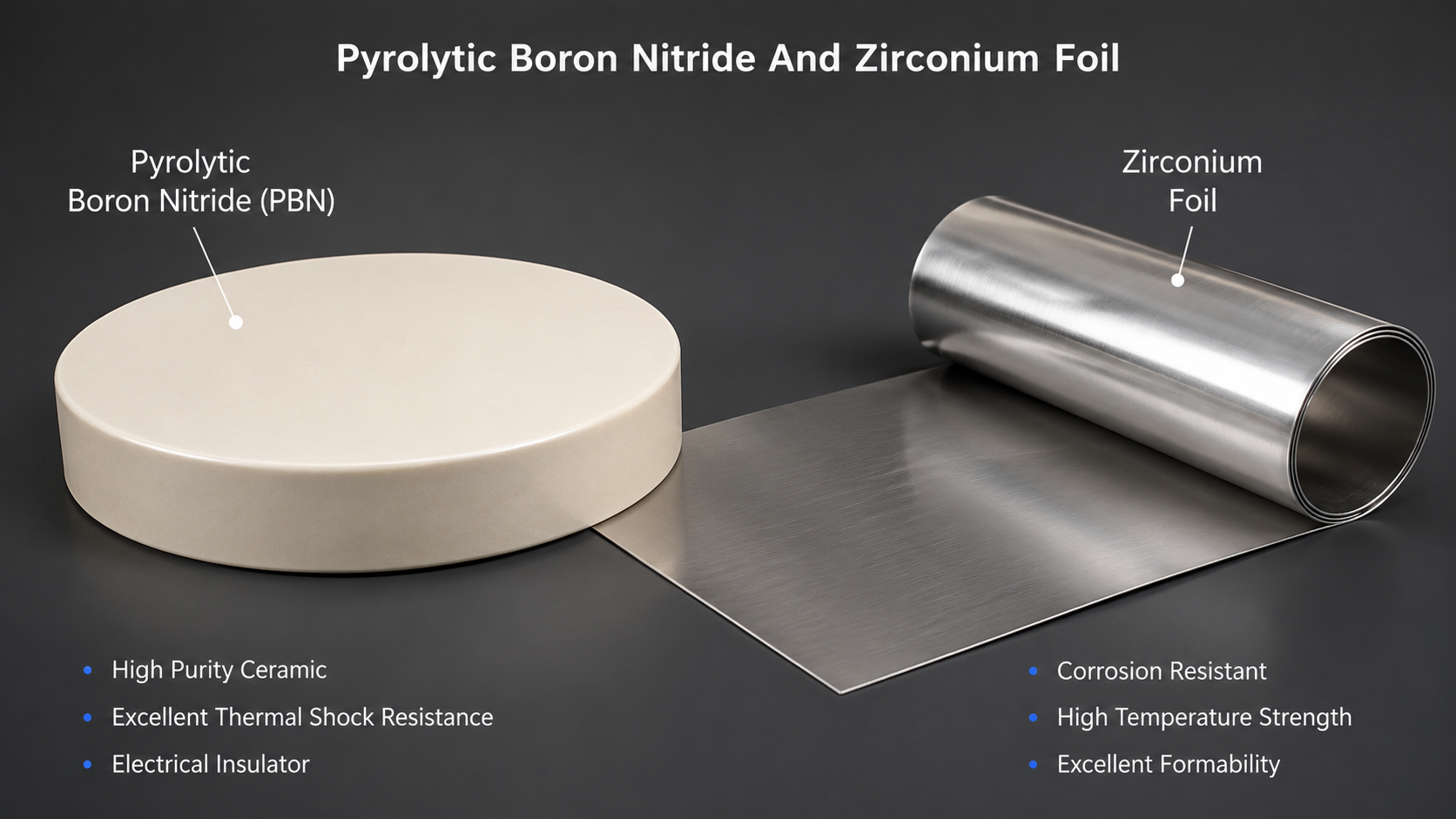
Advanced engineering needs materials that remain reliable under extreme heat, corrosive chemicals, vacuum, and electrical stress. Pyrolytic Boron Nitride and Zirconium Foil meet different high-performance needs.
PBN is a high-purity ceramic made by chemical vapour deposition. Zirconium foil is valued for corrosion resistance, formability, and low neutron absorption in semiconductor, vacuum, nuclear, chemical-processing, and research applications.
What Is Pyrolytic Boron Nitride?
Pyrolytic Boron Nitride is a synthetic boron nitride ceramic deposited from gaseous precursors onto a heated substrate. Unlike many pressed ceramics, PBN can be produced with extremely high purity and a dense, layered structure.
Its hexagonal crystal arrangement creates pronounced anisotropy, meaning properties vary according to direction. Thermal conductivity, thermal expansion, electrical behaviour, and mechanical strength can therefore differ between the plane of deposition and the perpendicular direction.
Important characteristics include:
- Excellent electrical insulation
- High chemical purity
- Strong resistance to thermal shock
- Low thermal expansion
- High-temperature capability in vacuum or inert atmospheres
- Good chemical stability
- Low contamination potential for sensitive processes
These qualities make PBN particularly valuable when process cleanliness and electrical isolation are critical.
How Pyrolytic Boron Nitride Is Manufactured
PBN is generally produced by chemical vapour deposition, or CVD. Gaseous boron- and nitrogen-containing compounds react at elevated temperature, allowing boron nitride to deposit layer by layer on a suitable mandrel or substrate.
After deposition, components can be removed, machined, coated, or integrated with other materials. The process enables crucibles, boats, plates, tubes, and specialised shapes without conventional ceramic binders.
Because processing affects crystal orientation and microstructure, buyers should compare grade-specific data carefully.
Major Applications of Pyrolytic Boron Nitride
Its purity, electrical resistance, thermal behaviour, and vacuum compatibility make Pyrolytic Boron Nitride valuable in semiconductor crucibles, molecular beam epitaxy effusion cells, OLED equipment, evaporation systems, high-vacuum insulation, heater supports, and coated graphite components.
PBN crucibles help limit contamination when processing molten or evaporated materials, while its dielectric behaviour supports electrical separation at elevated temperatures.
What Is Zirconium Foil?
Zirconium Foil is zirconium metal rolled into thin sheet. Zirconium naturally develops a protective oxide layer that supports strong resistance to many corrosive environments.
Its corrosion resistance, formability, heat tolerance, and low neutron-capture behaviour support nuclear studies, chemical processing, vacuum experiments, surface science, thin-film development, and sensors.
Key Properties of Zirconium Foil
The practical performance of Zirconium Foil depends on purity, thickness, temper, surface condition, and operating environment.
Engineers commonly value it for:
- Strong resistance to many acids, alkalis, and corrosive media.
- A high melting point of approximately 1,854°C.
- Good ductility for forming thin components.
- Low neutron absorption, particularly important in nuclear applications.
- A stable protective oxide film under suitable conditions.
- Compatibility with demanding research and chemical-processing environments.
However, zirconium can become highly reactive with certain gases at elevated temperatures. Application-specific compatibility and safe handling must therefore be reviewed carefully.
Pyrolytic Boron Nitride vs Zirconium Foil
| Feature | Pyrolytic Boron Nitride | Zirconium Foil |
| Material type | Advanced ceramic | Reactive transition metal |
| Primary strength | Electrical insulation and purity | Corrosion resistance and metallic formability |
| Electrical behaviour | Excellent insulator | Conductive metal |
| Typical form | Crucibles, plates, tubes, coatings | Thin foil or sheet |
| High-temperature use | Strong in vacuum/inert environments | Suitable depending on atmosphere |
| Common sectors | Semiconductor, vacuum, electronics | Nuclear, chemical, research |
| Key selection factor | Directional properties and purity | Purity, thickness, temper, environment |
These materials are not direct substitutes. Selection should be based on the engineering function required.
How to Select the Right Material
Choosing between Pyrolytic Boron Nitride and Zirconium Foil starts with defining operating conditions.
Consider temperature range, atmosphere, electrical requirements, chemical exposure, dimensional tolerance, contamination limits, mechanical loading, thermal cycling, required purity, and component geometry.
PBN is generally preferred when insulation, ultra-high purity, vacuum compatibility, and thermal-shock resistance are priorities. Zirconium foil is more appropriate when a thin metallic material with corrosion resistance, formability, or specialised nuclear characteristics is needed.
For critical systems, designers should review supplier data sheets and verify performance under actual operating conditions rather than selecting material solely from nominal values.
Frequently Asked Questions
1. What is Pyrolytic Boron Nitride used for?
It is widely used for crucibles, semiconductor processing, MBE equipment, high-vacuum insulation, heaters, evaporation systems, and high-purity research components.
2. Is PBN electrically conductive?
No. PBN is an excellent electrical insulator and is valued for high dielectric performance.
3. Why is PBN called anisotropic?
Its layered crystal structure causes thermal, electrical, and mechanical properties to vary by direction.
4. Can PBN withstand high temperatures?
Yes, particularly in vacuum or inert atmospheres, although allowable temperature depends on grade, design, and atmosphere.
5. What is Zirconium Foil mainly used for?
It is used in nuclear research, chemical environments, surface science, vacuum experiments, sensors, and advanced materials studies.
6. Is zirconium corrosion resistant?
Yes. Its protective oxide surface provides excellent resistance to many corrosive substances.
7. Is Zirconium Foil suitable for nuclear applications?
Zirconium is important in nuclear technology because of its relatively low neutron absorption, but exact grade requirements are application-specific.
8. Can Zirconium Foil be formed?
Yes. Appropriate foil grades can be cut, shaped, or formed, depending on thickness and temper.
9. Are PBN and zirconium interchangeable?
No. PBN is an insulating ceramic, while zirconium is a conductive metal with different mechanical and chemical behaviour.
10. What should buyers check before ordering?
Confirm purity, dimensions, tolerances, surface condition, operating temperature, atmosphere, chemical compatibility, certification, and supplier quality documentation.