2,3-Dimethyl-2,3-Diphenylbutane and 1,2-Octanediol: Properties, Applications and Industrial Importance
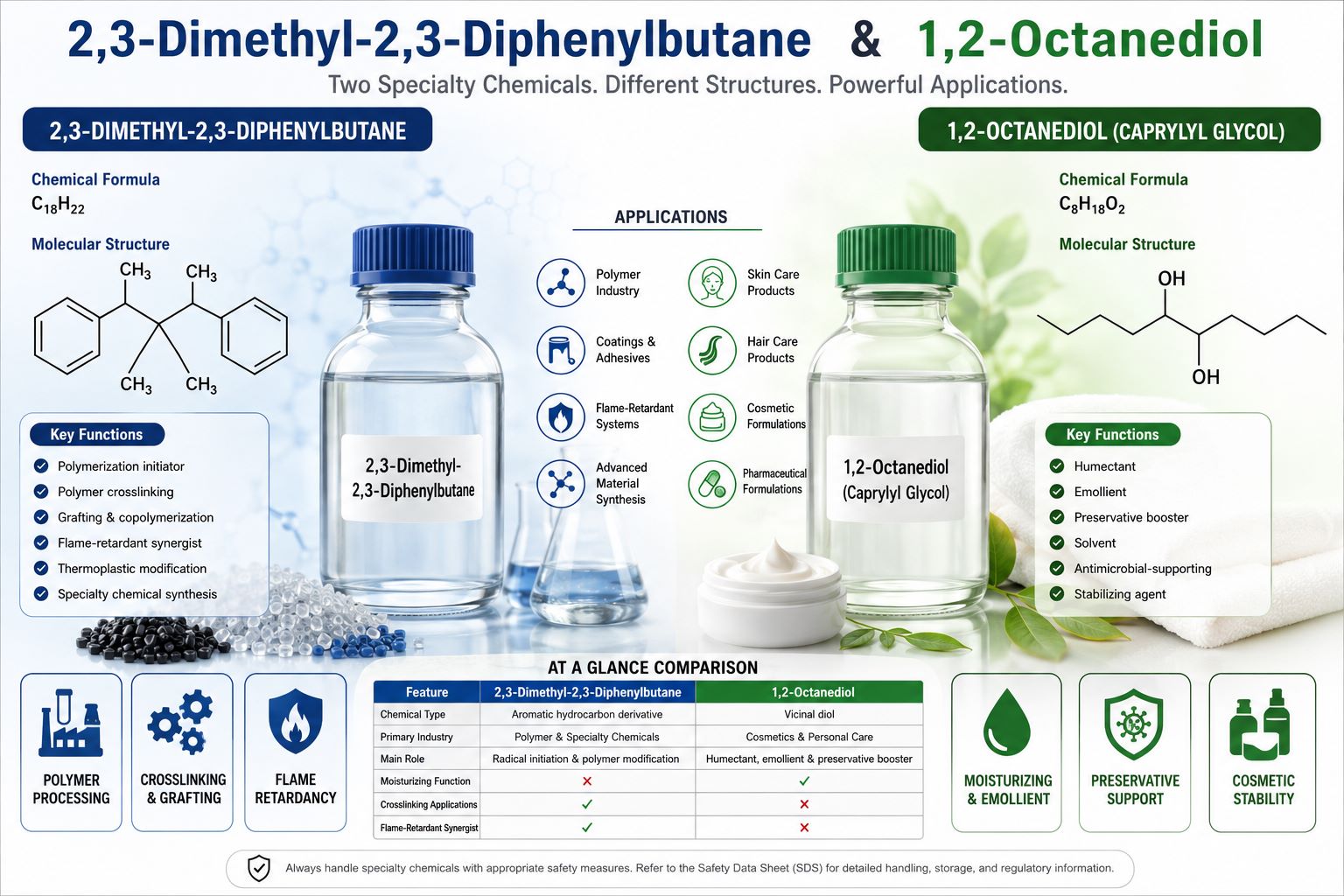
Specialty chemicals play an essential role in modern manufacturing, formulation science, polymer technology, cosmetics and research. Among the many compounds used by specialised industries, 2,3-dimethyl-2,3-diphenylbutane and 1,2-octanediol are interesting examples because their molecular structures give them very different functional characteristics.
2,3-dimethyl-2,3-diphenylbutane is an aromatic hydrocarbon associated primarily with specialised chemical and research applications, while 1,2-octanediol, widely known as caprylyl glycol, is a vicinal diol commonly associated with cosmetic and personal-care formulations. Understanding their chemistry, applications, handling requirements and sourcing considerations helps formulators, manufacturers and researchers select appropriate materials for their processes.
Understanding 2,3-Dimethyl-2,3-Diphenylbutane
2,3-dimethyl-2,3-diphenylbutane, also known by the synonym dicumene, has the molecular formula C18H22 and a molecular weight of approximately 238.37 g/mol. Its CAS Registry Number is 1889-67-4. Commercial technical information generally describes the material as a solid.
Its molecular architecture contains two phenyl groups and multiple methyl substituents surrounding the central carbon-carbon framework. This hydrocarbon-rich structure distinguishes it significantly from compounds containing hydroxyl, carboxyl or other strongly polar functional groups.
The compound is mainly encountered as a specialty or research chemical rather than as a conventional household ingredient. Supplier documentation may identify it specifically for research and development applications.
Applications of 2,3-Dimethyl-2,3-Diphenylbutane
The usefulness of 2,3-dimethyl-2,3-diphenylbutane comes from its specialised behaviour in chemical systems rather than broad consumer applications. Research literature and commercial databases associate the compound with free-radical chemistry and polymer-related investigations. It has also been investigated in connection with oxidation stabilisation of coal-tar pitch and polymer processing.
Potential areas in which researchers may encounter the compound include:
- Polymer chemistry and materials research
- Free-radical reaction studies
- Organic synthesis and reaction-mechanism research
- Speciality chemical development
- Laboratory investigations involving thermal or chemical behaviour
- Industrial materials research
The exact suitability of 2,3-dimethyl-2,3-diphenylbutane always depends on the particular formulation, reaction conditions, purity specification and processing requirements.
What Is 1,2-Octanediol?
1,2-octanediol is an eight-carbon organic compound containing two hydroxyl groups on neighbouring carbon atoms. It is also commonly called caprylyl glycol or octane-1,2-diol. Its molecular formula is C8H18O2, its molecular weight is approximately 146.23 g/mol, and its CAS Registry Number is 1117-86-8.
The presence of hydroxyl groups makes 1,2-octanediol chemically and functionally different from 2,3-dimethyl-2,3-diphenylbutane. The molecule combines a hydrocarbon chain with a polar diol region, helping explain its usefulness in formulations involving skin conditioning, moisture management and formulation support.
PubChem identifies uses and functional classifications connected with cosmetics, including emollient, humectant and hair-conditioning functions. It is also associated with preservative and stabilising applications.
Why 1,2-Octanediol Is Important in Cosmetic Formulation
One of the best-known applications of 1,2-octanediol is in personal-care and cosmetic formulations. Its combination of conditioning and formulation-support properties makes it useful when developers are balancing product feel, moisture retention and microbial-control strategies.
In practical formulation work, caprylyl glycol may contribute to emolliency and humectancy while also supporting preservation systems. PubChem reports its use in cosmetic and pharmaceutical preparations and lists functional categories that include emollients, preservatives, antioxidants and solvents.
Products in which formulators may evaluate 1,2-octanediol include creams, lotions, hair-care preparations, moisturising products and other personal-care formulations.
Its inclusion, however, should always be based on compatibility testing, the complete ingredient system, intended market regulations and validated product specifications.
2,3-Dimethyl-2,3-Diphenylbutane vs 1,2-Octanediol
| Property | 2,3-Dimethyl-2,3-Diphenylbutane | 1,2-Octanediol |
| Molecular formula | C18H22 | C8H18O2 |
| Molecular weight | Approx. 238.37 g/mol | Approx. 146.23 g/mol |
| CAS number | 1889-67-4 | 1117-86-8 |
| Chemical character | Aromatic hydrocarbon | Vicinal diol |
| Important structural feature | Two phenyl groups | Two hydroxyl groups |
| Typical relevance | Specialty chemistry and research | Cosmetics and formulation science |
| Common alternative name | Dicumene | Caprylyl glycol |
The comparison demonstrates why these chemicals should not be considered interchangeable. Their structures, polarity and intended applications are fundamentally different.
Quality and Sourcing Considerations
Selecting specialty chemicals involves considerably more than checking the chemical name. Buyers, laboratories and manufacturers should assess identity, assay or purity, batch consistency, documentation, packaging and storage requirements.
A reliable purchasing process should examine certificates of analysis, safety data sheets, CAS numbers and applicable regulatory documentation. Particular attention should be paid to whether the grade supplied is appropriate for research, industrial processing, cosmetics or another intended application.
For formulations using 1,2-octanediol, cosmetic-grade requirements may be different from laboratory reagent specifications. Likewise, 2,3-dimethyl-2,3-diphenylbutane intended for research should meet the purity and analytical requirements of the specific experiment or production process.
Safe Handling and Storage
Chemical safety must be evaluated from the current Safety Data Sheet supplied with the actual product and grade being purchased.
Supplier safety information for 2,3-dimethyl-2,3-diphenylbutane includes hazard classifications requiring appropriate precautions during handling. Available SDS information, for example, identifies potential skin-sensitisation concerns.
Commercial safety information for 1,2-octanediol also specifies precautions; one Sigma-Aldrich listing carries a warning classification related to serious eye irritation.
Personnel should therefore follow the supplier’s SDS, workplace risk assessment, applicable regulations and appropriate personal protective equipment requirements rather than assuming that either material is harmless.
Frequently Asked Questions
1. What is 2,3-dimethyl-2,3-diphenylbutane?
It is an aromatic hydrocarbon with the molecular formula C18H22 used primarily in specialty chemical and research contexts.
2. What is the CAS number of 2,3-dimethyl-2,3-diphenylbutane?
Its CAS Registry Number is 1889-67-4.
3. What is another name for 1,2-octanediol?
It is commonly known as caprylyl glycol.
4. What is the formula of 1,2-octanediol?
Its molecular formula is C8H18O2.
5. Is 1,2-octanediol used in cosmetics?
Yes. It is associated with emollient, humectant, hair-conditioning and preservation-related functions.
6. Are these two chemicals interchangeable?
No. They have very different molecular structures and functional properties.
7. What functional groups does 1,2-octanediol contain?
It contains two neighbouring hydroxyl groups, making it a vicinal diol.
8. Is 2,3-dimethyl-2,3-diphenylbutane a diol?
No. Unlike 1,2-octanediol, its molecular formula contains no oxygen.
9. Why does chemical purity matter?
Purity can influence reaction performance, formulation consistency, analytical accuracy and final-product quality.
10. What documents should buyers request from suppliers?
Important documentation normally includes a Certificate of Analysis and current Safety Data Sheet, together with relevant technical or regulatory information.