From Digital Sequence to Research-Ready DNA: Understanding Custom Gene and DNA Synthesis
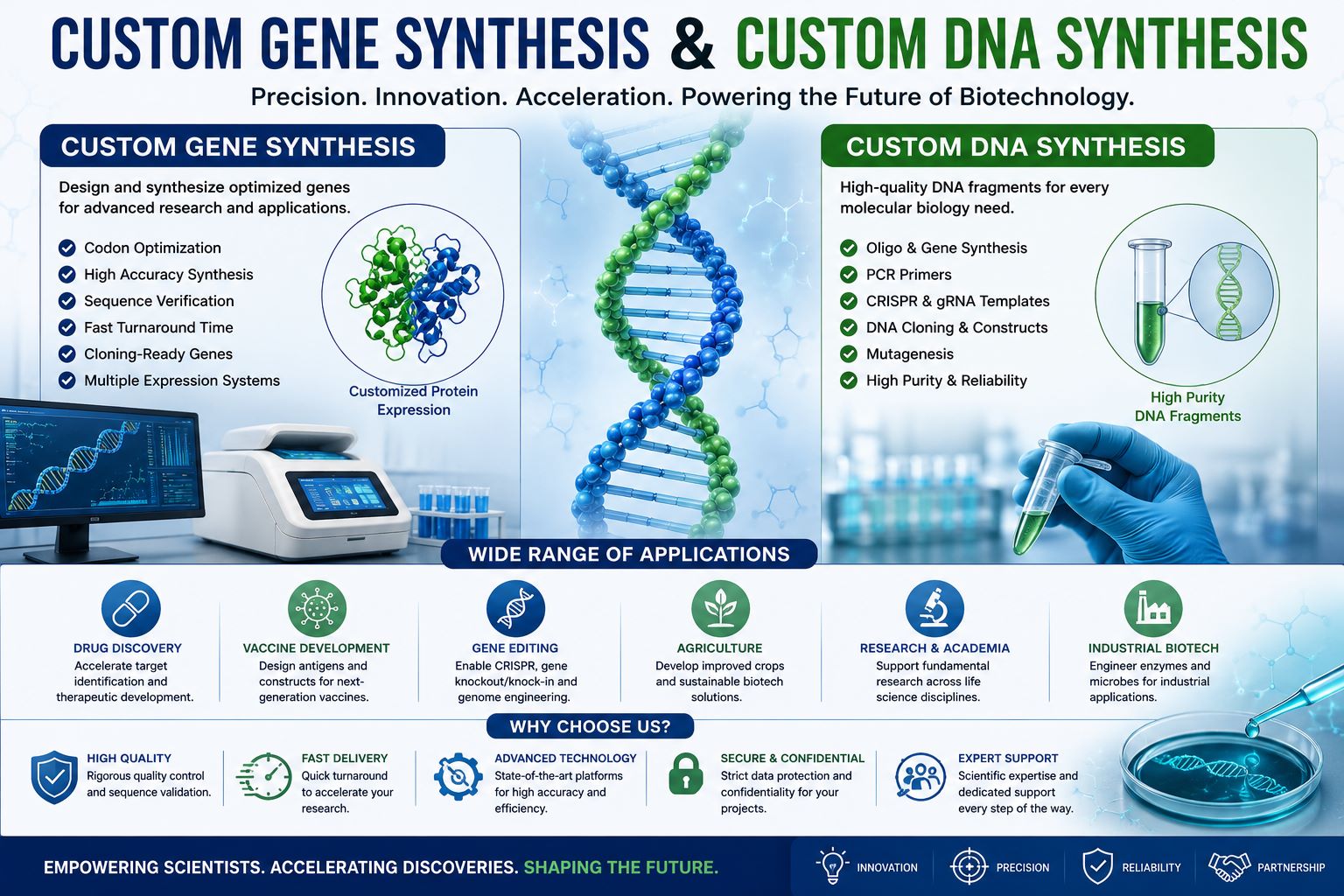
Biological research is moving from finding useful DNA in nature to designing sequences around specific scientific objectives. This shift has made custom gene synthesis and custom DNA synthesis valuable resources across biotechnology, life sciences, molecular research, and synthetic biology.
Researchers can now start with a digital sequence and obtain purpose-designed genetic material instead of depending entirely on existing templates. Whether the goal is to study protein function, investigate genetic variants, develop engineered biological systems, or prepare specialised research constructs, synthetic DNA provides considerable design flexibility.
Designing DNA Around the Research Objective
Conventional molecular biology often starts with genetic material already available in an organism or laboratory collection. Researchers may then need to isolate, amplify, clone, and modify that DNA before it becomes suitable for a particular experiment.
Custom DNA synthesis approaches the problem differently.
The desired nucleotide sequence can first be designed computationally. Researchers can define important characteristics before manufacturing begins, including coding regions, regulatory elements, sequence modifications, cloning-related features, and other project-specific components.
This design-first model is particularly valuable when an appropriate natural template is difficult to obtain or when substantial sequence modification would otherwise be necessary.
Understanding Custom Gene Synthesis
Custom gene synthesis refers specifically to manufacturing a gene based on a predefined nucleotide sequence.
The requested gene does not necessarily need to be an exact copy of a naturally occurring sequence. Depending on the scientific objective, researchers may design an altered coding sequence, introduce selected mutations, adjust sequence characteristics, or create an artificial construct.
Common research areas include:
- Gene function studies
- Recombinant protein research
- Antibody research
- Enzyme engineering
- Synthetic biology
- Molecular diagnostics research
- Metabolic pathway studies
- Functional genomics
The result is a sequence designed around the experiment rather than an experiment being restricted by the available sequence.
How Custom DNA Synthesis Expands Design Possibilities
While gene synthesis commonly refers to coding sequences or complete genes, custom DNA synthesis has a wider scope.
Researchers may require DNA fragments containing promoters, regulatory regions, linkers, tags, modified sequence elements, or combinations of different functional components.
This makes custom synthesis useful for both straightforward and more specialised genetic designs.
| Research Requirement | Custom Gene Synthesis | Custom DNA Synthesis |
| Complete coding gene | Highly suitable | Suitable |
| Designed DNA fragment | Possible | Highly suitable |
| Sequence modification | Yes | Yes |
| Regulatory elements | Can be incorporated | Common application |
| Artificial constructs | Yes | Yes |
| Vector-based delivery | Often available | Often available |
The appropriate option ultimately depends on what the researcher needs to build.
Why Sequence Design Deserves Careful Attention
DNA synthesis begins long before physical manufacturing. Good sequence planning can make downstream research easier and reduce unnecessary redesign.
For example, researchers may evaluate whether a sequence contains unwanted restriction sites, repetitive regions, challenging GC composition, or motifs that could interfere with the intended experimental system.
When the DNA encodes a protein, codon usage may also be considered.
Because different organisms can show different codon preferences, a coding sequence originally associated with one organism may be redesigned for another expression context. This process is commonly associated with custom gene synthesis projects involving recombinant protein research.
However, sequence optimisation alone does not determine experimental success. Expression conditions, host biology, protein characteristics, vector design, and other factors remain important.
Where Synthetic Genes Add Research Value
One of the strongest advantages of synthetic DNA is the ability to create precisely defined variants.
Imagine a research project comparing several versions of the same protein. Instead of repeatedly modifying a single starting construct, researchers can design individual sequences containing the required variations.
This approach can support studies involving:
- Defined sequence variants
- Protein structure and function
- Engineered enzymes
- Gene regulation
- Biological pathway construction
- Comparative functional studies
By defining the sequence digitally, researchers gain greater control over the starting genetic material.
Synthetic Biology and Engineered Genetic Systems
Synthetic biology relies heavily on the ability to assemble biological components in new ways.
Custom DNA synthesis enables researchers to design genetic components that can be combined into larger systems. These may include coding regions, regulatory sequences, engineered pathways, or other functional elements.
The technology therefore supports research into biosystems that may not exist naturally in exactly the required configuration.
This ability to move from digital biological design to physical DNA is one reason synthesis has become an important enabling technology for modern biotechnology.
What Happens During a Synthesis Project?
Although processes vary between providers, a typical project starts when the researcher submits the desired DNA sequence and project specifications.
The sequence is reviewed for manufacturability and other relevant requirements. Smaller synthetic DNA components can then be produced and assembled into the requested construct. Verification procedures are subsequently used to assess whether the completed sequence corresponds to the intended design.
Depending on the provider and project, additional services may include sequence optimisation, cloning into a chosen vector, preparation of DNA material, or supporting documentation.
Choosing a Custom Synthesis Partner
Selecting a provider should involve more than comparing the lowest advertised price.
Researchers should consider:
- Sequence verification standards
- Quality-control procedures
- Supported construct sizes
- Capability for complex sequences
- Available cloning options
- Sequence design support
- Turnaround expectations
- Technical communication
- Documentation
- Biosafety and sequence screening
A service that provides clear technical information can be particularly valuable when working with unusual or challenging sequence designs.
Accuracy and Verification Are Essential
Synthetic DNA often becomes the foundation for subsequent experiments. Sequence accuracy therefore matters.
An unexpected sequence difference can potentially affect protein coding, regulatory behaviour, cloning compatibility, or interpretation of experimental results.
Quality-focused custom gene synthesis services generally incorporate appropriate sequence verification before delivering the final material.
Researchers should still review supplied sequence information and confirm that the construct corresponds with their original specifications before beginning downstream experiments.
Frequently Asked Questions
1. What does custom gene synthesis mean?
It means manufacturing a specified gene sequence based on a researcher-provided or designed nucleotide sequence.
2. Why use custom DNA synthesis?
It allows researchers to obtain DNA designed specifically for their experimental requirements.
3. Are custom gene synthesis and DNA synthesis identical?
They overlap, but gene synthesis usually focuses on genes, whereas DNA synthesis can cover a broader variety of designed DNA constructs.
4. Can researchers request modified sequences?
Yes. Defined sequence changes can be incorporated into a synthetic design.
5. Does synthetic DNA need a natural template?
Not necessarily. The manufacturing process can begin from digital sequence information.
6. What is codon optimisation used for?
It is used to adapt aspects of a coding sequence for a selected expression context while preserving the intended protein sequence where appropriate.
7. Can regulatory sequences be included?
Depending on the project, regulatory and other functional DNA elements may be incorporated into the overall design.
8. Is synthetic DNA useful for protein research?
Yes. Synthetic coding sequences are frequently used as starting materials in recombinant protein studies.
9. What influences gene synthesis complexity?
Sequence length, composition, repetitive regions, secondary structural characteristics, and other design factors can influence manufacturability.
10. What should researchers check before ordering?
They should review the sequence, intended application, required format, verification standards, cloning needs, provider capabilities, and applicable biosafety requirements.