5G Modem Manufacturer and 5G SIM Card Router: Building the Future of High-Speed Connectivity
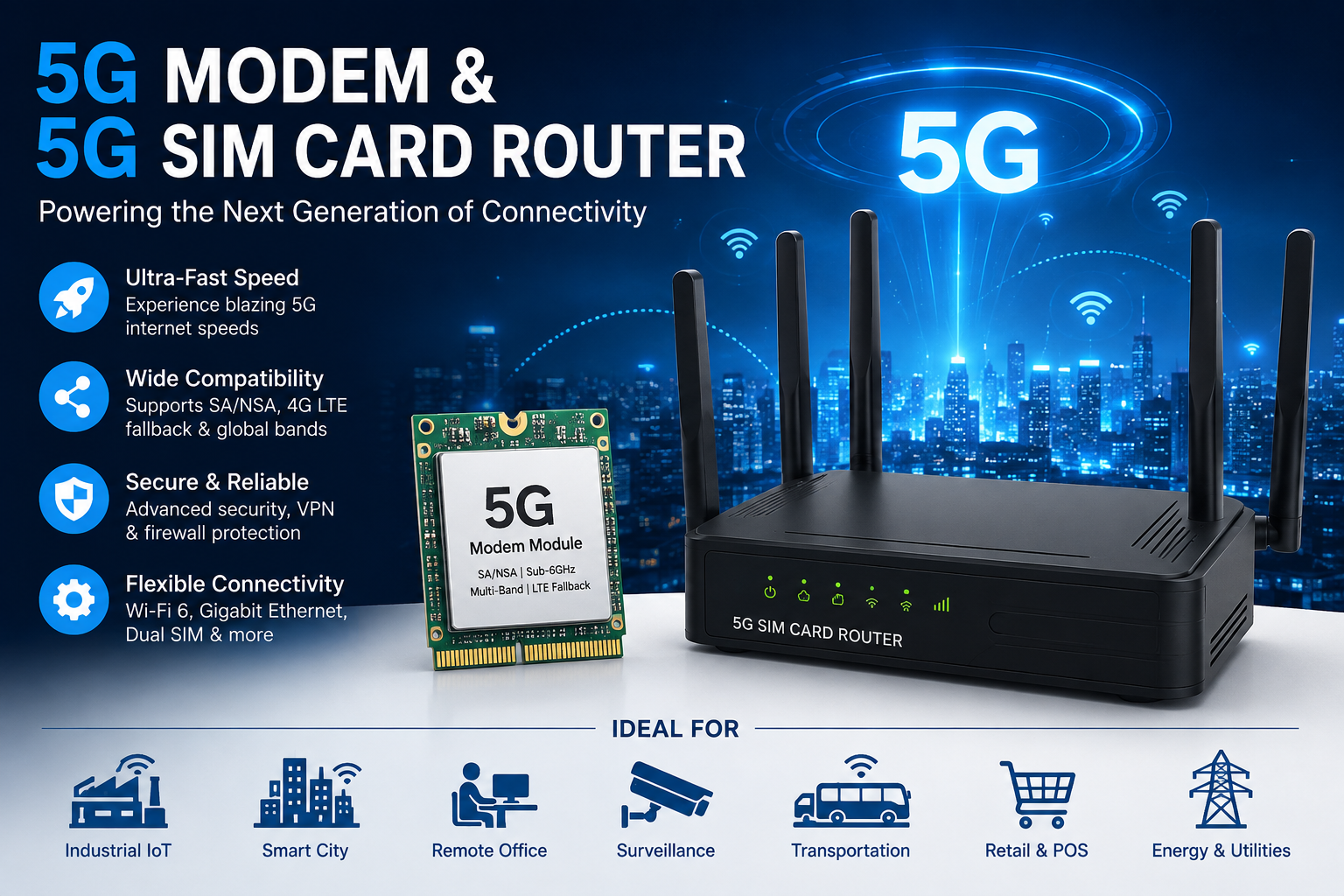
The rapid expansion of 5G is changing how businesses, factories, smart devices, and remote locations connect to the internet. Behind this transformation are two important technologies: the 5G modem manufacturer ecosystem that develops cellular connectivity hardware and the 5G SIM card router that converts a mobile network connection into usable internet access for multiple devices.
Modern 5G equipment is no longer designed only for smartphones. It is increasingly used for industrial IoT, smart infrastructure, retail networks, surveillance systems, transportation, remote offices, edge computing, and fixed wireless access. Choosing the right modem technology and router therefore requires understanding performance, network compatibility, security, reliability, and deployment requirements.
What Does a 5G Modem Manufacturer Do?
A 5G modem manufacturer develops or produces hardware that enables electronic devices to communicate with 5G cellular networks. Depending on the company, its products may include embedded cellular modules, modem chipsets, M.2 modules, USB modems, industrial communication modules, gateways, and customised OEM solutions.
The modem serves as the communication bridge between equipment and the cellular network. It processes radio signals and enables data transmission over supported 5G frequency bands.
Modern modem platforms may support:
- 5G Standalone and Non-Standalone connectivity
- Sub-6 GHz frequency bands
- 4G LTE fallback
- Multiple antenna configurations
- GNSS positioning
- USB, PCIe or other hardware interfaces
- IoT and M2M applications
- Network management capabilities
Newer technologies such as 5G RedCap are also expanding opportunities for IoT devices that do not require the extreme bandwidth of conventional 5G broadband equipment. RedCap was introduced through 3GPP Release 17 with reduced device complexity and bandwidth requirements.
Understanding a 5G SIM Card Router
A 5G SIM card router connects directly to a cellular network using a compatible SIM or eSIM service. Instead of requiring a traditional fibre, cable, or DSL connection, the router receives internet connectivity through the mobile operator’s network.
Once connected, it can distribute internet access through Wi-Fi, Ethernet, or both.
This makes the technology particularly useful where wired broadband is unavailable, expensive to install, temporary, or unsuitable for operational requirements.
A typical setup works in four stages:
- A compatible SIM card is inserted into the router.
- The internal cellular modem connects to the mobile operator.
- The router establishes an internet connection.
- Connected devices access the connection through Wi-Fi or Ethernet.
Some professional routers additionally provide dual-SIM functionality, allowing businesses to configure cellular redundancy or operator failover.
Why 5G Connectivity Is Becoming Important for Businesses
Organisations increasingly need networks that can be deployed quickly without depending entirely on fixed infrastructure. A 5G SIM card router provides an alternative or backup connectivity option for many environments.
Common applications include construction sites, warehouses, temporary offices, retail stores, ATMs, digital signage, CCTV systems, transportation networks, smart factories, kiosks and remote monitoring equipment.
For manufacturers, 5G also creates opportunities to integrate cellular communication directly into industrial and commercial equipment.
The emergence of RedCap is particularly relevant to IoT. Current Release 17 implementations are designed to reduce hardware complexity and power requirements compared with full-capability 5G while retaining useful 5G functionality for connected devices.
Key Features to Look for in a 5G Modem
Selecting a suitable 5G modem manufacturer should involve more than comparing advertised download speeds. Network requirements can differ significantly between countries, carriers, and applications.
Important considerations include:
Frequency-band compatibility: The modem must support the bands used by the intended network operators and deployment regions.
SA and NSA support: Compatibility with both architectures can improve deployment flexibility as operators continue developing their 5G networks.
LTE fallback: 4G support provides additional connectivity where 5G coverage is limited.
Hardware interfaces: Industrial integrations may require USB, PCIe, UART, Ethernet, GPIO, or other interfaces.
Operating environment: Industrial deployments can require equipment designed for wider temperature ranges, vibration, continuous operation, and challenging environments.
Certification: Regional and carrier certifications should be checked before large-scale deployment.
Important Features of a 5G SIM Card Router
Not every router is designed for the same purpose. A home router and an industrial cellular gateway can have significantly different capabilities.
Look for features such as:
- Dual-band or tri-band Wi-Fi
- Wi-Fi 6 support where required
- Gigabit Ethernet connectivity
- Dual-SIM capability
- Automatic WAN failover
- VPN functionality
- Firewall controls
- External antenna connectors
- Remote device management
- Firmware update support
- IPv4 and IPv6 compatibility
- Traffic monitoring
Commercial 5G routers are already available with features such as Wi-Fi 6, WPA3 security, Gigabit Ethernet and dual nano-SIM slots, demonstrating how cellular routers are developing into complete networking platforms.
5G Modem vs 5G SIM Card Router
| Feature5G Modem5G SIM Card Router | ||
| Main purpose | Cellular communication | Network distribution |
| SIM support | Usually supported through module/device design | Typically integrated |
| Wi-Fi | Not always available | Common |
| Ethernet | Depends on implementation | Common |
| Best suited for | OEM and embedded applications | Complete network deployments |
| Integration | Often requires additional hardware | Usually ready to deploy |
| Typical users | Manufacturers and system integrators | Businesses and end users |
The two technologies often work together. The cellular modem handles communication with the operator, while the router manages local networking and distributes connectivity.
Applications Across Different Industries
The combination of equipment supplied by a 5G modem manufacturer and a reliable 5G SIM card router can support numerous connected applications.
Industrial IoT
Factories can connect sensors, gateways, monitoring equipment, automated systems and edge devices where cellular networking offers operational advantages.
Smart Surveillance
Cellular routers can connect IP cameras and monitoring systems in locations where fixed broadband installation is difficult.
Retail
Stores, kiosks and payment environments can use cellular connectivity as either primary internet access or backup connectivity.
Transportation
Connected vehicles, fleet-management systems and transportation infrastructure can use cellular modules for communication and telemetry.
Temporary Worksites
Construction projects, exhibitions and temporary offices can establish connectivity without waiting for permanent wired infrastructure.
How to Choose a Reliable 5G Modem Manufacturer
Selecting a manufacturer requires technical and commercial evaluation.
Start by checking:
- Supported 5G and LTE bands.
- Regional certifications.
- Product lifecycle and availability.
- Documentation and integration resources.
- Firmware and security update policies.
- Technical support capabilities.
- Form-factor compatibility.
- Customisation or OEM services.
- Production capacity.
- Long-term product roadmap.
For IoT deployments, it is also worth evaluating RedCap. Commercial RedCap modem platforms now support Release 17 functionality alongside LTE and 5G NR FR1 connectivity, providing another option between traditional LTE IoT and higher-performance 5G devices.
Frequently Asked Questions
1. What is a 5G modem?
A 5G modem enables compatible equipment to communicate with a 5G cellular network.
2. What is a 5G SIM card router?
It is a router that uses cellular service through a SIM card to provide internet connectivity to connected devices.
3. Does a 5G router require a SIM card?
Most cellular 5G routers require an activated SIM or supported eSIM service.
4. Can a 5G router work on a 4G network?
Many models support LTE fallback, but compatibility depends on the specific router and operator.
5. Can a 5G SIM card router replace fibre broadband?
It can serve as primary connectivity in suitable locations, although actual performance depends on coverage, network congestion, signal quality and the service plan.
6. What is dual-SIM functionality?
Dual-SIM routers accommodate two SIMs, commonly for operator flexibility or connection redundancy.
7. What industries use 5G modems?
Applications include manufacturing, IoT, transportation, surveillance, energy, retail, smart infrastructure and connected equipment.
8. What is 5G RedCap?
RedCap is a reduced-capability 5G technology introduced in 3GPP Release 17 for applications that need 5G connectivity without the full complexity of conventional high-performance 5G devices.
9. Should a 5G router have external antennas?
External antenna support can be valuable in challenging signal environments, but requirements depend on the installation.
10. How do I select a 5G modem manufacturer?
Evaluate network compatibility, certifications, technical specifications, documentation, reliability, support, product lifecycle and integration requirements.