Big Bag Filling Machine: A Practical Guide to Efficient Bulk Material Handling
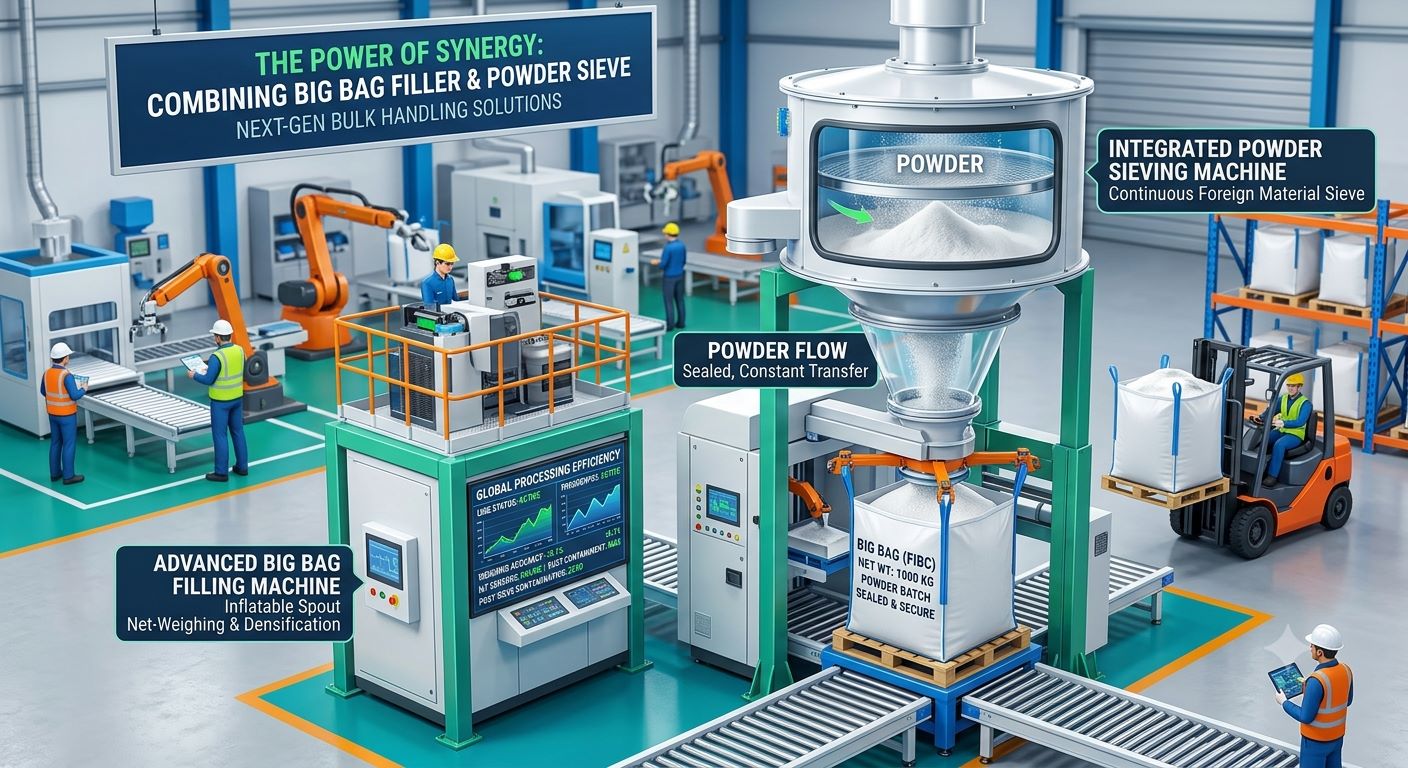
For manufacturers handling powders, granules, flakes or other dry bulk materials, filling large flexible containers manually can become slow, inconsistent and labour-intensive. A big bag filling machine provides a controlled way to fill FIBCs (Flexible Intermediate Bulk Containers), commonly known as jumbo bags or big bags, while improving filling consistency, operator safety and material handling efficiency.
However, choosing the right machine is not simply a matter of selecting a particular filling capacity. Material characteristics, bag dimensions, dust generation, weighing accuracy, production volume and upstream equipment all influence the right configuration.
This guide explains how big bag filling systems work, what to consider before purchasing one, and how equipment such as a powder sieving machine can complement the filling process.
What Is a Big Bag Filling Machine?
A big bag filling machine is an industrial system designed to fill large flexible bulk bags with a controlled quantity of powder, granules, pellets or other dry materials.
Depending on the application, the system can incorporate:
- Bag support frames
- Filling nozzles
- Weighing systems
- Load cells
- Material feeding equipment
- Dust extraction connections
- Bag inflation or conditioning systems
- Vibrating or densification mechanisms
- Conveyor systems
- PLC-based controls
The objective is straightforward: deliver the required quantity of material into a big bag accurately, safely and consistently.
Big bag fillers are widely used in industries such as chemicals, minerals, plastics, food processing, pharmaceuticals, agriculture and construction materials.
How Does a Big Bag Filling Machine Work?
The exact operating sequence varies by machine design, but a typical system follows these stages:
1. Bag positioning
The empty FIBC is placed on the filling station and its loops are attached to the supporting frame. The bag inlet is then connected securely to the filling spout.
2. Bag preparation
Some applications use an inflation or air-assistance system to open the bag before filling. This helps establish the correct bag shape and can improve material distribution.
3. Material feeding
Material is transferred from a hopper, silo, screw conveyor, rotary valve or another upstream feeding system into the bag.
4. Controlled filling
The filling system controls the material flow according to the required filling rate. For weight-based systems, load cells continuously monitor the bag weight.
5. Densification
Where appropriate, vibration or other densification methods may be used to settle the material inside the bag. This can help maximise available bag volume and improve stability during handling.
6. Filling completion
Once the target weight is reached, the material flow is stopped and the filling spout is disconnected or sealed according to the bag design.
7. Bag removal
The filled bag is lowered or transferred from the filling station for storage, palletising or transportation.
This controlled process can be considerably more consistent than manually filling large containers.
What Materials Can Be Filled Using a Big Bag Filling Machine?
The suitable material depends on the machine configuration and its feeding system.
Common examples include:
- Plastic granules and pellets
- Calcium carbonate
- Titanium dioxide
- Silica and mineral powders
- Cement and construction materials
- Fertiliser
- Flour and food powders
- Chemical powders
- Pigments
- Animal feed
- Agricultural products
- Ceramic materials
- Industrial additives
Free-flowing granules generally behave differently from fine, cohesive powders. Therefore, a machine designed for plastic pellets may not be suitable for a very fine powder without appropriate modifications.
Big Bag Filling for Powder vs Granular Materials
Material behaviour is one of the most important considerations when specifying a filling machine.
Powder materials
Fine powders may generate airborne dust, bridge inside hoppers or have poor flow characteristics. They may therefore require:
- Dust extraction
- Enclosed filling arrangements
- Appropriate feeding equipment
- Agitation or vibration
- Screw-based dosing
- Flow-control systems
Granular materials
Granules and pellets can often flow more freely, although their bulk density, particle size and tendency to segregate still need to be considered.
For example, a lightweight polymer granule may require a different feeding and filling arrangement from a dense mineral product.
The best big bag filling machine is therefore determined by the material and process—not simply by the required bag size.
Why Is a Powder Sieving Machine Important in Powder Processing?
A powder sieving machine is used to separate particles according to size and remove unwanted oversize particles, agglomerates or foreign material from a powder stream.
In many manufacturing processes, sieving takes place before packaging or filling.
A typical powder-handling sequence may look like:
Raw material → Feeding → Sieving → Storage/Hopper → Dosing → Big Bag Filling → Sealing → Dispatch
Integrating a powder sieving machine upstream of the filling process can help maintain a more consistent material stream.
This is particularly relevant where powders can form lumps during storage or processing.
Benefits of Using a Powder Sieving Machine Before Filling
Using sieving equipment before bulk packaging can offer several process benefits.
Improved particle-size consistency
Sieving helps separate material according to the selected screen aperture, depending on the equipment and process requirements.
Removal of lumps
Powders can agglomerate because of moisture, storage conditions, pressure or other processing factors. Sieving can help remove unsuitable larger particles.
Better downstream flow
A more consistent powder stream can make subsequent conveying, dosing and filling easier to control.
Product quality control
For applications where particle size affects product performance, sieving can form an important part of the quality-control process.
Protection of downstream equipment
Removing oversized particles before they reach pumps, feeders or filling equipment can reduce the risk of blockages or process interruptions.
Key Benefits of a Big Bag Filling Machine
A properly specified system can provide several operational advantages.
1. Consistent filling
Automated weighing and controlled feeding can provide greater consistency than manual filling.
2. Reduced manual handling
Operators do not need to manually handle and transfer the entire quantity of material into each large bag.
3. Improved productivity
Automating repetitive filling activities can help manufacturers handle higher production volumes without relying entirely on manual labour.
4. Better housekeeping
For dusty powders, an enclosed filling design with suitable dust extraction can help control material escaping into the surrounding work area.
5. Flexible material handling
Depending on the configuration, the same filling station may be adapted for different materials and bag formats.
6. Improved inventory control
Accurate weight measurement can help businesses maintain better control over the quantity of material being packed and dispatched.
What Should You Consider Before Buying a Big Bag Filling Machine?
Purchasing decisions should begin with the material and process requirements rather than the machine catalogue.
Material characteristics
Provide the equipment supplier with information about:
- Bulk density
- Particle size
- Moisture content
- Flowability
- Dustiness
- Temperature
- Cohesiveness
- Abrasiveness
These characteristics can influence the feeder, hopper, filling nozzle and dust-control arrangement.
Required bag capacity
Determine the required filling weight and bag dimensions.
Common FIBC applications involve different capacities depending on the product density and intended handling method.
Filling accuracy
If the finished product is sold by weight, filling accuracy becomes especially important.
Ask the supplier how the weighing system works and how the equipment manages the transition from fast filling to final dosing.
Production rate
Consider the number of bags you need to fill per hour rather than simply asking for a machine with a particular motor size.
Your supplier should evaluate:
Required bags per hour + target bag weight + material flow characteristics
to determine an appropriate configuration.
Dust control
Fine powders can create significant dust during filling.
A suitable system may require a dedicated dust extraction connection, sealed filling spout or other containment measures.
Bag design
FIBCs are available in different designs, including variations in inlet, outlet, loops, dimensions and construction.
The filling equipment should be compatible with the bags you actually use.
Automation level
Depending on the production environment, you may require:
- Manual bag loading
- Semi-automatic filling
- Automatic bag handling
- Automatic weighing
- Conveyor integration
- PLC controls
- Data recording
- Automated bag discharge
There is little value in paying for automation that does not solve a genuine production requirement.
Weighing System: Why It Matters
Many big bag filling machines use load cells to measure the weight of the material entering the bag.
A typical control strategy may involve:
- Starting at a higher filling rate.
- Reducing the feed rate as the target weight approaches.
- Stopping the feeder at the programmed target.
- Recording or displaying the final weight.
The actual achievable accuracy depends on several factors, including material flow behaviour, feeding technology, equipment design and operating conditions.
For this reason, buyers should ask for application-specific performance information rather than relying on a generic accuracy figure.
Big Bag Filling Machine vs Manual Filling
| Factor | Manual Filling | Big Bag Filling Machine |
| Filling consistency | Operator-dependent | Controlled by the system |
| Labour requirement | Higher | Lower |
| Dust control | Often more difficult | Can be integrated into the design |
| Weighing | Manual or separate | Can be integrated |
| Production scalability | Limited | Better suited to higher throughput |
| Process monitoring | Often limited | Can include automated controls |
| Material handling | More manual | More structured |
Automation is not necessarily the right solution for every operation. For low-volume applications, manual or semi-automatic systems may remain economically practical.
For repetitive, higher-volume production, however, automation can offer significant process advantages.
Common Applications of Big Bag Filling Systems
Chemical industry
Big bags are commonly used for transporting and storing dry chemicals, pigments, additives and industrial powders.
Plastics industry
Polymer granules and plastic compounds can be handled using bulk bag filling systems designed for free-flowing materials.
Mineral processing
Mineral powders and granular products can require controlled filling, dust management and robust construction.
Food industry
Food-grade applications require suitable hygienic construction and materials, along with an appropriate cleaning and contamination-control strategy.
Pharmaceutical manufacturing
Pharmaceutical powder handling may require specialised hygienic designs and carefully controlled process conditions.
Construction materials
Products such as dry building materials and mineral-based powders can be packaged into FIBCs for transportation and storage.
How to Choose the Right Big Bag Filling Machine Supplier
The supplier’s technical capability is just as important as the machine itself.
Before placing an order, consider asking:
- Does the supplier have experience with your material?
- Can they conduct application trials?
- What filling technology do they recommend?
- How is dust controlled?
- What weighing system is used?
- Can the system integrate with existing equipment?
- What bag sizes are supported?
- What level of automation is available?
- Is after-sales service available?
- Are spare parts readily accessible?
- Can the machine be customised for the production line?
A supplier that understands your complete material-handling process can usually provide more useful guidance than one focused only on selling a standard machine.
Big Bag Filling Machine: Customisation Options
Industrial filling requirements vary significantly from one factory to another.
Depending on the application, a filling system may be customised with:
- Different hopper capacities
- Screw feeders
- Vibratory feeders
- Pneumatic conveying connections
- Dust extraction
- Load-cell weighing
- Bag vibration systems
- Conveyor integration
- Automatic bag discharge
- PLC/HMI controls
- Stainless-steel construction
- ATEX or other application-specific requirements where applicable
Any compliance or safety requirement should be evaluated against the actual installation environment and applicable regulations.
Maintenance Tips for Bulk Bag Filling Equipment
Regular maintenance helps maintain reliable operation.
A practical maintenance programme should include:
- Inspecting filling nozzles and clamps
- Checking load cells and weighing components
- Inspecting flexible connections
- Cleaning powder deposits
- Checking feeders for build-up
- Inspecting vibration equipment
- Checking electrical connections
- Reviewing sensor operation
- Inspecting dust extraction connections
- Replacing worn seals and components where required
Fine powders can accumulate around moving components, sensors and connections, so cleaning procedures should be appropriate for the material being processed.
Frequently Asked Questions
What is a big bag filling machine used for?
A big bag filling machine is used to fill large flexible intermediate bulk containers with controlled quantities of powders, granules, pellets and other dry bulk materials.
What is the difference between a big bag and an FIBC?
In industrial packaging, “big bag”, “jumbo bag” and “FIBC” are commonly used terms for flexible bulk containers. The precise bag specification depends on its construction, capacity, lifting arrangement and intended application.
Can a big bag filling machine handle powders?
Yes. Big bag filling systems can be designed for powders, but the feeding and dust-control arrangements need to match the powder’s flowability, particle size, bulk density and other characteristics.
Why is a powder sieving machine used before filling?
A powder sieving machine can remove oversize particles and agglomerates and help produce a more consistent material stream before dosing, packaging or filling.
Can filling and sieving equipment be integrated?
Yes. A powder-processing line can combine sieving, conveying, storage, dosing and big bag filling equipment. The appropriate configuration depends on the material, production rate and plant layout.
How accurate is a big bag filling machine?
Accuracy depends on the machine configuration, weighing technology, material characteristics and filling method. Buyers should request application-specific performance information rather than assuming a universal accuracy level.
Is a big bag filling machine suitable for small production volumes?
It can be, although the investment should be assessed against production volume, labour costs, handling requirements and the expected return on automation. A semi-automatic system may be more appropriate for lower-volume operations.
How Much Does a Big Bag Filling Machine Cost?
There is no single price that applies to every big bag filling system.
The cost can vary according to:
- Filling capacity
- Automation level
- Weighing system
- Material characteristics
- Dust-control requirements
- Feeder technology
- Bag handling requirements
- Construction material
- PLC and control requirements
- Conveyors and auxiliary equipment
- Custom engineering
For an accurate quotation, provide the supplier with your material name, bulk density, target bag weight, required bags per hour, bag dimensions, material flow characteristics and existing upstream/downstream equipment.
This allows the supplier to recommend a system based on your actual process rather than offering a generic machine specification.
Practical Example: Powder Packaging Line
Consider a manufacturer processing a fine industrial powder.
The production process could be structured as:
Raw powder → Powder Sieving Machine → Storage Hopper → Controlled Feeder → Weighing System → Big Bag Filling Machine → Bag Sealing → Pallet/Storage
In this arrangement, the sieving stage addresses particle-size consistency and lump removal, while the filling system focuses on accurate bulk packaging.
The result is a more structured material-handling process from preparation through final packaging.