Disc Cap and Cosmetic Pump: Choosing the Right Dispensing Solution for Modern Packaging
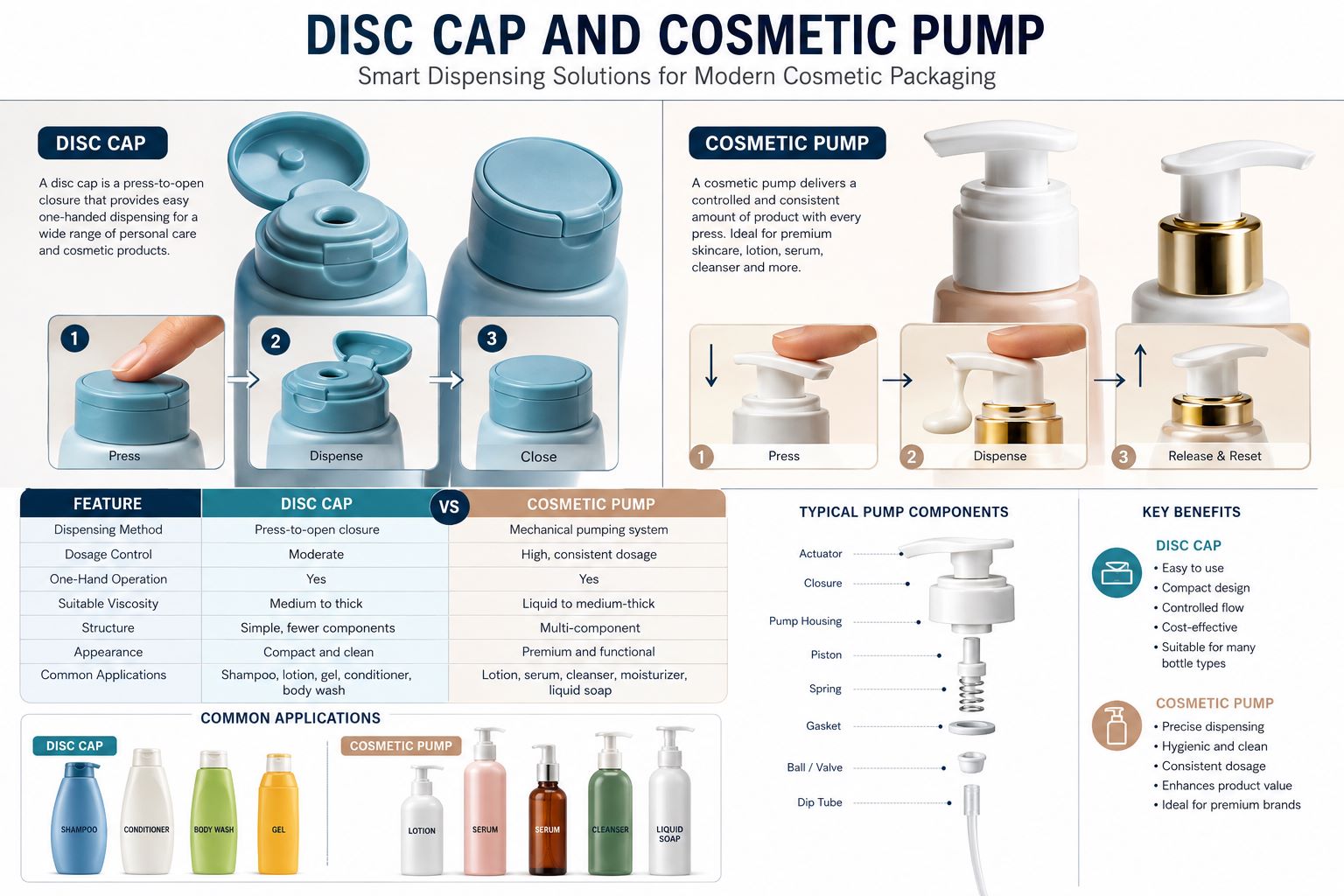
Understanding how a disc cap differs from a cosmetic pump can help skincare brands, cosmetic manufacturers, contract fillers, and packaging buyers select a dispensing system that supports both product performance and brand positioning.
What Is a Disc Cap?
A disc cap, often called a disc-top closure, is a dispensing closure commonly fitted to plastic bottles. The top contains a movable disc. When one side is pressed, the opposite side rises and reveals a dispensing opening. After use, pressing the raised portion closes the package again.
Disc caps are commonly used for shampoos, conditioners, lotions, body washes, cleansers, gels, hair-care products, and other medium-viscosity formulations.
Their simple structure makes them practical for products that consumers dispense frequently. Unlike traditional screw caps, users generally do not need to remove the closure completely.
Important benefits include:
- Convenient one-handed operation
- Controlled product dispensing
- Clean and compact appearance
- Compatibility with many bottle designs
- Suitable construction for mass-market packaging
- Easy opening and closing during everyday use
The cap can also be produced in different colours, finishes, neck sizes, and styles to complement a brand’s visual identity.
What Is a Cosmetic Pump?
A cosmetic pump is a dispensing mechanism designed to deliver a measured or reasonably controlled amount of product when the actuator is pressed. Pumps are commonly found on moisturisers, serums, liquid soaps, lotions, foundations, cleansers, hair treatments, and premium personal-care products.
A typical pump incorporates several interacting components, including an actuator, closure, stem, internal pumping mechanism, dip tube, and associated sealing elements. When pressed, the mechanism draws formula from the container and dispenses it through the outlet.
For consumers, the main advantage is convenient dispensing without repeatedly opening the bottle. This can help minimise unnecessary direct contact with the bulk formula during normal use.
Disc Cap vs Cosmetic Pump
Choosing between the two depends on formulation viscosity, expected dosage, bottle construction, consumer behaviour, positioning, and cost.
| Feature | Disc Cap | Cosmetic Pump |
| Dispensing method | Press cap and squeeze bottle | Press actuator |
| Dosage control | Moderate | Generally more controlled |
| Packaging complexity | Simple | More complex |
| User convenience | High | Very high |
| Common products | Shampoo, gel, conditioner | Lotion, serum, cleanser |
| Premium appearance | Moderate to high | High |
| Bottle requirement | Usually squeezable | Rigid or semi-rigid options |
Neither solution is universally better. The right component is the one that performs reliably with the intended formulation and container.
Why Disc Caps Remain Popular
The popularity of the disc cap comes from its balance of functionality, visual simplicity, and economical packaging design.
For shampoos or body lotions, consumers often want to dispense variable quantities rather than an identical dose every time. A disc-top closure works particularly well because the user can squeeze the bottle according to individual requirements.
Disc caps can also support streamlined packaging designs. Brands can match closure colours with bottles, labels, or product variants to create a coordinated appearance.
Manufacturers should nevertheless test the complete package. Formula thickness, bottle flexibility, dispensing-orifice dimensions, closure fit, transportation conditions, and repeated opening cycles can influence performance.
Why Cosmetic Pumps Improve Product Experience
A cosmetic pump can provide a more refined dispensing experience, particularly for products where clean application and controlled output are important.
Instead of turning a bottle upside down or squeezing it, consumers press the actuator to obtain product. This makes pumps particularly useful for bathroom counters, dressing tables, salons, spas, hotels, and professional cosmetic environments.
Controlled dispensing may also help consumers avoid using excessive product. However, output varies by pump design, so brands requiring a specific dose should verify actual pump output through supplier specifications and compatibility testing.
Choosing Packaging According to Product Viscosity
Viscosity is one of the most important factors when selecting either dispensing system.
Thin liquids may require smaller outlets and carefully selected pumps to prevent uncontrolled flow. Medium-viscosity shampoos, conditioners, gels, and lotions frequently work effectively with a disc cap. Thicker creams may require pumps specifically engineered to handle higher-viscosity formulations.
Selection should never be based on appearance alone. Testing the actual formulation with the intended bottle, closure, pump, and dip-tube configuration provides much more reliable information.
Important Factors Before Buying Disc Caps or Cosmetic Pumps
Packaging buyers should assess the complete packaging system rather than purchasing components independently. Important considerations include neck finish compatibility, material selection, leakage resistance, output performance, dip-tube length, formula compatibility, decoration requirements, shipping conditions, recyclability goals, and target pricing.
A practical evaluation process is:
- Identify product viscosity and formulation characteristics.
- Select suitable bottle material and neck finish.
- Shortlist compatible disc caps or pumps.
- Conduct dispensing and leakage tests.
- Evaluate transportation and storage performance.
- Confirm visual appearance and user experience.
- Complete production-scale validation before commercial launch.
This approach reduces the risk of choosing attractive packaging that performs poorly after filling.
Packaging Design and Brand Presentation
Packaging strongly affects how consumers perceive cosmetics. A minimalist disc-top bottle may communicate practicality and everyday convenience, while an elegant pump bottle can create a more premium impression.
Custom colours, metallic effects, matte finishes, glossy surfaces, printing, labelling, and coordinated bottle-and-closure designs can reinforce brand identity. However, decoration should complement functionality rather than compromise it.
For growing cosmetic companies, establishing consistent closure colours and bottle families can also make multiple products appear visually connected on retail shelves and e-commerce listings.
Sustainability Considerations
Sustainable cosmetic packaging requires evaluating the entire package instead of focusing on a single component.
A simple disc cap may contain fewer components than a conventional pump, while pumps may combine several materials depending on their construction. Brands pursuing recyclability goals should discuss material composition, component separation, recycled-content options, and locally available recycling infrastructure with packaging suppliers.
Reducing unnecessary packaging weight and selecting appropriately sized containers can also contribute to broader sustainability objectives.
Frequently Asked Questions
1. What is a disc cap used for?
It is commonly used for shampoos, conditioners, lotions, gels, cleansers, and similar personal-care formulations.
2. How does a disc cap open?
Pressing one side of the top raises the dispensing side and exposes the outlet.
3. What is a cosmetic pump?
It is a mechanical dispensing component that releases product when its actuator is pressed.
4. Are cosmetic pumps suitable for lotions?
Yes, provided the pump is compatible with the lotion’s viscosity and formulation.
5. Which is more economical?
Disc caps generally have simpler construction, although actual pricing depends on material, design, quantity, decoration, and supplier.
6. Can disc caps be customised?
Yes. Colour, finish, size, and other design elements may be customised depending on manufacturing capability.
7. Can cosmetic pumps dispense thick products?
Certain pumps can, but the formulation should be tested with the selected mechanism.
8. Which option looks more premium?
Cosmetic pumps frequently create a premium appearance, although well-designed disc caps can also support upscale packaging.
9. Are disc caps leak-proof?
Performance depends on closure design, bottle compatibility, sealing quality, and testing. No component should be assumed leak-proof without validation.
10. How do I choose the correct pump?
Consider viscosity, desired output, bottle neck finish, dip-tube length, formulation compatibility, and intended application.