Disc Cap vs Flip Top Cap: How Smart Packaging Improves Consumer Experience
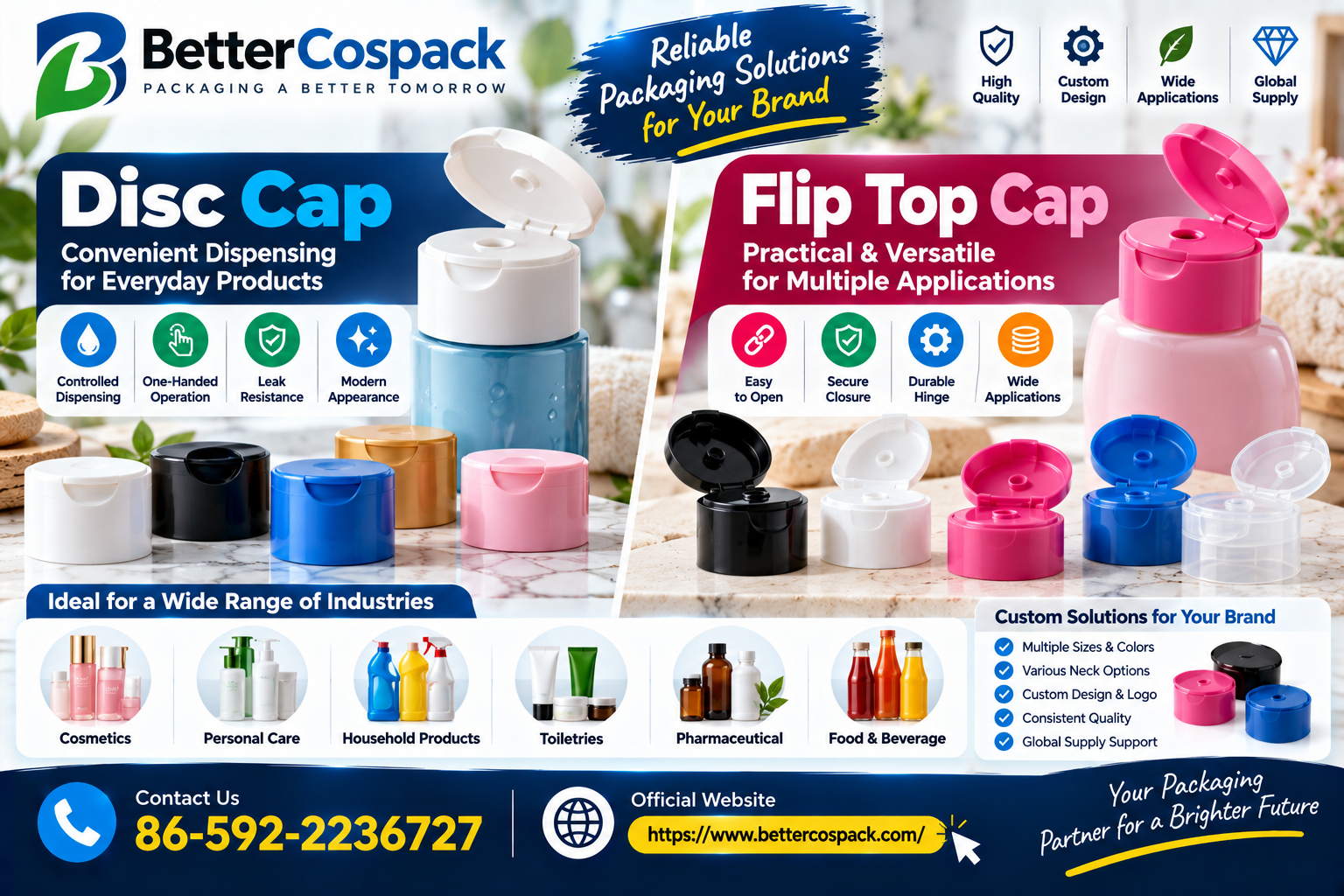
Packaging has become an important factor in how consumers evaluate personal care, cosmetic, and household products. Beyond attractive bottle designs and distinctive branding, the dispensing closure plays an essential role in product convenience, controlled application, and everyday usability.
Among the widely used dispensing solutions, the disc cap and flip top cap offer different functional advantages for liquid and semi-liquid products.
These closures may appear simple, but their design can influence dispensing accuracy, product protection, customer satisfaction, and packaging compatibility.
For cosmetic manufacturers, personal care brands, and packaging buyers, selecting the right closure requires an understanding of product viscosity, consumer behaviour, bottle compatibility, and intended application.
Why Packaging Closures Matter to Modern Consumers
Consumers interact with packaging whenever they use a product. An inconvenient closure can affect the overall experience, regardless of the quality of the formulation inside.
Dispensing caps must balance convenience with appropriate sealing and product delivery.
A shampoo bottle, body lotion container, or cosmetic cleanser may require a different closure depending on the product’s consistency and intended use.
This makes closure selection an important part of packaging development rather than a minor finishing detail.
What Is a Disc Cap?
A disc cap is a dispensing closure featuring a movable disc-shaped top that opens when pressure is applied to one side.
The opening allows compatible liquid or semi-liquid products to be dispensed from the container.
The mechanism is commonly associated with personal care packaging, including certain shampoos, lotions, and cosmetic products.
Important Characteristics
- Press-to-Open Design: The dispensing opening is exposed by pressing one side of the cap.
- Controlled Product Delivery: The opening can support convenient dispensing when matched with the formulation.
- Compact Appearance: The closure provides a streamlined packaging profile.
- Convenient Operation: Suitable designs can reduce unnecessary handling.
- Multiple Design Options: Sizes, finishes, and dispensing openings vary by manufacturer.
The closure must be evaluated with the actual product formulation and bottle design to confirm suitability.
What Is a Flip Top Cap?
A flip top cap is a dispensing closure featuring a hinged lid that opens to expose a dispensing opening.
It is commonly used for compatible personal care, cosmetic, and household products.
The hinged construction keeps the lid connected to the main closure during normal use.
This can provide a convenient packaging experience where consumers prefer a clearly visible opening and closing mechanism.
Flip top designs may also offer different dispensing orifice sizes and closure profiles.
Their suitability depends on the container, formulation, sealing system, and intended consumer application.
Disc Cap vs Flip Top Cap: Understanding the Difference
Although both closures support product dispensing, their operating mechanisms differ.
| Packaging Feature | Disc Cap | Flip Top Cap |
| Opening Mechanism | Press-operated disc | Hinged lid |
| Design Appearance | Compact, streamlined top | Visible opening lid |
| Consumer Interaction | Press to expose opening | Lift lid to expose opening |
| Common Applications | Shampoos, lotions, liquid cosmetics | Cleansers, conditioners, creams |
| Dispensing Control | Depends on orifice and formulation | Depends on orifice and formulation |
| Packaging Selection | Based on compatibility and usability | Based on compatibility and usability |
Neither closure is universally superior. The right option depends on the product’s dispensing requirements and consumer expectations.
How Product Viscosity Influences Closure Selection
Product viscosity is an important consideration when selecting dispensing packaging.
Thin liquids flow differently from thick creams, gels, and lotions.
For example, a lightweight liquid cleanser may require a different dispensing opening than a thick conditioner.
An incorrectly sized orifice can result in excessive dispensing or difficulty releasing the product.
Manufacturers should evaluate the complete packaging system rather than select a closure based only on visual appearance.
Practical compatibility testing helps determine whether the selected cap delivers an appropriate quantity with reasonable effort.
The Role of Closure Design in Brand Identity
Packaging communicates a product’s intended positioning before consumers experience its formulation.
A minimalist bottle with a coordinated closure may create a clean, contemporary appearance.
Similarly, carefully selected colours and surface finishes can support a consistent product family.
A disc cap may suit packaging concepts that prioritise a compact, integrated appearance.
A flip top cap may appeal to brands seeking a familiar hinged-opening mechanism.
However, branding should not compromise functional requirements.
A visually attractive closure must still provide suitable dispensing, sealing, and operational performance.
Why Leakage Prevention Requires Proper Testing
Leakage is a significant concern in cosmetic and personal care packaging.
A closure’s design alone cannot guarantee a leakproof container.
Leakage performance depends on the interaction between the cap, bottle neck, sealing surfaces, formulation, and handling conditions.
Manufacturers should assess relevant factors such as closure fit, container compatibility, orientation, and potential pressure changes during distribution.
Testing should also consider the intended product environment and storage conditions.
A properly evaluated packaging system can help reduce avoidable product loss and customer complaints.
Sustainability Considerations in Dispensing Closures
Sustainability discussions increasingly influence packaging development.
Brands may explore material reduction, compatible recyclable components, and alternatives using appropriately sourced recycled materials.
However, a closure should not be described as environmentally friendly based solely on its appearance or material label.
Actual recyclability depends on factors such as material composition, local collection systems, sorting capabilities, and packaging design.
For both a disc cap and a flip top cap, sustainability considerations should be balanced with product protection and functional performance.
Manufacturers can evaluate opportunities to simplify packaging components without compromising essential usability.
What Packaging Buyers Should Check Before Ordering
Selecting the correct dispensing closure requires technical and commercial evaluation.
Important considerations include:
- Bottle Neck Compatibility: Confirm dimensions and closure fit.
- Dispensing Orifice: Select an opening suitable for the formulation.
- Material Compatibility: Assess interactions between the closure material and product.
- Sealing Performance: Evaluate leakage resistance under relevant conditions.
- Consumer Usability: Consider opening effort and dispensing convenience.
- Appearance Requirements: Confirm colours, finishes, and branding expectations.
Buyers should request appropriate product specifications and samples before committing to large production quantities.
How Packaging Innovation Supports Product Differentiation
A well-designed closure can help a cosmetic product stand out without requiring a completely new bottle structure.
Improvements in opening mechanisms, ergonomic design, dispensing accuracy, and material selection can contribute to a more satisfying consumer experience.
For packaging developers, innovation should focus on solving practical problems.
These may include reducing accidental dispensing, improving handling, or supporting compatibility with particular formulations.
The strongest packaging solutions combine appearance, engineering, and practical functionality.
Frequently Asked Questions (FAQs)
1. What is a disc cap used for?
A disc cap is used to dispense compatible liquid or semi-liquid products, including certain shampoos, lotions, and cosmetic formulations.
2. What is the main advantage of a flip top cap?
Its hinged lid offers a familiar opening and closing mechanism while keeping the lid attached to the closure.
3. Which closure is better for cosmetic packaging?
The better option depends on the formulation, bottle design, dispensing requirements, consumer preferences, and compatibility testing.
4. Can disc caps and flip top caps prevent leakage?
They can contribute to effective sealing when correctly designed and matched with the container, but leak resistance must be verified through appropriate testing.
5. Are dispensing caps available in different colours and sizes?
Yes. Manufacturers may offer various dimensions, colours, materials, and finishes depending on their product range and customisation capabilities.
Media Contact
Department: Cosmetic Packaging and Product Enquiries
Company Information: Available through official company communication channels.
Email: info@bettercospack.com
Contact: 86-592-2236727
Official Website: https://www.bettercospack.com/