FIBC Unloader and Vibrating Fluid Bed Dryer: Building More Efficient Powder Processing Lines
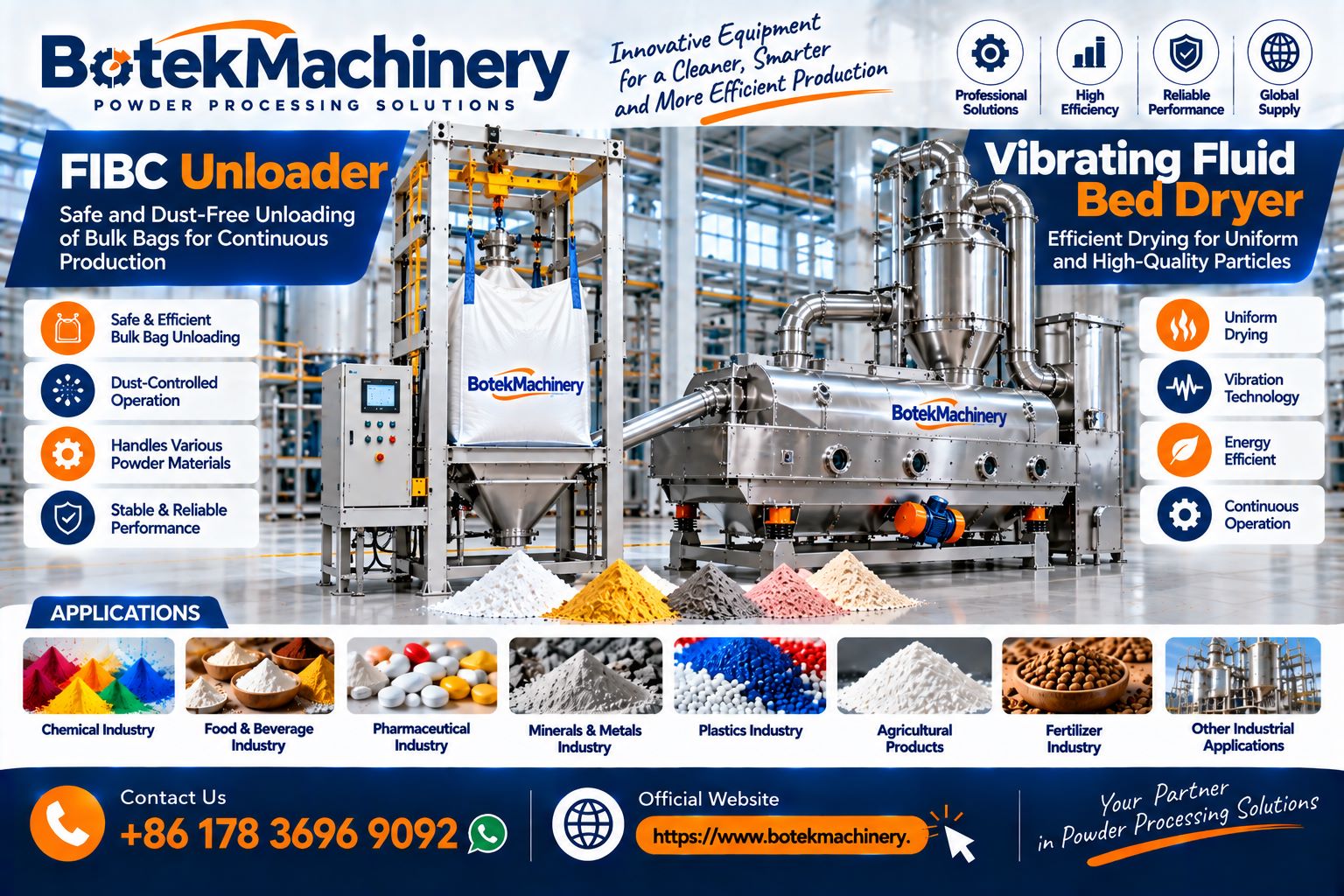
Industrial manufacturers are placing greater emphasis on cleaner powder handling, consistent product quality, reduced manual intervention, and efficient moisture control. Two technologies that support these objectives are the FIBC unloader and vibrating fluid bed dryer. Although they perform very different functions, both can become important parts of an integrated production line for chemicals, food ingredients, pharmaceuticals, minerals, agricultural materials, plastics, and specialty powders.
An FIBC unloading system helps transfer material from flexible intermediate bulk containers into downstream processing equipment in a controlled manner. A vibrating fluid bed dryer then uses heated airflow and mechanical vibration to reduce moisture while moving particulate material steadily through the drying chamber.
What Is an FIBC Unloader?
An FIBC unloader is equipment designed to safely discharge powders, granules, or other bulk solids from flexible intermediate bulk containers, often called big bags, bulk bags, or jumbo bags.
A typical unloading system may include:
- Structural support frame
- Bag lifting arrangement
- Bag-spout connection
- Discharge hopper
- Flow-assistance equipment
- Dust extraction
- Downstream feeder
- Safety and control systems
Its main purpose is to provide a controlled transition from bulk storage into the manufacturing process.
Why FIBC Unloading Matters
Manual handling of large bulk bags can create several operational challenges.
These may include:
- Dust release
- Product spillage
- Irregular material flow
- Difficult bag positioning
- Operator exposure
- Excessive manual intervention
A well-designed FIBC unloader can help manufacturers create a more contained and repeatable material-handling process.
This is especially useful when processing fine powders or products where contamination and housekeeping are important concerns.
Handling Difficult-Flowing Materials
Not every powder flows easily from a bulk bag.
Some materials may compact during transportation or storage, creating problems such as:
- Bridging
- Rat-holing
- Agglomeration
- Slow discharge
- Inconsistent feeding
An FIBC unloader may incorporate flow-assistance features such as vibration, bag massage systems, mechanical agitation, or carefully designed hoppers.
The correct method should be selected according to the material because excessive vibration can sometimes increase compaction rather than improve flow.
Dust Control During Bulk Bag Discharge
Dust management is one of the most important considerations when handling fine powders.
A contained unloading system may include:
- Sealed bag connections
- Local dust extraction
- Enclosed hoppers
- Negative-pressure operation
- Filters
These features can support cleaner working areas and reduce unnecessary material loss.
For potentially combustible or hazardous powders, appropriate engineering and process-safety assessments remain essential.
What Is a Vibrating Fluid Bed Dryer?
A vibrating fluid bed dryer is industrial drying equipment that combines upward airflow with controlled vibration to remove moisture from particulate materials.
The material is normally introduced onto a perforated deck.
Heated air passes upward through the product bed, while vibration helps move the material steadily from the inlet toward the discharge end.
Typical materials may include:
- Powders
- Granules
- Crystals
- Food ingredients
- Chemical products
- Minerals
- Pharmaceutical granules
- Agricultural materials
The exact machine configuration depends on product characteristics and drying requirements.
How a Vibrating Fluid Bed Dryer Works
A typical drying process can involve several stages.
First, wet or moisture-containing material enters the drying chamber.
Conditioned air passes through the perforated deck and contacts the particles.
The combined airflow and vibration help create movement through the equipment.
As the product travels through the dryer:
- Heated air transfers energy to the material.
- Moisture evaporates.
- Air carries the moisture away.
- Vibration supports product movement.
- Dried material exits for downstream processing.
The drying result depends on temperature, airflow, residence time, vibration, feed rate, and product properties.
Why Vibration Is Useful
Some materials are difficult to fluidize using airflow alone.
Mechanical vibration can help move particles and maintain a more stable product bed.
Potential benefits of a vibrating fluid bed dryer include:
- Controlled material movement
- More uniform product exposure
- Consistent residence time
- Reduced stagnant zones
- Better handling of selected difficult materials
- Continuous operation
This can make the equipment suitable for a broad range of particulate products.
Moisture Control and Product Quality
Moisture content can significantly influence product quality.
Excess moisture may contribute to:
- Caking
- Reduced flowability
- Storage instability
- Packaging problems
- Microbial concerns in some products
- Downstream processing issues
Over-drying can also create problems by wasting energy or affecting product characteristics.
For this reason, manufacturers should define clear inlet and target moisture levels before selecting dryer conditions.
Integrating an FIBC Unloader with a Fluid Bed Dryer
A practical production line can use the FIBC unloader as the upstream handling stage before drying.
A simplified process may look like:
Bulk Bag → FIBC Unloading → Controlled Feeding → Drying → Cooling → Product Collection
This arrangement can reduce manual material transfers and provide a more stable feed into the dryer.
Stable feeding is important because major fluctuations in product flow can affect drying consistency.
Why Controlled Feeding Matters
A vibrating fluid bed dryer generally performs best when material enters at a predictable rate.
Inconsistent feeding can lead to:
- Uneven residence time
- Variable final moisture
- Reduced capacity
- Energy inefficiency
- Unstable operating conditions
For this reason, the FIBC discharge system may be paired with equipment such as:
- Screw feeders
- Rotary valves
- Vibratory feeders
- Loss-in-weight systems
- Intermediate hoppers
The correct feeder depends on material behaviour and required capacity.
Cooling After Drying
Some products leave the dryer at an elevated temperature.
If they are transferred immediately into storage or packaging, residual heat can create problems.
A cooling stage may help reduce:
- Condensation
- Caking
- Packaging instability
- Heat-related product changes
Some processing systems incorporate drying and cooling zones, while others use separate cooling equipment.
Hygiene and Cleaning Requirements
Food, pharmaceutical, and specialty chemical applications may require higher standards of cleanliness.
Important design features can include:
- Smooth product-contact surfaces
- Accessible internal areas
- Reduced dead zones
- Easy-to-clean components
- Sealed transfer connections
- Suitable construction materials
Both the FIBC unloader and vibrating fluid bed dryer should fit into the facility’s cleaning and contamination-control procedures.
Automation and Process Monitoring
Modern powder-processing systems increasingly use automated controls.
Operators may monitor:
- Feed rate
- Hopper level
- Dryer temperature
- Airflow
- Pressure
- Product moisture
- Vibration settings
- Discharge rate
Automation can help maintain consistent operating conditions and reduce unnecessary manual adjustments.
Frequently Asked Questions
What is an FIBC unloader?
An FIBC unloader is a bulk-material handling system used to discharge powders or granules from flexible intermediate bulk containers into downstream equipment.
What is a vibrating fluid bed dryer?
A vibrating fluid bed dryer is industrial equipment that uses heated airflow and controlled vibration to dry and move particulate materials.
Why use an FIBC unloading system?
It can support safer handling, cleaner discharge, reduced dust, and more consistent material flow.
What materials can be handled?
Depending on equipment design, applications may include chemicals, food ingredients, minerals, pharmaceuticals, fertilizers, plastics, and other powders or granules.
Why is vibration used in fluid bed drying?
Vibration helps transport the product and can improve handling of materials that are difficult to fluidize using airflow alone.
Can an FIBC unloader feed directly into a dryer?
Yes, although a controlled feeder is often placed between the unloading station and dryer to stabilize feed rate.
How can dust be controlled during unloading?
Sealed connections, extraction systems, enclosed hoppers, and suitable filtration can help reduce dust release.
What affects drying performance?
Important factors include inlet moisture, feed rate, airflow, temperature, residence time, vibration, and particle characteristics.
Is cooling required after drying?
It depends on the product and downstream process. Some materials benefit from cooling before storage or packaging.
What information should buyers provide when selecting equipment?
Useful information includes material type, bulk density, particle size, inlet moisture, target moisture, required capacity, bag dimensions, dust behaviour, and cleaning requirements.
Media Contact
Sales & Media Enquiries
Contact: +86 178 3696 9092
Official Website: https://www.botekmachinery.