Hydraulic Hose and Frac Hose: Essential Components for Reliable Industrial Fluid Transfer
Industrial equipment depends on the controlled movement of fluids to generate power, operate machinery and support complex production processes. In construction, mining, manufacturing, agriculture and oilfield operations, hoses must perform under pressure while dealing with vibration, movement, temperature changes and challenging working environments.
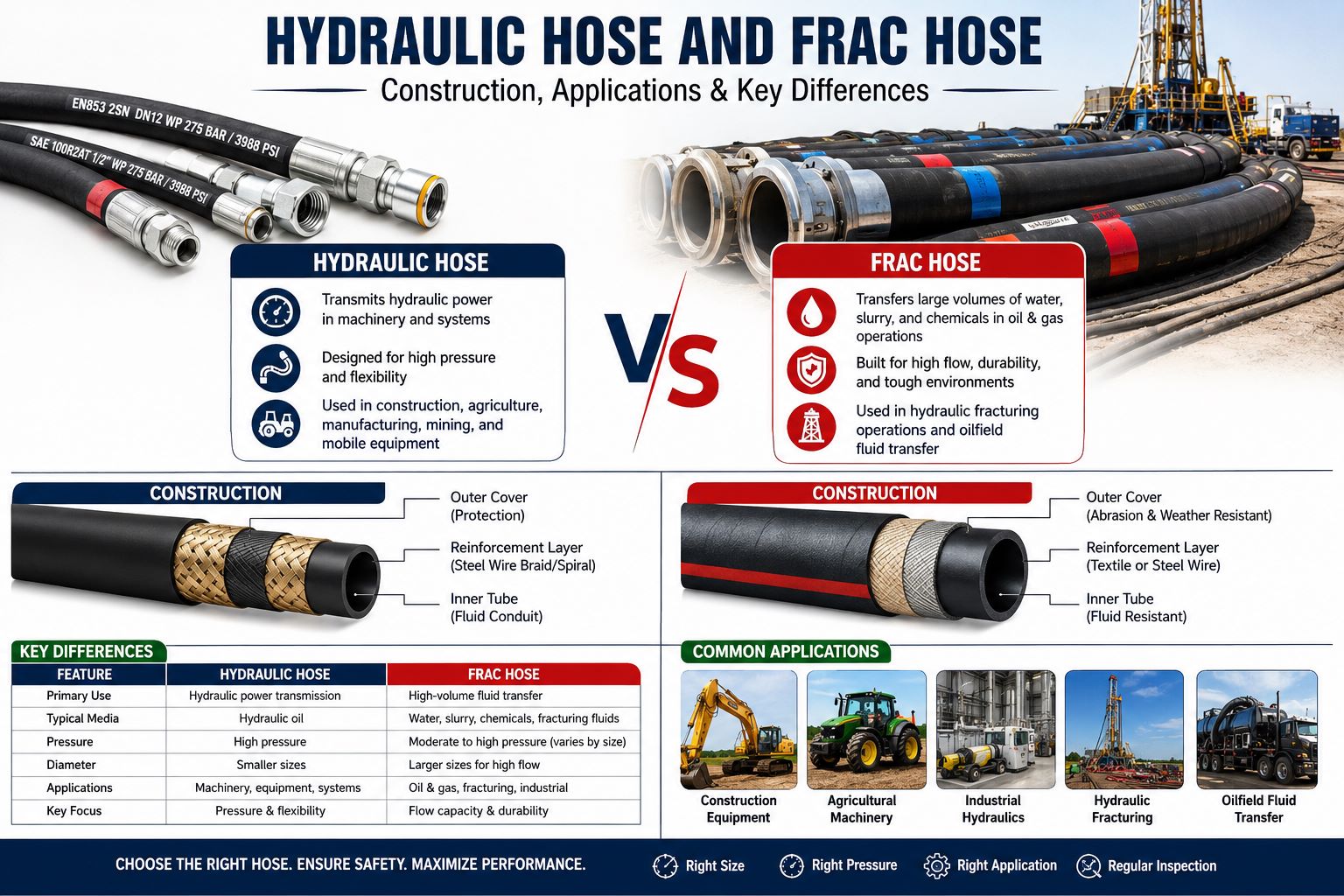
Two important solutions are the Hydraulic Hose and frac hose. Although both are used for fluid transfer, their applications and performance requirements are different. A hydraulic hose is primarily designed to carry pressurised hydraulic fluid within machinery, whereas a frac hose is commonly associated with fluid-transfer operations at hydraulic fracturing and oilfield sites.
Understanding their construction, applications, performance factors and maintenance requirements helps users select a hose based on technical suitability rather than price or appearance alone.
Understanding the Function of Hydraulic Hose
A Hydraulic Hose is a flexible reinforced conduit that transports hydraulic fluid between components within a hydraulic system. The fluid carries energy generated by a hydraulic pump and delivers it to valves, cylinders, motors and other actuators.
This allows hydraulic equipment to perform operations such as lifting, pushing, pulling, rotating and clamping.
Common applications include:
- Excavators
- Wheel loaders
- Cranes
- Forklifts
- Agricultural machinery
- Mining equipment
- Industrial presses
- Material-handling systems
- Manufacturing machinery
Unlike rigid pipes, hydraulic hoses can accommodate equipment movement and vibration. This flexibility is especially important on mobile machinery where components continuously change position during operation.
How a Hydraulic Hose Is Constructed
The performance of a hydraulic hose depends on several engineered layers working together.
The inner tube carries the hydraulic fluid. Its material must be compatible with the specific fluid and operating temperature.
The reinforcement layer provides strength against internal pressure. Depending on application requirements, reinforcement may consist of textile braid, steel-wire braid or spiral steel wire.
Finally, the outer cover protects the reinforcement against abrasion, oil, weather, moisture and mechanical damage.
The combination of these layers determines pressure capability, flexibility, durability and suitability for different working environments.
What Is a Frac Hose?
A frac hose is designed for specialised fluid-transfer applications commonly found in hydraulic fracturing and related oilfield operations.
Hydraulic fracturing sites can require large volumes of water and prepared fluids to move between storage tanks, blending systems, pumping equipment and other wellsite infrastructure.
Depending on its construction and manufacturer’s specification, a frac hose may handle:
- Water
- Fracturing fluids
- Chemical mixtures
- Slurry
- Compatible oilfield fluids
Because oilfield applications vary significantly, a hose suitable for one transfer operation should not automatically be assumed suitable for another.
Why Frac Hose Requires Application-Specific Engineering
Oilfield environments can place considerable mechanical and environmental demands on hoses.
A frac hose may be exposed to abrasive ground surfaces, mud, dust, direct sunlight, repeated movement and changing temperatures. The media travelling through the hose may also contain chemicals or suspended abrasive materials.
As a result, important performance characteristics can include:
- Abrasion-resistant outer cover
- Suitable internal lining
- Strong reinforcement
- High-volume flow capability
- Appropriate pressure rating
- Chemical compatibility
- Reliable coupling systems
The precise combination required depends on how and where the hose will be used.
Difference Between Hydraulic Hose and Frac Hose
Although both products transfer fluids, they perform different roles.
| Feature | Hydraulic Hose | Frac Hose |
| Primary function | Hydraulic power transmission | Oilfield fluid transfer |
| Common applications | Machinery and equipment | Hydraulic fracturing sites |
| Typical media | Hydraulic oil and compatible fluids | Water, slurry and frac fluids |
| Flow requirement | Based on hydraulic circuit | Often high-volume |
| Main environment | Industrial and mobile equipment | Outdoor oilfield operations |
| Key considerations | Pressure, flexibility and temperature | Flow, abrasion and media compatibility |
Understanding these differences is essential because hoses should not be considered interchangeable solely because their dimensions appear similar.
Why Working Pressure Is a Critical Specification
Every Hydraulic Hose is designed to operate within specified pressure conditions.
The selected hose should meet the working requirements of the hydraulic circuit. Equipment may also experience pressure pulsations during operation, which should be considered when specifying the complete assembly.
It is important to distinguish working pressure from burst pressure.
Working pressure represents the intended operating capability defined for the hose. Burst pressure relates to destructive testing and should never be used as the normal operating limit.
Selecting an unsuitable hose can increase the possibility of:
- Fluid leakage
- Hose deformation
- Reinforcement deterioration
- Connection problems
- Unexpected downtime
Pressure requirements are equally important when choosing a frac hose for demanding transfer applications.
The Relationship Between Hose Diameter and Fluid Flow
Internal diameter has a direct influence on fluid velocity and pressure loss.
When a Hydraulic Hose is undersized, fluid must move faster to achieve the required flow. Excessive velocity can increase pressure losses and may contribute to heat generation.
The same issue becomes particularly important with a frac hose, where large fluid volumes may need to be transferred efficiently.
Proper sizing should consider:
- Required flow rate
- Internal hose diameter
- Hose length
- Fluid characteristics
- Operating pressure
- Acceptable pressure drop
Hose size should therefore be determined by system requirements rather than connection size alone.
Fluid Compatibility and Hose Material Selection
Not every hose compound is suitable for every fluid.
The inner tube remains in continuous contact with the transferred media. Chemical incompatibility may cause the tube material to swell, soften, harden or crack.
When choosing a Hydraulic Hose, users should identify the exact hydraulic fluid being used.
For a frac hose, the complete composition of the transferred media should be considered, particularly when chemical additives or abrasive solids are involved.
Manufacturer compatibility information should always be checked where specialised fluids are used.
How Temperature Affects Hose Performance
Both fluid temperature and ambient temperature can influence hose durability.
A hydraulic hose installed near an engine, exhaust system or industrial heat source may experience substantial external temperature even when the fluid remains within its normal range.
Similarly, a frac hose used outdoors can encounter considerable environmental temperature variation.
Operating outside the recommended temperature limits can accelerate material deterioration.
Where excessive external heat cannot be avoided, suitable routing or protective measures may be required.
Importance of Correct Hose Routing
Even a correctly specified Hydraulic Hose can experience premature deterioration when installed incorrectly.
Common installation problems include:
- Excessive twisting
- Sharp bending
- Stretching
- Continuous rubbing
- Contact with sharp edges
- Crushing
- Exposure to unnecessary heat
Every hose has a specified minimum bend radius. Bending below this recommendation can place additional stress on the hose structure.
Proper routing allows the hose to accommodate machine movement naturally without unnecessary tension.
Why Fittings Matter to Hose Reliability
A hose should be treated as part of a complete assembly.
Fittings need to match the hose construction, dimensions, working pressure and equipment connection.
For crimped Hydraulic Hose assemblies, correct fitting selection and crimp dimensions are particularly important.
A similar approach applies to frac hose connections. Couplings should be suitable for the pressure, media and operating environment.
A high-quality hose combined with an unsuitable connection does not create a properly specified assembly.
Common Reasons for Premature Hose Deterioration
Industrial hoses can deteriorate for numerous reasons.
Some of the most common include:
- Incorrect pressure selection
- Excessive abrasion
- High operating temperature
- Incompatible fluids
- Tight bend radius
- Poor routing
- Incorrect fittings
- External mechanical damage
- Natural material ageing
When a hose repeatedly fails in the same location, maintenance teams should investigate the underlying cause rather than simply installing another identical replacement.
Inspection and Preventive Maintenance
Regular inspection can help identify developing problems before complete hose failure occurs.
Operators should check for:
- Cracks
- Cuts
- Blisters
- Leakage
- Exposed reinforcement
- Severe abrasion
- Kinks
- Damaged fittings
- Corrosion
- Unusual deformation
Inspection intervals should reflect the severity of the application, manufacturer guidance and applicable maintenance requirements.
High-pressure hydraulic leaks should always be handled using appropriate safety procedures.
How to Select the Right Hydraulic Hose
A reliable selection process should consider the complete operating environment.
Before purchasing, identify:
Size: Determine the correct internal diameter and length.
Temperature: Check fluid and ambient temperatures.
Application: Understand movement, vibration and abrasion.
Media: Identify the exact hydraulic fluid.
Pressure: Determine system working requirements.
Connections: Specify the required fitting type.
These factors provide a more reliable basis for hose selection than pressure rating alone.
Selecting the Correct Frac Hose
Frac applications require additional consideration of field conditions and transfer volume.
Buyers should establish:
- Fluid type
- Presence of abrasive materials
- Required flow rate
- Internal diameter
- Working pressure
- Temperature
- Hose length
- Coupling type
- External abrasion exposure
- Frequency of movement
Providing detailed application information helps suppliers recommend an appropriate frac hose for the intended service.
Frequently Asked Questions
1. What is a Hydraulic Hose?
A Hydraulic Hose is a reinforced flexible conduit used to transport pressurised hydraulic fluid through machinery and hydraulic systems.
2. What is a frac hose used for?
It is commonly used for specialised fluid transfer during hydraulic fracturing and related oilfield operations.
3. Are Hydraulic Hose and frac hose the same?
No. Their applications, construction, flow requirements and operating environments can differ significantly.
4. Why is reinforcement used in hydraulic hoses?
Reinforcement provides structural strength and enables the hose to withstand its specified internal pressure.
5. How do I select the correct hose diameter?
Consider flow rate, fluid velocity, hose length, pressure loss and overall system requirements.
6. What causes a hydraulic hose to fail?
Possible causes include abrasion, excessive heat, incorrect pressure, poor routing, incompatible fluids and improper fittings.
7. Can frac hose transfer abrasive slurry?
Certain hose designs can handle abrasive media, but suitability should be verified for the specific application.
8. What is the minimum bend radius?
It is the smallest recommended radius at which a hose can bend without placing excessive stress on its structure.
9. Is burst pressure the same as working pressure?
No. Burst pressure is associated with destructive testing, whereas working pressure relates to intended operating conditions.
10. Why is fluid compatibility important?
An incompatible fluid can damage the hose’s inner tube and contribute to premature deterioration.
Read more – https://newsgrow.blogspot.com/2026/08/hydraulic-hose-manufacturer-and.html
https://newsgrow.blogspot.com/2026/08/hydraulic-hose-and-frac-hose-deep.html