Moving Walkway and Elevator Parts: A Deep Guide to Modern Mobility Systems
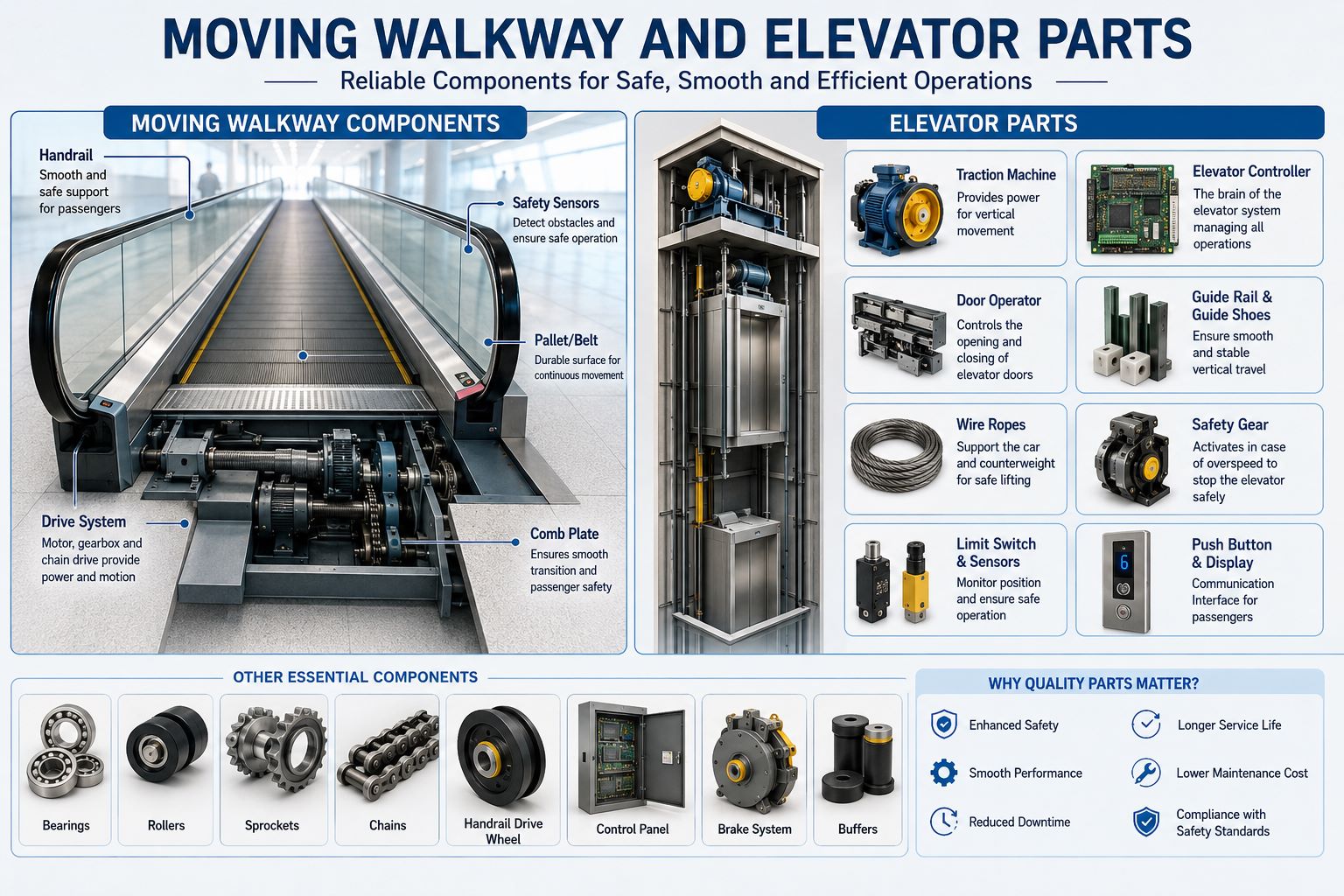
Modern buildings, airports, shopping centres, hospitals, metro stations, hotels, and commercial complexes depend on reliable mobility systems to move people safely and efficiently. Among the most important technologies are moving walkway systems and high-quality elevator parts. Although these systems perform different functions, both rely on carefully engineered mechanical, electrical, and safety components working together continuously.
Understanding how a moving walkway operates and how different elevator parts contribute to elevator performance is essential for building owners, facility managers, engineers, maintenance companies, and procurement professionals. Selecting compatible components, following preventive maintenance schedules, and replacing worn parts at the correct time can significantly improve safety, reliability, passenger comfort, and equipment lifespan.
What Is a Moving Walkway?
A moving walkway is a continuous passenger transportation system designed to move people horizontally or along a slight incline. It is commonly found in airports, railway stations, exhibition centres, large shopping complexes, and transportation hubs where passengers need to travel relatively long distances.
Unlike an escalator, which uses individual steps to move passengers between different floors, a moving walkway generally uses a continuous flat belt or interconnected metal pallets.
Modern systems are engineered for:
- Continuous passenger movement
- Comfortable transportation over long corridors
- Reduced walking fatigue
- Improved pedestrian traffic management
- Safe movement of passengers carrying luggage
- Efficient transportation during peak periods
The performance of a moving walkway depends heavily on the condition and quality of its drive, control, structural, and safety components.
Important Moving Walkway Components
Several interconnected parts enable the system to operate smoothly.
Drive System
The drive system provides the mechanical force required to move the belt or pallets. It generally includes an electric motor, gearbox, drive chain, sprockets, and related transmission components.
Any excessive wear in these components may lead to vibration, unusual noise, inconsistent movement, or unexpected shutdowns.
Pallets or Moving Belt
Depending on its design, a moving walkway may have metallic pallets or a reinforced continuous belt. These surfaces must provide sufficient grip while remaining comfortable for passengers and luggage carts.
Handrail System
The moving handrail normally travels at approximately the same speed as the passenger surface. Handrails, guide rollers, drive wheels, tensioning mechanisms, and handrail entry guards all require routine inspection.
Safety Sensors and Controls
Modern systems incorporate multiple safety devices capable of detecting abnormal operation. These may include speed monitoring devices, emergency stop switches, entry sensors, comb plate monitoring, and overload protection.
Their purpose is not simply operational convenience; they form an essential layer of passenger protection.
Understanding Elevator Parts
An elevator consists of hundreds of components working as one integrated transportation system. High-quality elevator parts help control movement, braking, door operation, communication, passenger safety, and system monitoring.
The exact configuration depends on whether the elevator uses traction, hydraulic, machine-room-less, or another lifting technology.
Some of the most important elevator parts include:
- Traction machines and motors
- Elevator controllers
- Door operators
- Guide rails and guide shoes
- Wire ropes or suspension belts
- Safety gears
- Braking systems
- Limit switches and sensors
- Push buttons and display units
- Cabin and landing door components
Each component has a specific responsibility, and failure of even a relatively small part can affect the entire system.
Critical Elevator Parts and Their Functions
Understanding the functions of essential components makes maintenance and replacement decisions easier.
Elevator Controller
The controller acts as the operational intelligence of the elevator. It processes passenger commands, determines travel direction, manages floor stops, communicates with sensors, and coordinates door operation.
Advanced controllers can also support destination control, fault diagnostics, energy management, and building management system integration.
Traction Machine
In traction elevators, the machine provides the power necessary to raise and lower the elevator car. Modern gearless machines are increasingly used because they can provide efficient operation, lower noise, and compact installation.
Elevator Door Operator
Door systems are among the most frequently operated elevator parts. The door operator controls opening and closing speed while coordinating cabin and landing doors.
Problems with rollers, belts, sensors, motors, or door tracks can cause delayed operation and repeated service interruptions.
Safety Gear and Governor
The overspeed governor monitors elevator movement. If the elevator exceeds predetermined safety limits, the governor can activate the safety gear, helping stop the elevator car.
These components are particularly important because they form part of the elevator’s emergency safety architecture.
Moving Walkway vs Elevator Systems
| Feature | Moving Walkway | Elevator |
| Primary movement | Horizontal or slightly inclined | Vertical |
| Passenger flow | Continuous | Batch transportation |
| Typical locations | Airports, stations, malls | Almost all multi-storey buildings |
| Main moving surface | Belt or pallets | Elevator cabin |
| Common components | Motor, pallets, handrails, chains | Motor, controller, doors, ropes |
| Maintenance focus | Continuous rotating components | Lifting, doors, controls and safety |
Both systems require professional inspection and correctly specified replacement components.
Why Component Quality Matters
The quality of a moving walkway component or replacement elevator parts directly influences operational reliability. Using unsuitable or poorly manufactured components may initially reduce procurement costs but can increase downtime, maintenance frequency, noise, vibration, and long-term expenses.
Reliable components should provide:
- Correct dimensional compatibility
- Appropriate load capacity
- Resistance to continuous operational stress
- Stable performance under repeated use
- Compliance with applicable safety requirements
- Reliable integration with existing equipment
Compatibility is particularly important. A component that appears physically similar may still have different electrical ratings, tolerances, materials, control protocols, or load specifications.
Preventive Maintenance for Longer Equipment Life
Preventive maintenance is one of the most effective ways to improve the service life of both elevator and walkway systems.
Maintenance teams should regularly inspect lubrication, drive chains, bearings, motors, braking mechanisms, door assemblies, handrails, sensors, electrical connections, controllers, and safety devices.
A practical maintenance process should include:
- Inspecting equipment for abnormal wear.
- Checking for vibration and unusual noise.
- Testing emergency and safety devices.
- Cleaning mechanical and electrical components.
- Verifying correct alignment and tension.
- Replacing worn components before failure.
- Recording inspection findings and replacement history.
A documented maintenance programme also helps technicians identify recurring faults before they develop into major operational problems.
Selecting the Right Elevator Parts Supplier
Purchasing elevator parts should involve more than comparing prices. Suppliers should understand technical specifications, equipment compatibility, component identification, and application requirements.
Before ordering, verify the manufacturer, model, component number, dimensions, electrical specifications, operating capacity, and installation requirements.
Where safety-critical components are involved, installation and testing should always be handled by qualified professionals according to applicable regulations and manufacturer requirements.
Technology and the Future of Mobility Systems
Digital technology is transforming both elevators and moving walkways. Intelligent controllers, condition-monitoring sensors, variable-frequency drives, remote diagnostics, and predictive maintenance technologies are making passenger transportation systems more efficient.
Instead of replacing components only after failure, operators can increasingly monitor temperature, vibration, motor performance, door cycles, operating hours, and fault patterns.
A modern moving walkway, for example, may reduce speed when passenger demand is low and automatically return to normal operation when users approach. Similarly, intelligent elevator systems can analyse traffic patterns and optimize car allocation.
Such technologies can potentially reduce unnecessary energy consumption while supporting proactive maintenance.
Frequently Asked Questions
1. What is the main purpose of a moving walkway?
It transports passengers continuously across long horizontal or slightly inclined distances, especially in airports and transportation facilities.
2. How is a moving walkway different from an escalator?
A walkway normally has a flat travelling surface, while an escalator uses individual steps for vertical transportation.
3. What are the most important elevator parts?
Important components include controllers, motors, brakes, doors, guide rails, suspension systems, sensors, safety gears, and operating panels.
4. How often should elevator components be inspected?
Inspection frequency should follow manufacturer recommendations, local regulations, equipment usage, age, and maintenance requirements.
5. Why do elevator doors require frequent maintenance?
Doors operate during almost every passenger journey, making their rollers, sensors, belts, tracks, and motors subject to frequent wear.
6. Can any replacement part be installed in an elevator?
No. Replacement elevator parts must match the technical, dimensional, electrical, operational, and safety requirements of the equipment.
7. What causes moving walkway vibration?
Possible causes include worn bearings, chain problems, improper tension, misalignment, damaged rollers, or issues within the drive system.
8. Are moving walkways energy efficient?
Modern systems can use efficient motors, variable-frequency drives, sensors, and standby operating modes to reduce unnecessary energy consumption.
9. What is predictive elevator maintenance?
Predictive maintenance uses operating data and condition monitoring to identify potential component problems before equipment failure occurs.
10. When should elevator parts be replaced?
Components should be replaced when inspections identify excessive wear, damage, unreliable operation, or failure to meet required specifications.
https://gosarkarijobs.com/how-escalator-companies-and-cargo-lifts-are-transforming-modern-buildings/
https://newsgrow.blogspot.com/2026/08/vertical-transportation-enters-new-era.html