Nonwoven Production Line: Complete Guide to PP Spunbond Nonwoven Machines
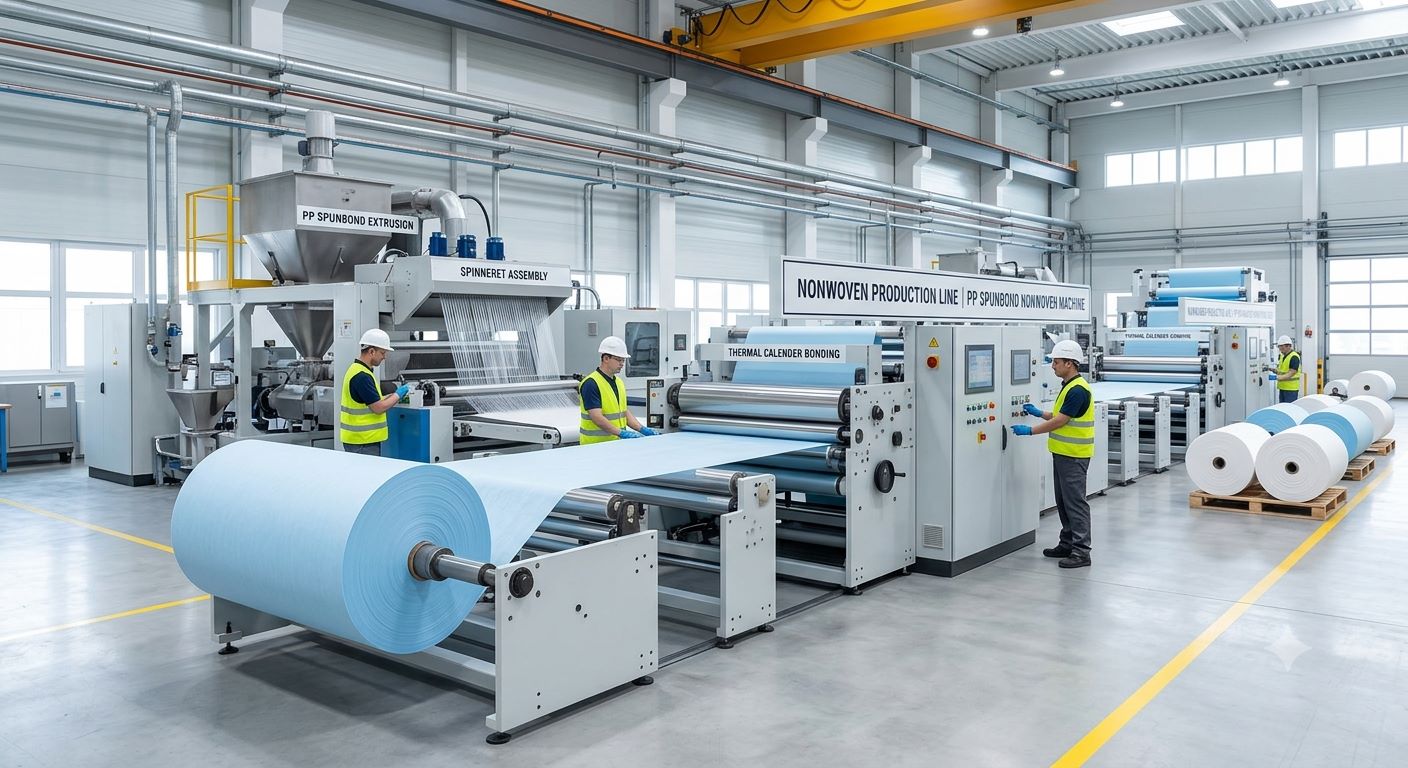
A well-designed Nonwoven Production Line is the foundation of efficient spunbond fabric manufacturing. It determines how consistently polymer is converted into fibres, how uniformly those fibres are distributed, how reliably the web is bonded, and ultimately whether the finished nonwoven fabric meets the buyer’s specifications.
For manufacturers planning to enter or expand in the nonwoven industry, choosing equipment is about more than purchasing a machine. The production technology, raw material requirements, line configuration, output expectations, fabric specifications, energy consumption, automation level and after-sales support all need to work together.
One of the most widely used technologies is the PP Spunbond Nonwoven Machine, which produces polypropylene spunbond fabrics for applications ranging from hygiene products and medical disposables to packaging, agriculture, construction and furniture.
This guide explains how a nonwoven production line works, what equipment it includes, how PP spunbond technology compares with other nonwoven processes, and what manufacturers should consider before investing.
What Is a Nonwoven Production Line?
A Nonwoven Production Line is an integrated manufacturing system used to convert polymer, fibres or other raw materials into nonwoven fabric without traditional weaving or knitting.
In a typical PP spunbond process, polypropylene resin is melted, extruded through spinnerets to form continuous filaments, stretched and laid into a web before being bonded into a finished fabric.
Unlike woven fabrics, which are produced by interlacing yarns, spunbond nonwovens form their structure directly from fibres or filaments.
A production line can include:
- Raw material feeding and dosing systems
- Extruders
- Melt filtration equipment
- Polymer conveying systems
- Spinning assemblies
- Spinnerets
- Filament drawing systems
- Web-forming equipment
- Calender or thermal bonding systems
- Fabric winding units
- Edge trimming systems
- Electrical control systems
- Automation and monitoring equipment
The exact configuration depends on the intended fabric, production capacity and manufacturer requirements.
How Does a Nonwoven Production Line Work?
The production process varies according to the technology used. In a PP spunbond line, the basic manufacturing sequence is:
Polypropylene resin → Melting → Extrusion → Filament formation → Drawing → Web formation → Thermal bonding → Winding → Finished nonwoven fabric
1. Raw Material Feeding
Polypropylene resin is introduced into the production system through a controlled feeding mechanism.
Depending on the required fabric specification, manufacturers may also use approved additives, masterbatch or other compatible materials.
Consistent raw-material feeding is important because fluctuations can affect melt behaviour and fabric uniformity.
2. Polymer Melting and Extrusion
The polypropylene is heated inside the extruder until it reaches the appropriate molten state.
The extruder then pushes the polymer through the melt-filtration system and towards the spinning assembly.
Temperature control is particularly important at this stage. Poor control can contribute to unstable extrusion, inconsistent filament formation and production interruptions.
3. Filament Formation
The molten polymer passes through spinneret holes to form continuous filaments.
The spinneret design, polymer conditions and process settings influence filament characteristics such as diameter and distribution.
4. Drawing and Cooling
The newly formed filaments are cooled and stretched using controlled air or drawing systems.
This stage helps develop the required filament properties before the fibres are deposited onto the forming surface.
5. Web Formation
The filaments are distributed across a moving surface to create a continuous fibre web.
Uniform web formation is essential for achieving consistent basis weight and fabric properties across the production width.
6. Thermal Bonding
In many PP spunbond systems, the web passes through heated calender rollers.
Heat and pressure bond selected points within the web, giving the fabric mechanical integrity while maintaining its nonwoven structure.
Bonding patterns can also influence appearance, strength, softness and other characteristics.
7. Winding and Slitting
The finished fabric is wound into rolls.
Depending on customer requirements, the material may then be slit into narrower widths or sent for additional processes such as printing, lamination, coating or cutting.
What Is a PP Spunbond Nonwoven Machine?
A PP Spunbond Nonwoven Machine is equipment designed to manufacture spunbond nonwoven fabric using polypropylene as the primary polymer.
The machine transforms polypropylene resin into continuous filaments and then bonds those filaments into a fabric web.
PP spunbond technology is popular because polypropylene can provide a useful combination of:
- Low density
- Chemical resistance
- Moisture resistance
- Processability
- Strength-to-weight performance
- Versatility in converting applications
The actual performance of the finished material depends on polymer characteristics, line design, processing parameters, fabric weight, bonding configuration and downstream converting.
Where Is PP Spunbond Nonwoven Fabric Used?
PP spunbond fabric has a broad range of applications.
Hygiene Products
Spunbond nonwoven materials can be used in components of:
- Disposable hygiene products
- Baby care products
- Adult care products
- Feminine hygiene products
Specific applications depend on the required softness, strength, liquid-management system and product design.
Medical and Healthcare Products
Nonwoven fabrics are used in various disposable healthcare products, including:
- Surgical gowns
- Protective apparel
- Caps
- Shoe covers
- Medical packaging components
- Disposable covers
Where a fabric is intended for a regulated medical application, manufacturers must consider applicable quality, safety and regulatory requirements rather than relying solely on the machine specification.
Agriculture
Agricultural applications include:
- Crop covers
- Plant protection fabrics
- Nursery materials
- Weed-control products
- Horticultural textiles
The appropriate fabric specification depends on factors such as light transmission, air permeability, strength and environmental exposure.
Packaging and Shopping Bags
Spunbond materials can be converted into reusable or promotional bags and other packaging products.
Printing, lamination, cutting and ultrasonic or heat-sealing processes may be integrated downstream depending on the final product.
Construction
Nonwoven fabrics can be incorporated into certain construction and civil-engineering products, including applications requiring separation, protection or filtration characteristics.
Furniture and Home Furnishings
The material can also be used in:
- Mattress components
- Furniture backing
- Upholstery-related applications
- Protective covers
- Household products
Key Components of a PP Spunbond Production Line
Before purchasing equipment, manufacturers should understand the role of the major components.
Extruder
The extruder melts and transports polypropylene under controlled conditions.
Important considerations include screw design, heating control, throughput requirements and compatibility with the intended raw material.
Melt Filter
The filtration system removes unwanted contaminants from the polymer melt.
A stable filtration system helps protect downstream spinning components and supports consistent processing.
Spinning System
This is one of the most technically important sections of the line.
It controls the conversion of molten polymer into continuous filaments through spinnerets and associated components.
Drawing System
The drawing or stretching section influences filament formation and helps achieve the desired fibre characteristics.
Web Former
The web-forming system distributes filaments over the production width.
Poor distribution can result in basis-weight variation and inconsistent fabric properties.
Calender
The calender bonds the web using controlled heat and pressure.
Bonding conditions and pattern selection should be matched to the intended end application.
Winder
The winding system converts continuous production into manageable fabric rolls.
Accurate tension control is important for producing stable rolls suitable for downstream conversion.
Control System
Modern production lines typically use automated controls to monitor and adjust operating parameters.
Depending on the equipment design, the control system may provide monitoring of:
- Temperature
- Pressure
- Line speed
- Extruder conditions
- Production parameters
- Alarm conditions
- Machine status
What Factors Should You Consider Before Buying a Nonwoven Production Line?
Choosing the cheapest machine is rarely the right starting point. A better approach is to define the finished fabric and business requirements first.
1. Production Capacity
Determine the required output based on expected orders rather than simply choosing the largest available line.
Consider:
- Required production volume
- Working hours
- Production width
- Fabric GSM range
- Expected utilisation
- Future expansion
2. Fabric Width
The required working width should match your target market.
A narrow line may be suitable for specific products, while wider equipment can support larger-scale applications.
3. Fabric GSM Range
Different applications require different fabric weights.
Ask the equipment supplier to clearly specify the achievable GSM range under defined operating conditions rather than assuming every machine can produce every specification.
4. Automation
Automation can reduce manual intervention and help operators monitor production parameters more consistently.
However, automation should be evaluated according to the operator’s skills, maintenance capabilities and production requirements.
5. Energy Consumption
Energy is a significant operating consideration in polymer-processing equipment.
When comparing machines, evaluate energy requirements alongside production capacity instead of looking only at the equipment purchase price.
6. Spare Parts and Technical Support
A production line is a long-term investment.
Before placing an order, ask:
- Which spare parts are normally stocked?
- What technical support is available?
- Is remote troubleshooting provided?
- What installation support is included?
- What operator training is provided?
- What is the expected maintenance schedule?
Reliable technical support can be particularly important when a line is installed in a new production facility.
7. Quality Control
A professional supplier should be able to discuss how the line supports fabric consistency.
Depending on the application, manufacturers may need to monitor characteristics such as:
- GSM
- Tensile strength
- Elongation
- Air permeability
- Thickness
- Appearance
- Bonding strength
The appropriate quality-control programme should be established according to the customer’s product specifications and applicable standards.
How Much Does a Nonwoven Production Line Cost?
There is no single price for a Nonwoven Production Line.
The investment can vary substantially depending on:
- Production capacity
- Machine width
- Spunbond configuration
- Automation level
- Number of beams or configurations
- Electrical and auxiliary equipment
- Installation requirements
- Factory infrastructure
- Shipping and commissioning
- Optional downstream equipment
For this reason, requesting a quotation based only on the phrase “PP spunbond machine” may not produce a meaningful comparison.
A better RFQ should include your target fabric GSM, width, raw material, required output, application, production location and desired automation level.
How to Choose the Right PP Spunbond Nonwoven Machine
A practical purchasing process can be divided into six stages.
Step 1: Define the End Product
Start with the application rather than the machine.
For example, a manufacturer producing agricultural fabric may have very different requirements from a company manufacturing disposable healthcare products.
Step 2: Establish Production Requirements
Document:
- Fabric width
- GSM range
- Target output
- Number of production hours
- Raw material
- Required fabric properties
- Expected future capacity
Step 3: Compare Technical Specifications
Compare suppliers using the same criteria.
Do not evaluate machines solely on headline production capacity. Look at the complete technical configuration and the conditions under which stated performance is achieved.
Step 4: Evaluate Supplier Experience
Ask about:
- Previous installations
- Similar production applications
- Commissioning process
- Operator training
- Technical support
- Spare-parts availability
Relevant experience is particularly valuable when the production line has specialised requirements.
Step 5: Calculate Total Cost of Ownership
The initial purchase price is only one part of the investment.
Consider:
Total ownership cost = Equipment + Installation + Energy + Maintenance + Consumables + Labour + Downtime + Spare Parts
This gives a more realistic picture of the economics of the project.
Step 6: Conduct a Technical Review Before Ordering
Before signing the final purchase agreement, review the technical specification, production assumptions, utilities, installation requirements and acceptance criteria with the supplier.
This step can prevent misunderstandings later in the project.
Common Mistakes When Buying Nonwoven Machinery
Focusing Only on Machine Price
A low initial quotation may not represent the lowest long-term cost.
A machine with better efficiency, support and reliability may offer stronger overall value.
Choosing Capacity Without Market Research
Buying more capacity than the business can utilise can increase financial pressure.
Production capacity should be linked to realistic demand and expansion plans.
Ignoring Raw Material Compatibility
The polymer and additives used in production should be compatible with the equipment and intended process.
Underestimating Factory Requirements
A nonwoven line may require appropriate electrical capacity, ventilation, cooling, compressed air and other utilities.
Factory planning should therefore happen before equipment installation.
Not Asking About After-Sales Service
Technical support should be part of the supplier evaluation, not an afterthought.
Frequently Asked Questions
What is a nonwoven production line?
A nonwoven production line is an integrated system that manufactures fabric from fibres or polymer filaments without traditional weaving or knitting. The exact process depends on the selected nonwoven technology.
What is a PP spunbond nonwoven machine used for?
A PP spunbond nonwoven machine converts polypropylene resin into continuous filaments and forms those filaments into bonded nonwoven fabric. The resulting material can be used in hygiene, healthcare, agriculture, packaging, construction and other applications.
Is PP spunbond fabric recyclable?
Polypropylene is a recyclable thermoplastic, but whether a particular finished nonwoven product can be practically recycled depends on its composition, additives, coatings, contamination and local recycling infrastructure.
What GSM can a PP spunbond machine produce?
The achievable GSM range depends on the specific production line, process configuration and operating conditions. Manufacturers should obtain a verified GSM range from the equipment supplier for the exact machine configuration being considered.
How long does a nonwoven production line last?
Service life depends on machine design, operating conditions, maintenance, component quality and production intensity. Regular preventive maintenance and timely replacement of wear components can help protect equipment performance.
What is the difference between spunbond and meltblown nonwoven fabric?
Spunbond technology generally produces continuous filaments, while meltblown technology uses a different high-velocity air process to create much finer fibres. They therefore have different structures and performance characteristics and are often selected for different applications.