RFID Parking and RFID People Tracking: Building Smarter, Safer and More Efficient Spaces
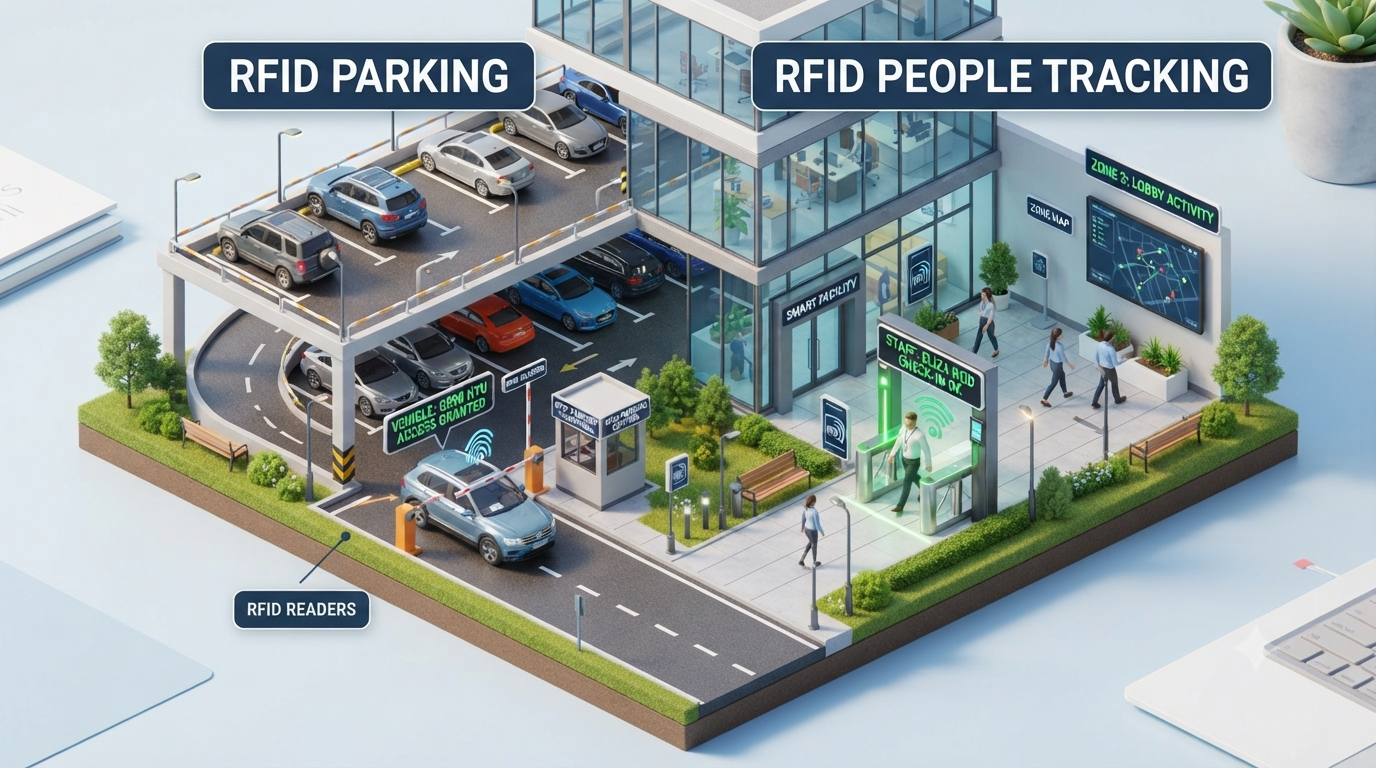
Modern facilities are becoming increasingly connected. From corporate campuses and residential complexes to hospitals, factories, universities and event venues, organisations need better ways to control vehicle access and understand how people move through physical spaces. Two technologies playing an important role in this transformation are RFID Parking and RFID People Tracking.
Radio Frequency Identification (RFID) uses tags and readers to identify objects or authorised individuals without requiring conventional manual checks. When properly implemented, RFID technology can reduce repetitive administrative work, improve access management and provide useful operational data.
Although RFID Parking focuses primarily on vehicles and RFID People Tracking focuses on individuals or tagged credentials, both systems can form part of an integrated smart facility management strategy.
What Is RFID Parking?
RFID Parking is an automated vehicle identification and parking access solution that uses RFID tags, readers, software and access-control equipment.
An authorised vehicle receives an RFID tag, usually associated with its registration number, owner, parking privileges or account. When the vehicle approaches an RFID-enabled entry point, a reader detects the tag and sends its identification information to the parking management system.
If the credentials are valid, the system can trigger the barrier or gate automatically.
A typical RFID parking solution may include:
- RFID vehicle tags
- Fixed RFID readers
- Antennas
- Automatic barriers
- Access-control software
- Parking management dashboards
- Entry and exit logs
- Integration with payment or visitor systems
This approach can make everyday parking access faster while reducing dependence on paper permits, manual registers and security personnel performing repetitive checks.
How Does RFID Parking Work?
The basic operating process is straightforward.
- A vehicle receives a registered RFID tag.
- The vehicle approaches the entrance.
- The RFID reader detects the tag within its configured reading range.
- The system checks the tag against the authorised database.
- Access is approved or denied according to predefined rules.
- The entry or exit transaction is recorded.
Depending on the implementation, administrators can assign different access permissions to employees, residents, visitors, contractors or VIP vehicles.
For example, an office campus could configure employee vehicles for regular access while issuing temporary RFID credentials to contractors.
Major Benefits of RFID Parking
One of the biggest advantages of RFID Parking is automation. Drivers may not need to stop, collect a ticket or manually show an access card when the system is designed for hands-free vehicle identification.
Other potential benefits include:
- Faster vehicle entry and exit
- Reduced queues at access points
- Automated access verification
- Better parking security
- Digital entry and exit records
- Reduced dependence on paper tickets
- Easier management of authorised vehicles
- Improved visitor parking administration
The actual performance depends on factors such as tag type, reader placement, antenna configuration, environmental conditions and software integration.
What Is RFID People Tracking?
RFID People Tracking uses RFID-enabled badges, cards, wristbands or other tags to identify and record the presence or movement of authorised individuals within designated areas.
It can be useful in workplaces, healthcare facilities, educational institutions, industrial environments, exhibitions and other managed spaces.
Importantly, RFID people tracking should be implemented transparently and responsibly. Organisations need clear policies regarding what information is collected, why it is collected, who can access it and how long records are retained.
How RFID People Tracking Works
An RFID tag is assigned to a person or credential. RFID readers installed at designated locations detect the tag when it enters an appropriate reading zone.
Depending on the technology and system architecture, RFID People Tracking may help organisations identify:
- When someone enters a controlled zone
- When someone leaves a designated area
- Which checkpoint a credential passed
- Attendance at specific locations
- Movement between authorised areas
RFID does not automatically provide precise GPS-style location information. Tracking accuracy and capabilities depend heavily on the RFID technology, reader infrastructure and system design.
Applications of RFID People Tracking
There are several legitimate operational applications for RFID-based identification and movement monitoring.
Workplace management: Employee badges can support automated attendance and controlled-area access.
Healthcare facilities: RFID credentials may assist with staff workflow management and authorised-zone monitoring.
Industrial facilities: Organisations can manage access to hazardous or restricted operational areas.
Events: RFID wristbands can support attendee identification, access validation and movement analysis.
Educational campuses: RFID cards may support attendance and controlled access where appropriate.
Any deployment involving individuals should consider privacy, security, applicable regulations and informed organisational policies.
RFID Parking vs RFID People Tracking
| Feature | RFID Parking | RFID People Tracking |
| Primary purpose | Vehicle identification | Person or credential identification |
| Common tag | Windshield/vehicle tag | Badge, card or wristband |
| Typical location | Parking entrances | Buildings and controlled zones |
| Main benefit | Automated vehicle access | Visibility and access management |
| Data generated | Vehicle entry/exit | Presence and movement records |
| Integration | Barriers and parking software | Access and workforce systems |
Despite their different applications, both solutions depend on accurate identification, appropriate reader infrastructure, reliable software and secure data management.
Choosing the Right RFID System
Before investing in either technology, organisations should evaluate their operational requirements rather than selecting hardware based only on reading distance or price.
Important considerations include:
- Required reading range
- Number of vehicles or users
- Indoor or outdoor installation
- Passive versus active RFID
- Existing access-control infrastructure
- Integration requirements
- Reporting requirements
- Data security
- Scalability
- Maintenance and technical support
A small residential parking area, for example, may require a very different RFID Parking architecture from a large industrial campus with thousands of vehicles.
Similarly, basic attendance identification requires a different RFID People Tracking configuration from zone-based movement monitoring.
Importance of Security and Privacy
RFID systems should not be treated simply as plug-and-play identification tools. Security and privacy need to be considered during system design.
Organisations should establish appropriate access permissions, secure stored information, restrict administrative privileges and maintain clear data-retention policies.
For RFID People Tracking, transparency is particularly important. Users should understand the purpose and scope of tracking where required, and organisations should collect only information necessary for legitimate operational needs.
Integrating RFID Into Smart Facilities
The greatest value can emerge when RFID solutions communicate with other facility systems.
For instance, RFID Parking may integrate with visitor management, employee databases, payment platforms or security systems. RFID People Tracking may connect with attendance management, building access control or emergency-management platforms.
Centralised integration can provide facility managers with more consistent information while reducing disconnected manual processes.
Frequently Asked Questions
1. What does RFID mean?
RFID stands for Radio Frequency Identification, a technology that uses radio waves for identification and data communication.
2. Is RFID Parking completely automatic?
It can automate many access processes when integrated correctly with readers, barriers and parking software.
3. Where are RFID parking tags installed?
Depending on the system, tags may be placed on windscreens or other suitable vehicle locations.
4. Can RFID Parking reduce queues?
Automated identification can reduce manual checking and help vehicles move through entrances more efficiently.
5. What is RFID People Tracking used for?
It can support attendance, access management, zone monitoring and operational movement analysis.
6. Does RFID People Tracking work like GPS?
Not necessarily. RFID usually identifies tags within reader coverage areas rather than continuously providing GPS coordinates.
7. Are RFID systems suitable for large facilities?
Yes, provided the infrastructure and software are designed for the required scale.
8. Can RFID integrate with existing access control?
Many solutions support integration, although compatibility should be verified before implementation.
9. Is RFID data secure?
Security depends on system architecture, configuration, authentication, encryption options and organisational practices.
10. How should businesses select an RFID solution?
Start with operational requirements, environment, desired accuracy, integrations, privacy obligations and long-term scalability.