Sheet Metal Fabrication and CNC Prototyping: A Practical Manufacturing Guide
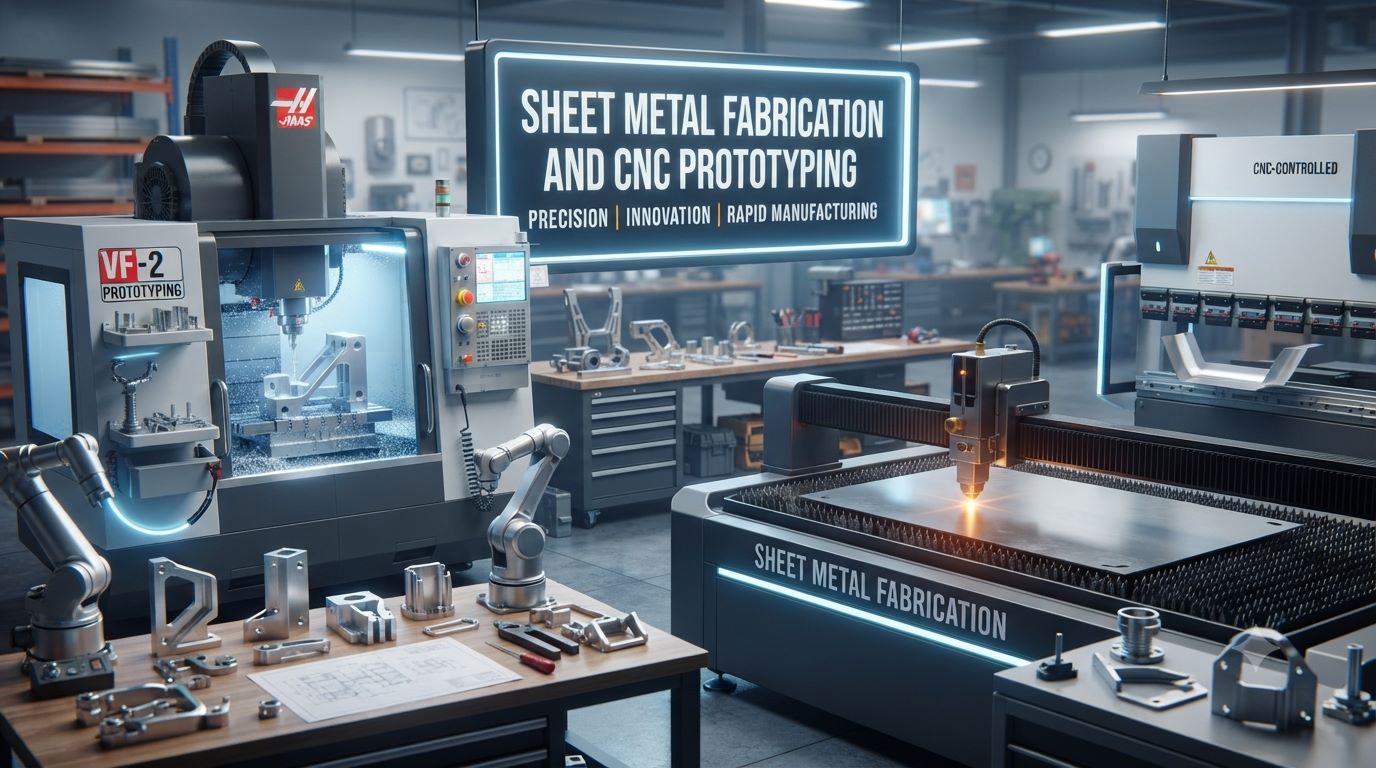
Modern product development depends on speed, accuracy, and efficient movement from concept to production. Sheet metal fabrication and CNC prototyping help engineers and manufacturers create reliable parts with precise dimensions and repeatable quality. Understanding where each process fits can reduce risk and improve overall manufacturing decisions.
What Is Sheet Metal Fabrication?
Sheet metal fabrication converts flat metal sheets into components through cutting, bending, punching, forming, welding, and finishing. Common materials include stainless steel, aluminium, mild steel, galvanised steel, copper, and brass.
It is widely used for enclosures, brackets, cabinets, panels, machine guards, automotive parts, HVAC components, and industrial housings. Modern facilities use laser cutters, press brakes, welding systems, and inspection equipment.
Common Sheet Metal Fabrication Processes
Typical operations include:
- Laser cutting for accurate profiles and complex shapes
- CNC punching for holes, slots, vents, and patterns
- Press brake bending for precise angles and folds
- Welding for joining fabricated components
- Riveting and hardware insertion for assembly
- Powder coating, plating, polishing, or anodising for protection
Fabrication design considers material thickness, bend radius, hole spacing, tolerances, finishing, and assembly before production.
What Is CNC Prototyping?
CNC prototyping uses computer-controlled machining equipment to create prototype parts from solid blocks, plates, or bars. CNC milling and turning machines remove material according to CAD and CAM instructions, producing accurate, repeatable parts.
CNC prototypes can be made from aluminium, stainless steel, engineering plastics, brass, copper, titanium, and other materials. This allows engineers to evaluate strength, fit, surface quality, and mechanical performance realistically.
Why CNC Prototyping Is Valuable
CNC machining is useful when a prototype requires:
- Tight dimensional tolerances
- Functional threads and precision holes
- Complex three-dimensional geometry
- Strong engineering materials
- Smooth machined surfaces
- Accurate mating with surrounding components
It is widely used in automotive, aerospace, robotics, electronics, medical equipment, and industrial machinery.
Sheet Metal Fabrication vs CNC Prototyping
Both technologies support product development but solve different challenges.
| Factor | Sheet Metal Fabrication | CNC Prototyping |
| Starting material | Flat metal sheet | Solid block, bar, or plate |
| Main operations | Cutting, bending, welding | Milling, drilling, turning |
| Best suited for | Enclosures, brackets, panels | Precision components |
| Material efficiency | High for thin parts | Material removed as chips |
| Complex 3D shapes | More limited | Excellent capability |
| Production scalability | Excellent | Strong for prototypes and low volumes |
The right choice depends on geometry, tolerances, quantity, budget, and function.
How Both Processes Work Together
Many products contain both fabricated and machined parts. A control system may combine a sheet metal enclosure with CNC-machined mounting blocks, shafts, or connectors.
Using both processes offers advantages:
- Complete assemblies can be tested before mass production.
- Design problems can be identified before tooling is ordered.
- Components can be modified quickly after testing.
- Production materials can be evaluated in realistic conditions.
- Final manufacturing specifications become easier to confirm.
This approach suits industrial machinery, automation equipment, electronics, transport systems, and custom engineering.
Design Tips for Better Results
Good design improves quality while reducing cost and production time.
Design for Sheet Metal Fabrication
Maintain consistent material thickness where possible. Allow enough space around holes near bends, avoid unnecessarily tight bend radii, and simplify complex welded assemblies. Consider tool access and how coatings may affect final dimensions.
Design for CNC Prototyping
Avoid extremely deep narrow cavities unless essential. Use standard drill sizes, provide practical internal corner radii, and apply tight tolerances only to critical features. Excessive precision increases time and cost.
Consider Assembly Early
Confirm fastener access, mating tolerances, cable clearance, weld locations, serviceability, and installation requirements early. Assembly-focused design prevents costly modifications.
Key Benefits for Product Development
Combining sheet metal fabrication with CNC prototyping can deliver:
- Faster transition from CAD to physical testing
- Accurate functional prototypes
- Lower risk before full production
- Flexible design changes
- Better verification of fit and assembly
- Improved material selection
- Easier custom product development
Early design-for-manufacturing feedback can reveal unnecessary complexity before it becomes costly.
Choosing the Right Manufacturing Partner
Choose a supplier with relevant material experience, modern equipment, quality control, engineering support, finishing capabilities, and communication. For accurate quotations, provide CAD files, drawings, materials, tolerances, finishes, quantities, and delivery requirements.
Frequently Asked Questions
1. What materials are used in sheet metal fabrication?
Common choices include aluminium, stainless steel, mild steel, galvanised steel, copper, and brass.
2. Is sheet metal fabrication suitable for prototypes?
Yes. It is commonly used to test enclosures, brackets, panels, guards, and assemblies before production.
3. What is the main advantage of CNC prototyping?
It produces accurate, functional parts from engineering materials without requiring dedicated production tooling.
4. How accurate is CNC prototyping?
Accuracy depends on equipment, geometry, material, and specified tolerances. Modern CNC systems can achieve high precision when requirements are defined.
5. Can CNC machines produce plastic prototypes?
Yes. Many engineering plastics can be CNC machined.
6. Is laser cutting part of sheet metal fabrication?
Yes. Laser cutting is used for accurate profiles, holes, slots, and detailed shapes.
7. Which process is better for an enclosure?
Sheet metal fabrication is usually practical and economical for enclosures, cabinets, covers, and housings.
8. Which process suits complex precision parts?
CNC prototyping is generally better for parts requiring tight tolerances, threads, pockets, channels, or precision surfaces.
9. Can both processes support low-volume production?
Yes. Both can support prototypes and low-volume manufacturing depending on geometry, material, finish, and cost targets.
10. How can manufacturing costs be reduced?
Simplify geometry, avoid unnecessary tolerances, use standard materials, minimise setups, optimise material use, and request design-for-manufacturing feedback.