Silicone Compression Molding and Low Volume Silicone Molding: A Deep Technical Guide
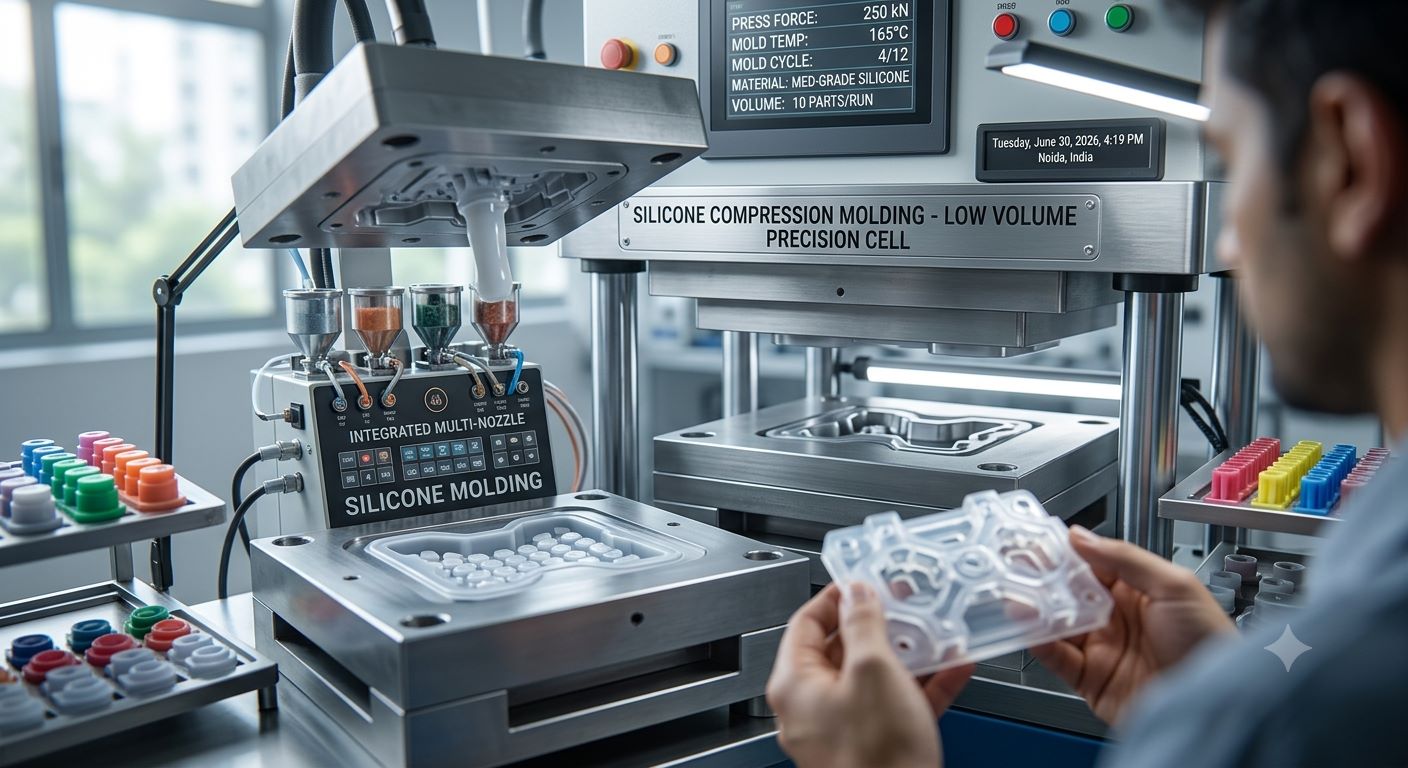
Silicone has become an essential material for industries that require flexibility, temperature resistance, durability, electrical insulation, and reliable sealing performance. From medical components and automotive seals to electronics, industrial equipment, consumer products, and specialised prototypes, silicone parts are used wherever conventional rigid plastics may not provide the required performance.
Two manufacturing approaches are particularly important for companies developing silicone products: Silicone Compression Molding and low volume silicone molding. Although both methods can produce accurate silicone components, their economics, tooling requirements, production speed, and ideal applications differ considerably.
Understanding these differences helps engineers, product designers, procurement teams, and manufacturers select a process that balances quality, production quantity, development time, and total manufacturing cost.
What Is Silicone Compression Molding?
Silicone Compression Molding is a manufacturing process in which a measured quantity of uncured silicone material is placed inside an open heated mould cavity. The mould is then closed under controlled pressure, causing the material to flow and fill the cavity.
Heat and pressure cure the silicone into its final shape. After curing, the mould opens and the finished component is removed. Any excess material, commonly called flash, may then be trimmed.
The basic process normally involves:
- Preparing and measuring the silicone compound.
- Placing the material into the heated mould.
- Closing the mould under pressure.
- Allowing the silicone to flow throughout the cavity.
- Curing the component at a controlled temperature.
- Removing, trimming, inspecting, and finishing the part.
The relatively straightforward tooling design makes compression moulding suitable for many silicone components ranging from simple seals to complex industrial parts.
Why Silicone Compression Molding Remains Important
One major advantage of Silicone Compression Molding is its ability to manufacture durable components without requiring the highly sophisticated equipment associated with some automated moulding technologies.
Manufacturers commonly use the process for:
- O-rings and sealing products
- Rubber gaskets
- Silicone keypads
- Electrical insulation components
- Medical silicone parts
- Protective covers
- Automotive seals
- Industrial diaphragms
- Consumer-product components
The method can also accommodate different silicone compounds and hardness levels depending on the application’s mechanical, thermal, chemical, or electrical requirements.
Material Behaviour During Compression
Silicone must flow evenly throughout the cavity while being compressed. Mould temperature, pressure, material quantity, curing time, compound viscosity, and component geometry can all affect the final result.
Poor process control may result in incomplete filling, excessive flash, dimensional variation, trapped air, or surface imperfections.
Importance of Correct Material Placement
The silicone charge should be positioned carefully inside the mould. Incorrect placement can cause uneven material flow, making process development and mould design important factors in achieving repeatable component quality.
What Is Low Volume Silicone Molding?
Low volume silicone molding focuses on producing relatively small quantities of silicone components without the investment normally required for very large production programmes.
It is particularly valuable during prototype development, product validation, specialised manufacturing, bridge production, market testing, and products with limited annual demand.
Instead of immediately investing in tooling designed for millions of cycles, companies can choose manufacturing strategies that prioritise flexibility and manageable initial investment.
Typical applications include:
- Engineering prototypes
- Functional testing components
- Custom seals
- Medical device development
- Replacement components
- Specialist industrial parts
- New product launches
- Limited-edition consumer products
- Pre-production validation batches
This makes low volume silicone molding particularly attractive when production requirements are still changing.
Silicone Compression Molding vs Low Volume Silicone Molding
Although the terms sometimes overlap, one describes a manufacturing process while the other primarily describes a production strategy.
| Factor | Silicone Compression Molding | Low Volume Silicone Molding |
| Primary focus | Manufacturing process | Small-batch production strategy |
| Tooling complexity | Generally moderate | Designed around economical quantities |
| Production quantity | Small to high volumes | Prototype to limited production |
| Initial investment | Usually lower than complex automated moulding | Usually controlled to reduce upfront cost |
| Design changes | Possible but tooling modifications may be required | Greater emphasis on development flexibility |
| Typical applications | Seals, gaskets, keypads, industrial parts | Prototypes, custom products, validation batches |
| Automation | Manual or semi-automated | Depends on chosen process |
| Best advantage | Reliable silicone production | Cost-effective small quantities |
A manufacturer may actually use Silicone Compression Molding as the production technology within a low volume silicone molding project.
Advantages of Silicone Compression Molding
Compression moulding offers several practical manufacturing benefits.
Lower tooling complexity: Moulds can often be simpler than those required by highly automated injection processes.
Wide material compatibility: Different silicone formulations and hardness levels can be processed according to application requirements.
Suitable for substantial components: The process can handle comparatively thick or larger silicone parts effectively.
Controlled production economics: Tooling and equipment requirements can make the technology attractive when production volumes do not justify expensive automation.
Good mechanical performance: Properly cured components can provide excellent elasticity, sealing capability, temperature resistance, and long service life.
However, production economics depend heavily on component design, cycle time, labour requirements, finishing operations, cavity count, and quality specifications.
Benefits of Low Volume Silicone Molding During Product Development
The greatest advantage of low volume silicone molding is flexibility.
A company developing a new product rarely wants to manufacture thousands of components before verifying whether the design works correctly.
Small production batches allow engineering teams to evaluate:
- Fit and assembly
- Dimensional accuracy
- Sealing performance
- Material hardness
- Temperature resistance
- User interaction
- Mechanical behaviour
- Product durability
Design problems can therefore be discovered before larger tooling investments are made.
This approach can also support bridge manufacturing. A company may manufacture limited quantities while waiting for high-volume production tooling or while determining actual market demand.
Important Design Considerations
Successful silicone moulding begins before manufacturing starts.
Engineers should consider wall thickness, draft angles, undercuts, parting lines, flash locations, dimensional tolerances, surface texture, material hardness, and expected operating conditions.
Wall thickness should generally remain as consistent as practical because extreme variations may influence material flow and curing behaviour.
Parting-line placement also requires careful planning. Because compression moulding involves closing two mould surfaces around uncured material, some degree of flash may occur along the mould separation line.
Tolerance requirements should therefore reflect both functional needs and realistic silicone manufacturing capabilities.
Choosing the Correct Silicone Material
Material selection affects virtually every performance characteristic of the finished component.
Important properties include:
- Shore hardness
- Tensile strength
- Tear resistance
- Compression set
- Temperature capability
- Chemical compatibility
- Electrical insulation
- Colour
- Regulatory requirements
For example, a flexible gasket may require excellent compression recovery, while an electrical component may prioritise dielectric properties and thermal resistance.
Medical or food-contact applications may also require silicone grades manufactured and documented according to relevant regulatory or industry requirements.
Quality Control in Silicone Molding
Quality assurance should address both material condition and manufacturing consistency.
Typical inspections may include dimensional measurement, visual examination, hardness testing, flash inspection, functional testing, and verification of critical specifications.
For demanding products, manufacturers may also establish documented process parameters covering mould temperature, pressure, curing duration, material batch, and post-curing requirements.
Consistent monitoring reduces variation and helps maintain repeatable production quality.
When Should You Choose Silicone Compression Molding?
Consider Silicone Compression Molding when your component requires silicone’s functional properties and production quantities do not necessarily justify highly automated manufacturing equipment.
It can be especially practical for relatively straightforward component geometries, thicker silicone products, gaskets, seals, electrical parts, and industrial applications.
When Is Low Volume Silicone Molding Better?
Choose low volume silicone molding when flexibility is more important than maximum production speed.
It is particularly appropriate when:
- Demand is uncertain.
- The product is still being validated.
- Several design revisions are expected.
- Only specialist quantities are required.
- A bridge between prototyping and mass production is needed.
- Tooling investment must initially remain controlled.
The best process should always be selected based on total programme requirements rather than simply choosing the lowest tooling quotation.
Frequently Asked Questions
1. What is Silicone Compression Molding?
Silicone Compression Molding uses heat and pressure to cure silicone material inside a shaped mould cavity.
2. Is compression moulding suitable for prototypes?
Yes. It can be practical for prototypes and early production when functional silicone components are required.
3. What is low volume silicone molding?
Low volume silicone molding is the manufacture of relatively small batches of silicone parts using processes and tooling selected for economical limited production.
4. Can compression moulding be used for low-volume manufacturing?
Yes. Compression moulding is frequently considered where modest production quantities make expensive automated tooling unnecessary.
5. Which industries use moulded silicone?
Medical devices, automotive systems, electronics, industrial machinery, appliances, consumer products, and sealing applications commonly use moulded silicone.
6. What affects silicone moulding cost?
Material type, component size, geometry, tolerances, mould cavities, tooling complexity, production quantity, cycle time, and finishing operations influence cost.
7. Can silicone hardness be customised?
Yes. Silicone compounds are available in different hardness ranges depending on functional requirements.
8. Does compression moulding create flash?
Some flash can occur around the mould parting line. Good mould design and process control help minimise it.
9. Is low-volume production useful before mass production?
Yes. It allows companies to verify designs, test products, assess demand, and identify manufacturing issues before larger investment.
10. How should manufacturers choose between silicone moulding processes?
They should evaluate component geometry, quantity, material requirements, tolerances, tooling budget, production speed, quality standards, and future demand.