Understanding Twin Extruder and Single Extruder for Efficient Plastic Processing
Producing these materials consistently requires more than simply heating plastic and forcing it into a desired shape. Manufacturers must control feeding, melting, mixing, temperature, pressure, and material flow throughout production.
Extrusion technology provides a practical solution for many of these requirements. Among the commonly used systems are the Twin Extruder and Single Extruder. Both are designed for continuous material processing, but their internal configurations make them suitable for different manufacturing objectives.
Understanding how each system operates can help manufacturers select equipment according to material characteristics, production capacity, mixing requirements, product quality, and long-term operational goals.
What Is Extrusion Technology?
Extrusion is a continuous manufacturing process in which suitable raw material enters a machine and travels through a barrel with the help of one or more rotating screws.
During processing, the material experiences controlled heat, mechanical energy, and pressure. For thermoplastics, these conditions help produce a processable melt.
The material can then pass through a die to create a continuous shape or proceed to equipment used for pelletizing or other downstream operations.
Extrusion technology is used across many applications, including:
- Plastic pipes
- Profiles and tubing
- Films and sheets
- Cable insulation
- Masterbatch
- Polymer compounds
- Engineering plastics
- Recycled polymer pellets
The machine configuration depends largely on what needs to happen to the material before it leaves the extruder.
How a Single Extruder Processes Polymer
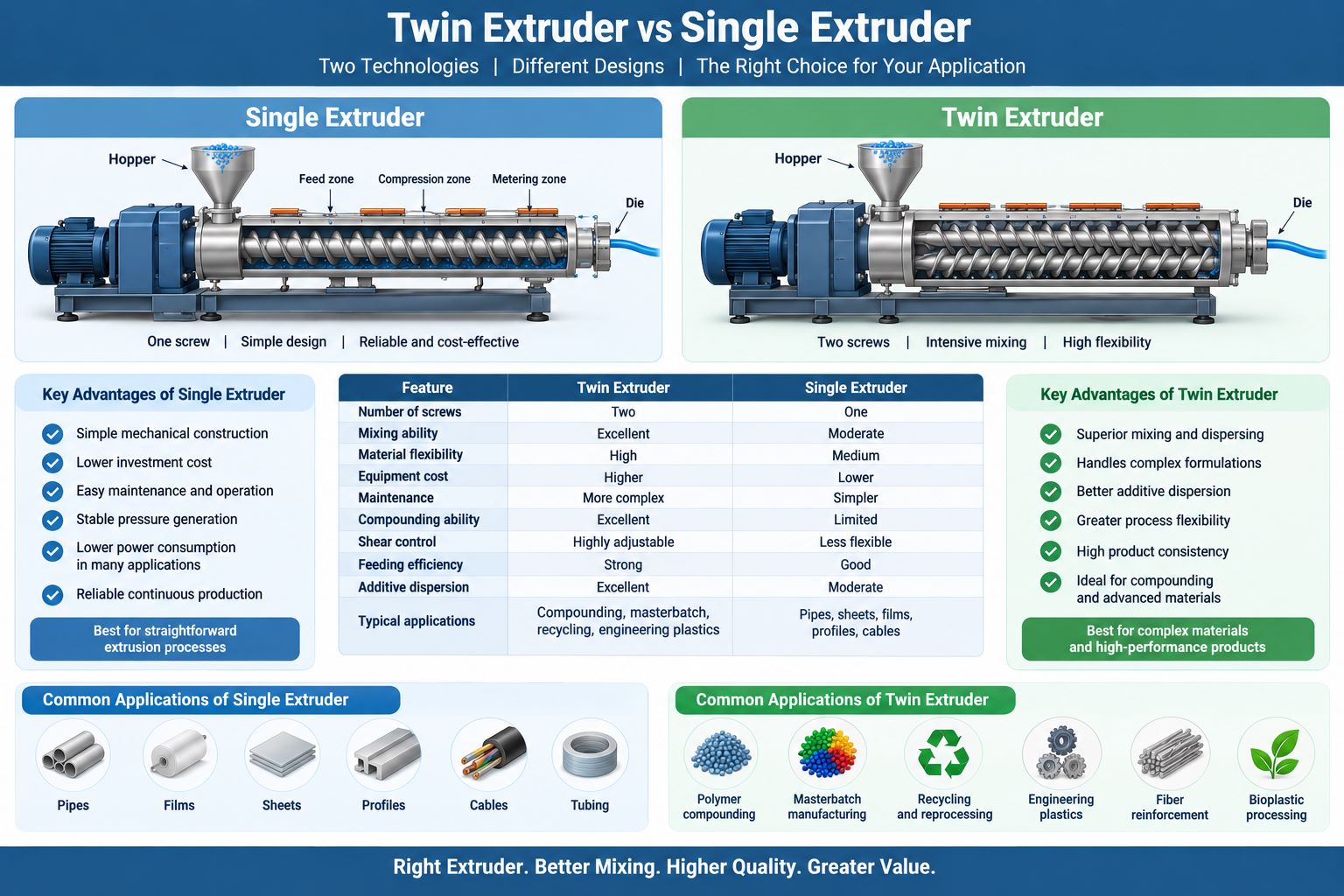
A Single Extruder, also known as a single-screw extruder, contains one rotating screw positioned inside a barrel.
Raw material normally enters through a hopper. As the screw rotates, it transports the material forward while heat from the barrel and mechanical energy contribute to the processing operation.
Different areas of the screw and barrel perform functions related to material feeding, melting, conveying, homogenization, and pressure generation.
After reaching an appropriate processing condition, the polymer moves toward the die.
The relatively straightforward construction of a Single Extruder makes it widely applicable to continuous manufacturing processes involving consistent thermoplastic materials.
Where Single Extruder Technology Is Commonly Applied
A Single Extruder is particularly useful when extensive compounding is not required.
For example, if a manufacturer receives a polymer that already contains the required additives and simply needs to convert it into a pipe or profile, intensive ingredient mixing may provide little additional value.
Typical applications can include:
- Pipe extrusion
- Profile extrusion
- Sheet manufacturing
- Film processing
- Tubing production
- Wire and cable coating
In such applications, manufacturers generally focus on stable material flow, consistent pressure, suitable melt quality, and dependable continuous production.
How a Twin Extruder Works
A Twin Extruder, commonly known as a twin-screw extruder, contains two screws operating inside the barrel.
Depending on equipment design, these screws can have different rotational and intermeshing arrangements.
The important advantage is the additional control this architecture can provide over material transportation and mixing.
Different screw elements can be positioned along the processing length to perform particular functions.
These may include conveying material, kneading ingredients, distributing additives, dispersing particles, homogenizing the formulation, and developing the required pressure.
This flexibility makes twin-screw technology particularly useful when extrusion involves material modification rather than straightforward shaping.
Why Twin Extruders Are Used for Polymer Compounding
Polymer compounding involves combining a base resin with other ingredients to create a material with desired characteristics.
A formulation may include:
- Color pigments
- Mineral fillers
- Glass fibers
- Stabilizers
- Processing aids
- Impact modifiers
- Functional additives
Simply placing these materials together does not guarantee a uniform compound.
They need to be introduced and processed under suitable conditions.
A Twin Extruder provides greater flexibility for controlling ingredient incorporation and mixing. This explains its widespread use in masterbatch, engineering plastics, filled compounds, reinforced polymers, and specialty formulations.
Twin Extruder and Single Extruder Differences
Although screw count is the most visible difference, manufacturers should evaluate the complete processing characteristics.
| Factor | Twin Extruder | Single Extruder |
| Screw configuration | Two screws | One screw |
| Processing complexity | Higher | Comparatively simple |
| Mixing capability | Extensive | Moderate |
| Compounding | Widely used | More limited |
| Conventional extrusion | Possible | Widely used |
| Equipment investment | Generally higher | Generally lower |
| Maintenance | More involved | Comparatively straightforward |
| Formulation flexibility | High | Moderate |
These characteristics are general. Actual machine performance depends on equipment design, polymer properties, screw geometry, operating conditions, and supporting machinery.
Importance of Material Feeding
Extrusion quality begins before melting takes place.
Raw materials must enter the machine consistently. Unstable feeding can affect production capacity, pressure, mixing ratios, and final product characteristics.
This becomes especially important when a formulation contains several components.
Pellets, powders, fibers, and lightweight recycled flakes can have very different feeding characteristics.
Some extrusion lines therefore use specialized feeders to control ingredient delivery.
The feeding system should always be selected according to the physical characteristics of the material.
Temperature Control During Extrusion
Temperature is another major processing variable.
Different sections of an extruder can operate under controlled temperature conditions. However, external barrel heaters are not the only source of thermal energy.
Mechanical energy created during screw rotation can also increase material temperature.
Excessive temperature may negatively affect heat-sensitive polymers or additives, while inadequate processing temperature can contribute to poor melting or unstable flow.
Manufacturers should therefore establish processing conditions based on the actual polymer rather than relying on a universal temperature profile.
Role of Extruders in Plastic Recycling
Extrusion has also become important in many plastic recycling processes.
Recycled feedstock can require additional preparation because it may contain moisture, contaminants, irregular particle sizes, or mixed additives.
A recycling process may involve:
- Sorting
- Washing
- Shredding or grinding
- Drying
- Controlled feeding
- Extrusion
- Filtration
- Degassing where required
- Pelletizing
Both Twin Extruder and Single Extruder systems can have recycling applications.
The correct configuration depends on feedstock characteristics and what the manufacturer expects from the recycled output.
Improving Extrusion Production Efficiency
Production efficiency should not be measured only through maximum kilograms per hour.
Manufacturers should examine how much acceptable product the line creates relative to the resources it consumes.
Important performance indicators include:
- Usable production output
- Material rejection rate
- Energy consumption
- Production downtime
- Product consistency
- Maintenance frequency
- Changeover time
- Labor requirements
Optimizing these factors can often provide more value than simply increasing screw speed.
Maintenance and Equipment Life
Extrusion machinery operates continuously under heat, pressure, and mechanical stress.
Screws and barrels can gradually wear, especially when processing abrasive formulations containing certain minerals or reinforcing materials.
Regular inspection can help identify wear before it causes serious production problems.
Maintenance programs should cover screws, barrels, gearboxes, bearings, heaters, cooling systems, feeders, sensors, electrical systems, and downstream machinery.
Keeping maintenance records can also help manufacturers identify recurring issues and plan component replacement more effectively.
How to Choose Between Twin Extruder and Single Extruder
Selecting extrusion equipment should begin with the production objective.
A manufacturer can ask several important questions:
- Which polymer will be processed?
- Is the raw material already compounded?
- Are fillers or additives being introduced?
- How much mixing is required?
- What production capacity is expected?
- Is the material heat-sensitive?
- Will recycled feedstock be processed?
- How frequently will formulations change?
- What downstream machinery is required?
- What products may be introduced in the future?
A Single Extruder can be an effective option when stable continuous processing is the main requirement.
A Twin Extruder becomes particularly relevant when production involves complex compounding, intensive mixing, or frequent formulation changes.
Frequently Asked Questions
1. What is a Single Extruder?
A Single Extruder uses one rotating screw to continuously transport and process suitable materials through a barrel.
2. What is a Twin Extruder?
A Twin Extruder contains two screws and provides additional processing flexibility, particularly for mixing and compounding.
3. Which extruder is commonly used for masterbatch?
Twin-screw extrusion is widely used for color, filler, and additive masterbatch applications.
4. Is a Single Extruder suitable for pipe production?
Yes. Single-screw technology is widely used for many thermoplastic pipe extrusion processes.
5. Can Twin Extruders process mineral fillers?
Yes. Suitable twin-screw configurations are commonly used for polymer formulations containing mineral fillers.
6. Can extrusion equipment process recycled plastic?
Yes. Both configurations can be used in suitable recycling applications depending on feedstock characteristics.
7. Why is screw design important?
Screw design affects material conveying, melting, mixing, shear, pressure generation, and residence time.
8. Which extruder is easier to maintain?
Single-screw machines generally have a less complex mechanical arrangement, although maintenance depends on the specific equipment.
9. Is maximum output the most important specification?
No. Product quality, usable output, energy consumption, maintenance, and process stability are also important.
10. How should an extrusion machine be selected?
Manufacturers should evaluate materials, formulations, required capacity, mixing needs, finished-product specifications, operating costs, and future production requirements.