Vacuum Casting: A Practical Guide to Prototypes, Materials, Process and Choosing the Right Manufacturing Partner
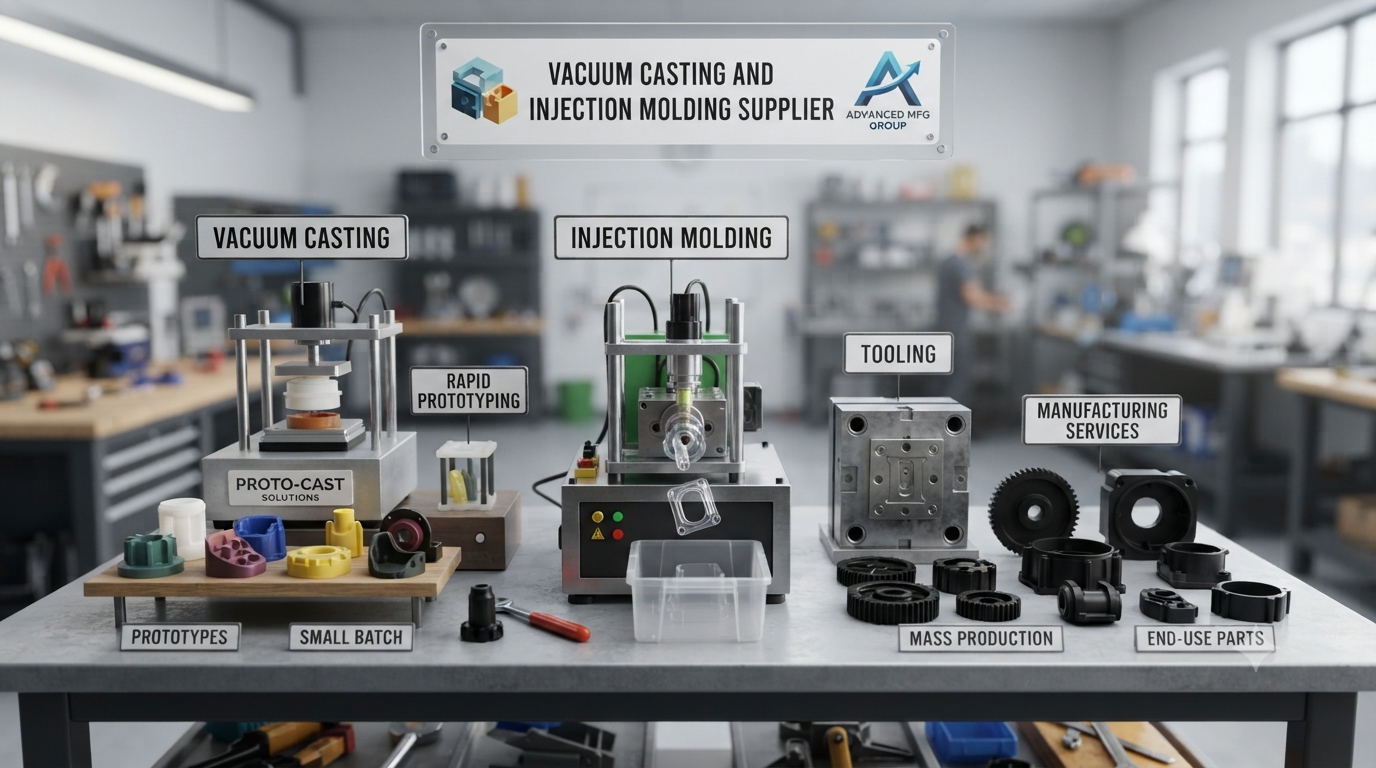
When a product is still being refined, moving directly from a CAD model to expensive production tooling can be a costly decision. Vacuum casting offers a practical middle ground: manufacturers can create high-quality polyurethane prototypes and small batches with useful levels of detail, surface finish and functional performance.
The process is particularly valuable for product development teams that need physical parts for design validation, market testing, demonstrations or low-volume production before committing to injection moulding.
If you are comparing manufacturing options, understanding how vacuum casting works—and where it fits alongside CNC machining, 3D printing and injection moulding—can help you choose a process based on the actual requirements of your project.
What Is Vacuum Casting?
Vacuum casting is a manufacturing process used to produce detailed plastic or elastomer parts from a master pattern, usually using silicone moulds and polyurethane casting resins.
A master model is first produced, commonly through high-resolution 3D printing or CNC machining. A silicone mould is then created around the master. Liquid casting material is poured or injected into the mould under vacuum conditions, reducing trapped air and helping reproduce fine details.
Once the material cures, the part is removed from the silicone mould, finished and inspected.
The process is often used for:
- Functional prototypes
- Product design validation
- Engineering samples
- Appearance models
- Small production runs
- Marketing samples
- Pre-production testing
- Custom housings and enclosures
- Consumer product prototypes
- Automotive and industrial components
How Does Vacuum Casting Work?
Although the exact workflow varies between manufacturers, the process generally follows several stages.
1. CAD Design and Master Pattern Creation
The process starts with a digital 3D model. Engineers review the design for dimensions, wall thickness, draft considerations and other manufacturing requirements.
A master pattern is then produced using a suitable technique, such as SLA or another high-resolution additive manufacturing process.
The quality of this master directly influences the quality of the final cast components.
2. Silicone Mould Making
The master pattern is positioned inside a moulding frame and surrounded with liquid silicone.
After curing, the silicone mould is carefully opened and the master is removed. This creates a flexible cavity that reproduces the geometry of the original pattern.
Depending on the component, the mould may include multiple parts, inserts or carefully positioned gates and vents.
3. Material Preparation
The casting resin is prepared according to the manufacturer’s specifications.
Different polyurethane materials can be selected to approximate properties such as:
- Rigid plastic
- Flexible rubber-like material
- Impact resistance
- Different levels of hardness
- Various colours
- Different surface appearances
Material selection should be based on the intended application rather than appearance alone.
4. Vacuum Casting
The liquid resin is introduced into the silicone mould in a controlled environment.
Vacuum conditions help remove air bubbles and improve material flow into detailed areas of the mould.
This is one of the reasons the process can produce clean surfaces and intricate features when the tooling and casting parameters are properly controlled.
5. Curing and Demoulding
After the resin has cured sufficiently, the mould is opened and the component is removed.
The part may then undergo trimming, sanding, polishing, painting, coating or other finishing operations.
6. Inspection and Quality Control
Finished parts can be inspected against the original CAD model or engineering drawings.
For functional prototypes, inspection may include dimensional checks, visual inspection and application-specific testing.
Why Choose Vacuum Casting for Prototypes?
One of the biggest advantages of vacuum casting is that it can provide a useful bridge between one-off prototyping and higher-volume manufacturing.
For example, imagine a company developing a new electronic enclosure.
A 3D-printed model may be sufficient for checking basic dimensions, but the team might eventually need several realistic samples with the desired texture, colour and mechanical characteristics.
Creating production injection moulding tooling at this stage could be premature.
Vacuum casting can allow the team to produce a limited batch for:
- Assembly testing
- Customer demonstrations
- Internal approval
- Fit and function evaluation
- Packaging development
- Investor presentations
- Early market feedback
This can help identify design issues before significant investment is made in production tooling.
Vacuum Casting vs 3D Printing
Both technologies have important roles in product development, but they solve different problems.
| Factor | Vacuum Casting | 3D Printing |
| Surface finish | Often very good | Depends on technology |
| Material options | Various polyurethane formulations | Depends on printer/process |
| Small batches | Well suited | Well suited |
| Replicated parts | Strong option | Good |
| Mould required | Yes | No |
| Complex geometry | Generally capable | Highly capable |
| Production-like appearance | Often possible | Technology dependent |
| Tooling cost | Requires silicone mould | Usually no mould |
| Best use | Detailed prototypes and small batches | Rapid design iteration |
For a single prototype, 3D printing may be more economical. For a small number of highly consistent parts with a production-like appearance, vacuum casting may become more attractive.
Vacuum Casting vs Injection Moulding
The choice between vacuum casting and injection moulding often comes down to volume, tooling investment, material requirements and production objectives.
Injection moulding is designed for repeatable production using durable mould tooling. It is highly effective when production volumes justify the initial tooling investment.
Vacuum casting, on the other hand, is particularly useful when volumes are limited or when the design is still undergoing development.
Vacuum Casting
Best suited to:
- Prototypes
- Low-volume parts
- Product validation
- Short production runs
- Pre-production samples
- Projects requiring flexibility
Injection Moulding
Best suited to:
- Medium- to high-volume production
- Repeat manufacturing
- Consistent production cycles
- Applications requiring production-grade thermoplastics
- Products where tooling costs can be spread over a larger quantity
A manufacturing partner should therefore assess the complete project rather than automatically recommending one process.
When Should You Use Vacuum Casting?
Vacuum casting can be a strong choice when you need multiple detailed parts without investing immediately in production mould tooling.
It may be appropriate when:
- The product design is close to final but still needs validation.
- You require a small batch rather than thousands of components.
- Appearance is important.
- You need consistent replicas of a master model.
- You need prototypes with specific material characteristics.
- You want physical samples for customer or stakeholder evaluation.
- Production tooling would be difficult to justify at the current volume.
It may be less appropriate when you need very high production volumes, specialised production thermoplastics or a process specifically representative of final injection-moulded manufacturing.
What Materials Are Used in Vacuum Casting?
Polyurethane resins are commonly used in vacuum casting because manufacturers can offer formulations with different physical and visual characteristics.
Depending on the supplier and application, available materials may replicate properties associated with:
- ABS-like plastics
- Polypropylene-like materials
- Polycarbonate-like materials
- Rubber-like elastomers
- Transparent or translucent plastics
- Different hardness levels
However, material names such as “ABS-like” should not automatically be interpreted as identical to production ABS.
If a prototype will undergo functional or environmental testing, ask the manufacturer for the material’s technical data sheet and confirm whether its properties are suitable for the intended test.
What Industries Use Vacuum Casting?
Vacuum casting is used across a range of product development environments.
Automotive
It can be used for prototype components, interior parts, covers, housings and design validation.
Consumer Electronics
Manufacturers can produce realistic housings, buttons, covers and other components for testing and presentation.
Medical Product Development
Prototype enclosures and certain non-clinical development components may be produced for design evaluation. Medical applications require careful material and regulatory assessment before any component is used in a clinical environment.
Industrial Equipment
Vacuum casting can support the development of housings, handles, covers, brackets and other low-volume components.
Consumer Products
Product developers can create realistic samples for design reviews, packaging development, photography and early customer feedback.
How Much Does Vacuum Casting Cost?
There is no single price for vacuum casting because project costs depend on several variables.
Important cost factors include:
- Part dimensions
- Geometry and complexity
- Master pattern method
- Silicone mould size
- Number of cavities or mould sections
- Casting material
- Surface finish
- Colour requirements
- Inserts
- Required quantity
- Post-processing
- Dimensional inspection
- Shipping requirements
The number of parts required is particularly important because silicone moulds have a finite useful life. If the project requires repeated batches, the manufacturer should discuss expected mould life and whether replacement tooling will eventually be required.
For an accurate quotation, provide the supplier with the 3D CAD files, required quantity, material expectations, colour or finish requirements and intended application.
How to Choose a Vacuum Casting Supplier
Price should not be the only factor when selecting a manufacturing partner.
A capable supplier should be able to discuss your design, identify potential manufacturing issues and explain what can realistically be achieved.
Look for a supplier with experience in:
- Silicone mould production
- Polyurethane casting
- Complex geometries
- Surface finishing
- Dimensional inspection
- Prototype development
- Low-volume manufacturing
- Engineering communication
- Quality control
It is also useful to ask how the company handles design changes. A supplier that communicates clearly during the prototype stage can save considerable time when revisions are required.
Can the Same Supplier Handle Injection Moulding?
If your project is expected to progress from prototypes into production, working with a supplier that offers both vacuum casting and injection moulding can simplify the transition.
An experienced injection molding supplier can assess when it makes sense to move from silicone moulds to production tooling.
For example, a product development programme might follow this path:
CAD design → 3D-printed master → vacuum-cast prototypes → design validation → tooling → injection moulding → production
This approach allows each manufacturing method to serve a different stage of product development.
When comparing an injection moulding supplier, consider tooling capabilities, material expertise, production capacity, quality systems, tolerances, communication and experience with similar components.
What Information Should You Send for a Quote?
A good RFQ can significantly reduce back-and-forth communication.
Include:
- 3D CAD files
- 2D engineering drawings, where applicable
- Quantity required
- Preferred material or required material properties
- Colour
- Surface finish
- Critical dimensions or tolerances
- Required inserts
- Intended application
- Testing requirements
- Delivery location
- Target delivery date
If you are unsure about the material or manufacturing process, say so. A technically capable supplier should be able to recommend an appropriate option based on the application.
Common Vacuum Casting Mistakes to Avoid
Choosing the Process Based Only on Price
The cheapest prototype is not necessarily the most useful prototype. Consider what the part needs to demonstrate.
Ignoring Material Differences
A cast polyurethane material may visually resemble a production plastic without behaving exactly like it.
Providing Incomplete CAD Information
Missing features, unclear tolerances or outdated CAD files can create delays.
Overlooking Surface Finish
A prototype used for customer demonstrations may require a significantly different finish from one intended purely for engineering testing.
Waiting Until the End to Discuss Production
If the final product is likely to be injection moulded, discuss this early. Some design decisions can affect the ease and cost of transitioning into production tooling.
Frequently Asked Questions About Vacuum Casting
What is vacuum casting mainly used for?
Vacuum casting is mainly used for producing detailed prototypes, appearance models, engineering samples and small batches of parts from silicone moulds.
Is vacuum casting better than 3D printing?
Neither process is universally better. 3D printing is often advantageous for rapid one-off design iterations, while vacuum casting can be useful when multiple detailed parts with consistent appearance and material characteristics are required.
Is vacuum casting suitable for production?
It can be suitable for certain low-volume applications. However, high-volume products will often require a production process such as injection moulding, depending on the component and material requirements.
How accurate is vacuum casting?
Accuracy depends on the master pattern, mould design, casting material, shrinkage, part geometry and process control. Critical dimensions should be discussed with the manufacturer before production.
How long does a vacuum-cast part take to manufacture?
Lead time varies according to master creation, mould production, material selection, quantity, finishing and inspection requirements. A supplier can provide a realistic schedule after reviewing the CAD files and specifications.
Can vacuum-cast parts be painted?
Yes. Depending on the material and required appearance, vacuum-cast components can undergo processes such as sanding, priming and painting.
What is the difference between vacuum casting and injection moulding?
Vacuum casting generally uses silicone moulds and casting resins and is particularly useful for prototypes and low-volume production. Injection moulding uses production tooling to manufacture parts, generally making it more suitable for larger production quantities.