Dumbwaiter Lift and Passenger Lift: A Complete Guide for Modern Buildings
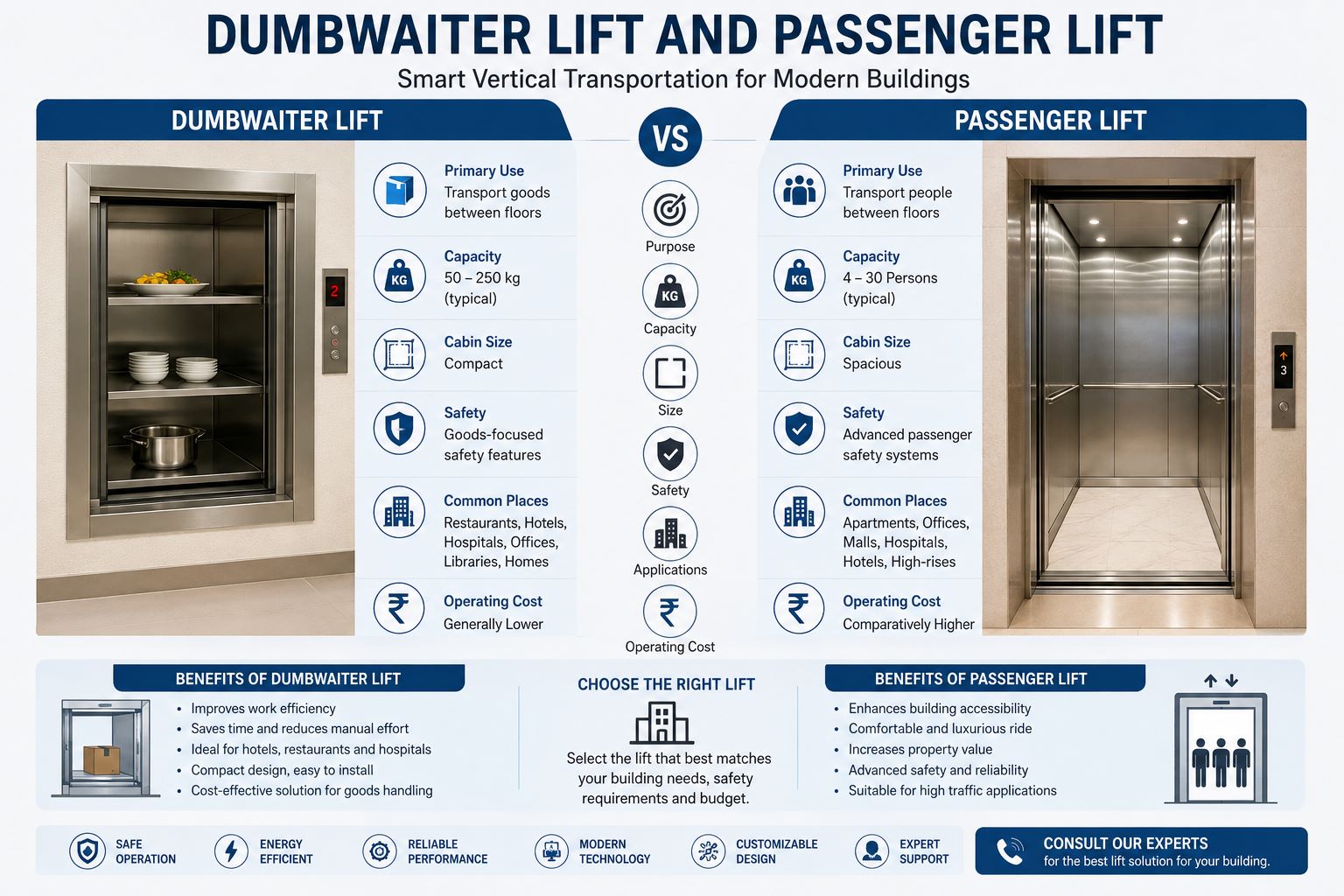
Vertical transportation has become an essential part of modern residential, commercial, hospitality, healthcare, and industrial buildings. While elevators may appear similar from the outside, different lift systems are designed for completely different purposes. Two important categories are the dumbwaiter lift and the passenger lift.
A dumbwaiter lift is primarily designed to transport goods between floors, while a passenger lift safely carries people. Understanding their construction, capacity, safety requirements, operating mechanisms, and applications helps architects, building owners, businesses, and facility managers choose the right vertical transportation system.
What Is a Dumbwaiter Lift?
A dumbwaiter lift is a compact goods transportation system designed to move lightweight or medium-weight materials vertically between different floors. Unlike passenger elevators, it is generally not intended for carrying people.
Dumbwaiters are commonly installed where staff regularly need to transport items such as food, documents, medicines, utensils, laundry, packages, or small equipment.
Typical applications include:
- Restaurants and commercial kitchens
- Hotels and resorts
- Hospitals and healthcare facilities
- Libraries and offices
- Warehouses
- Retail stores
- Villas and residential buildings
- Laboratories
- Banks and document storage facilities
The primary advantage of a dumbwaiter is operational efficiency. Instead of employees repeatedly using stairs to transport materials, items can be placed inside the lift cabin and delivered directly to another floor.
How Does a Dumbwaiter Lift Work?
A modern dumbwaiter lift usually operates through an electric drive mechanism installed within a dedicated lift shaft.
The basic process includes:
- Goods are loaded inside the cabin.
- The landing door is securely closed.
- The destination floor is selected using a control button.
- The motor moves the cabin vertically through the shaft.
- The lift automatically stops at the selected floor.
- The receiving person opens the landing door and removes the goods.
Depending on the design, dumbwaiters may use traction, drum-driven, hydraulic, or other lifting mechanisms.
Modern systems can also include automatic floor leveling, door interlocks, overload protection, emergency stopping systems, call indicators, and microprocessor-based controllers.
Main Components of a Dumbwaiter Lift
The performance and reliability of a dumbwaiter depend heavily on its engineering and component quality.
Important components include:
- Lift cabin
- Drive motor
- Guide rails
- Suspension mechanism
- Controller
- Landing doors
- Door interlocks
- Push-button stations
- Limit switches
- Safety brakes
- Electrical control panel
Stainless steel cabins are particularly popular in restaurants, hospitals, and food-service environments because they are durable, hygienic, and easier to clean.
What Is a Passenger Lift?
A passenger lift is an elevator specifically engineered for transporting people safely between different floors of a building.
Passenger elevators require significantly more sophisticated engineering and safety features because human transportation involves stricter requirements for cabin stability, emergency communication, braking, accessibility, ventilation, door protection, and ride comfort.
Passenger lifts are commonly used in:
- Residential apartments
- Office buildings
- Shopping centres
- Hospitals
- Hotels
- Educational institutions
- Airports
- Commercial complexes
- High-rise buildings
- Public facilities
The appropriate lift design depends on building height, expected passenger traffic, available shaft dimensions, required capacity, travel speed, and applicable safety regulations.
How Does a Passenger Lift Work?
A passenger lift generally operates through either traction or hydraulic technology.
In traction elevators, steel ropes or belts connect the elevator cabin to a counterweight. An electric motor rotates a traction sheave that moves the cabin upward or downward.
Hydraulic elevators use a hydraulic piston to move the cabin and are generally suitable for certain low-rise applications.
Modern passenger lift systems use intelligent controllers to manage floor calls, acceleration, deceleration, door movement, traffic flow, and emergency functions.
Advanced systems may also use variable-frequency drives that provide smoother starts and stops while helping improve energy efficiency.
Important Passenger Lift Safety Features
Safety is one of the most important considerations when choosing a passenger lift.
Modern passenger elevators may incorporate:
- Automatic rescue devices
- Emergency alarms
- Intercom systems
- Overload sensors
- Door safety sensors
- Emergency lighting
- Automatic braking systems
- Speed governors
- Battery backup
- Fire emergency operation
- Accurate floor leveling
- Door interlocking systems
These features work together to reduce operational risks and improve passenger confidence.
Regular inspection and preventive maintenance are equally important for maintaining long-term lift reliability.
Dumbwaiter Lift vs Passenger Lift
| Feature | Dumbwaiter Lift | Passenger Lift |
| Primary Purpose | Transportation of goods | Transportation of people |
| Cabin Size | Compact | Larger |
| Typical Capacity | Lower | Higher |
| Human Transportation | Generally prohibited | Specifically designed for people |
| Installation Space | Relatively small | Larger shaft required |
| Safety Systems | Goods-focused safety | Extensive passenger safety |
| Common Locations | Restaurants, hotels, hospitals | Apartments, offices, malls |
| Operating Cost | Generally lower | Comparatively higher |
| Interior Design | Functional | Functional and decorative |
| Accessibility | Goods loading | Passenger accessibility |
The choice should never be based purely on cost. The lift must match the intended application and required safety standards.
Benefits of Installing a Dumbwaiter Lift
Businesses dealing with frequent movement of goods can gain significant productivity benefits from installing a dumbwaiter lift.
Key advantages include improved workflow, reduced manual handling, faster movement of materials, better use of staff time, and reduced dependence on staircases.
In restaurants, for example, prepared food can move efficiently between the kitchen and dining floors. In hospitals, medicines and supplies can be transported without employees repeatedly moving between levels.
A well-designed dumbwaiter can therefore become an important part of daily operational infrastructure.
Benefits of Installing a Passenger Lift
A passenger lift improves accessibility, convenience, building functionality, and overall user experience.
In residential buildings, elevators provide convenient access for elderly residents, children, visitors, and people with limited mobility. In commercial properties, reliable elevators improve traffic movement between floors.
Passenger lifts may also enhance property value because accessible vertical transportation is increasingly expected in modern multi-storey developments.
Factors to Consider Before Selecting a Lift
Choosing an elevator requires careful technical planning.
Consider the following factors:
- Building height
- Number of floors
- Required carrying capacity
- Expected usage frequency
- Available shaft dimensions
- Travel speed
- Door configuration
- Power requirements
- Safety requirements
- Maintenance accessibility
- Energy consumption
- Installation environment
The selected elevator should be designed around actual building requirements rather than choosing capacity or specifications based only on assumptions.
Lift Capacity and Size Considerations
Capacity requirements differ considerably between dumbwaiters and passenger elevators.
A dumbwaiter lift may be designed for relatively small loads or larger commercial goods depending on its intended application. Cabin dimensions should accommodate the typical materials being transported.
A passenger lift, however, must account for the expected number of occupants, passenger traffic patterns, cabin dimensions, accessibility requirements, and overall building population.
Correct capacity planning helps reduce waiting times and prevents unnecessary strain on elevator equipment.
Importance of Lift Maintenance
Preventive maintenance significantly affects elevator performance, safety, and service life.
Routine maintenance should include checking:
- Door operation
- Safety switches
- Electrical connections
- Motor condition
- Guide rails
- Braking systems
- Controller performance
- Cabin leveling
- Emergency systems
Minor problems identified during scheduled inspections can often be corrected before they develop into expensive failures.
Building owners should therefore consider after-sales service and maintenance capability when selecting an elevator supplier.
Energy Efficiency in Modern Lift Systems
Energy efficiency is becoming increasingly important in building design.
Modern lift technologies may use efficient motors, LED cabin lighting, standby modes, variable-frequency drives, intelligent controllers, and regenerative systems.
A correctly sized elevator can also prevent unnecessary energy consumption. Installing significantly more capacity than required may increase both initial investment and operational costs.
Frequently Asked Questions
1. What is a dumbwaiter lift used for?
A dumbwaiter transports food, documents, medicines, packages, laundry, and other goods between floors.
2. Can people travel inside a dumbwaiter lift?
Generally, no. Dumbwaiters are designed for goods and should not be used for passenger transportation.
3. What is a passenger lift?
A passenger lift is an elevator engineered specifically to transport people safely between different building levels.
4. Where are dumbwaiters commonly installed?
They are frequently installed in restaurants, hotels, hospitals, offices, libraries, warehouses, and residential properties.
5. Which lift requires more safety systems?
Passenger lifts generally require more comprehensive safety systems because they transport people.
6. Are dumbwaiter lifts suitable for restaurants?
Yes. They are widely used to transport food, dishes, utensils, and kitchen supplies between different floors.
7. How do I choose passenger lift capacity?
Capacity should be determined using building occupancy, expected traffic, number of floors, and operational requirements.
8. Do lifts require regular maintenance?
Yes. Scheduled preventive maintenance helps maintain safe operation, reliability, efficiency, and longer equipment life.
9. Can a dumbwaiter be installed in an existing building?
In many cases, yes, provided sufficient shaft space, structural support, and technical requirements can be accommodated.
10. What affects the cost of a lift?
Capacity, travel height, number of stops, technology, cabin design, doors, safety features, installation conditions, and customization affect pricing.
https://gosarkarijobs.com/how-escalator-companies-and-cargo-lifts-are-transforming-modern-buildings/
https://newsgrow.blogspot.com/2026/08/vertical-transportation-enters-new-era.html
https://bhoomijanatural.info/the-hidden-engineering-behind-moving-walkways-and-elevator-parts/
https://shopnets.com/infrastructure-growth-puts-moving-walkway-and-elevator-parts-in-focus/
https://blogstream.net/smart-mobility-systems-transform-how-modern-buildings-move-people/
https://newsgrow.blogspot.com/2026/08/new-era-of-passenger-mobility-brings.html